
Basel III for banks in Germany
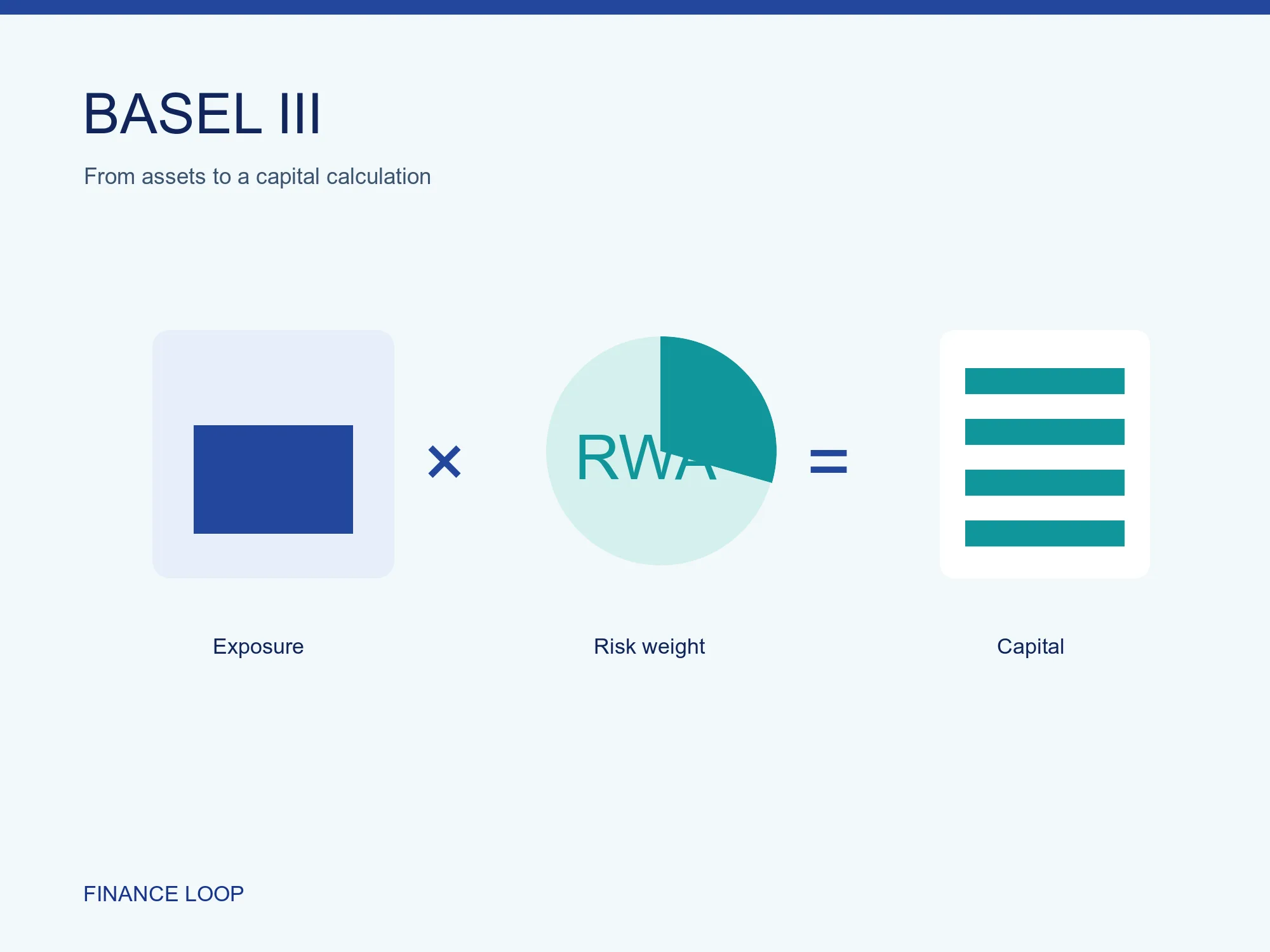
Basel III is the international bank-capital framework. For a German bank, the binding rules come through EU law, especially the Capital Requirements Regulation. The practical question is how exposures become risk-weighted assets and how much capital the bank must hold against them.
International standard, EU rules
The Basel Committee sets standards; it does not supervise a German bank directly. The European Commission implemented the remaining reforms through CRR III and CRD VI. Banks therefore work with the applicable EU provisions and supervisory guidance when calculating capital.
Why the output floor matters
Some banks calculate risk-weighted assets with approved internal models. The output floor limits how far their result may fall below a calculation based on standardized approaches. It is a floor for the aggregate capital calculation, not a flat capital charge on each loan. The Basel text explains the purpose: make reported risk weights more comparable.
Credit risk, market risk and operations
The final reforms revise standardized approaches for credit and operational risk and restrict parts of internal modeling. A bank has to map products and counterparties to the right exposure class, maintain data for the calculation and explain the result. The credit risk page covers the borrower-level work behind one major input.
Does "Basel IV" mean a different treaty?
"Basel IV" is a market nickname for parts of the final Basel III reforms. In formal documents, look for Basel III, CRR III and CRD VI. Check the applicable EU provision for an implementation date; the different risk frameworks do not all have the same timetable.
Upcoming events in Germany
Basel III for banks and Finance Loop
Finance Loop brings risk teams, advisers and financial technology firms together around the rules that shape bank balance sheets. Basel III comes up where data, models and supervisory reporting meet.
Finance Loop is a professional network for emerging technologies in finance. Its events and partnerships bring practitioners together across Investment & Digital Assets, Payments & Digital Money, and Risk & Compliance.