
Building AI Agents for Finance: a new book from the Finance Loop network
Published on 8 September 2026.

What the book covers
Finance Loop network member Fayssal El Mofatiche has co-written a book, and it lands right in the middle of what the Finance Loop network works on. Building AI Agents for Finance, written with Hanane Dupouy and published by Packt in August 2026, is a hands-on guide to building agents that hold up in real financial systems.
AI agents are changing how financial systems read information, reach decisions and automate work that used to need a person in the loop. Plenty of material explains agentic AI at the concept level. Far less of it shows how to build agents that run reliably once money and regulation are involved. That is the gap this book sets out to close.
For Finance Loop, that makes it an easy one to recommend.
The book starts from the ground up: what an AI agent is, how it differs from a non-agentic system, and when an agentic architecture is the right call instead of a plain workflow. From there it moves into Python labs built on Claude and OpenAI models, working through design patterns, memory, retrieval-augmented generation, framework choice and reasoning methods such as ReAct, Reflection, Self-Consistency, Language Agent Tree Search and multi-agent collaboration.
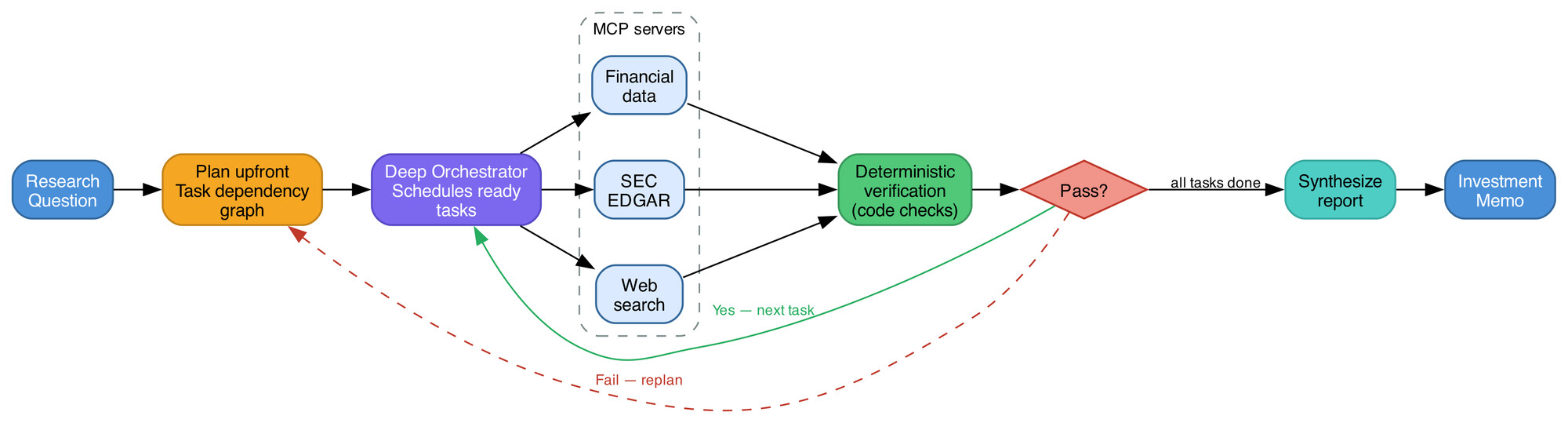
Each method is applied to a concrete finance use case: fundamental analysis, deep research, trading, insurance and compliance. The diagram above is one of them, the deep-research agent from Chapter 5: an orchestrator plans the task graph, pulls financial data, SEC EDGAR filings and web search through MCP servers, verifies each step deterministically, and replans when a check fails.
Evaluation and operations, not an afterthought
The part that sets the book apart is where it spends the second half. Two topics that usually get a paragraph each get full treatment here.
Evaluation. An agent you cannot measure is a liability. The book treats calibrated LLM judges, drift detection and model risk reports as part of building an agent, not as clean-up after the fact.
Operations. In finance the running system is what counts. Agent harness and execution loop, observability and tracing, safe deployment and versioning, guardrails and governance with human oversight are what turn a prototype into something a bank can actually put into production.
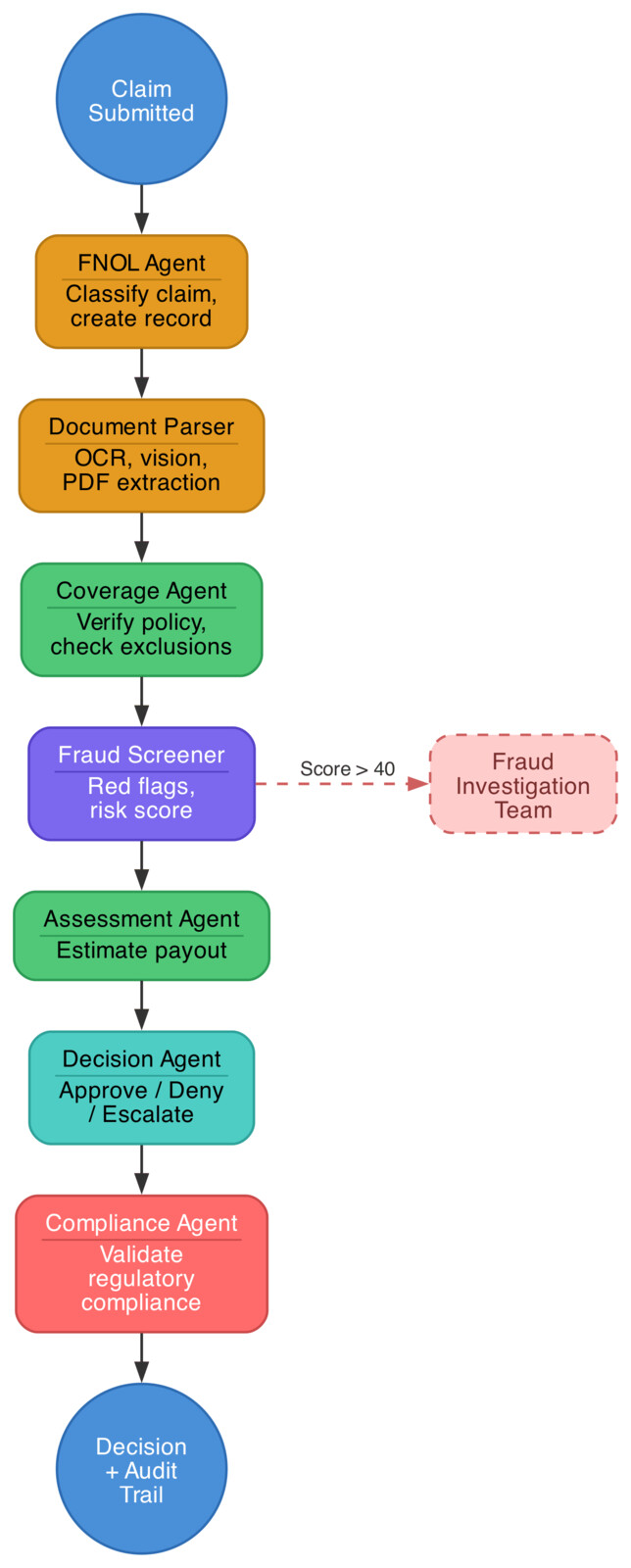
The second diagram shows a Chapter 9 example: a multi-agent pipeline for insurance claims, running from first notice of loss through coverage check and fraud detection to a compliance sign-off with a full audit trail.
Book details
Title: Building AI Agents for Finance
Subtitle: Build and deploy robust financial agentic systems with advanced reasoning, architectures, and Python
Authors: Hanane Dupouy and Fayssal El Mofatiche
Publisher: Packt, 27 August 2026
Length: 756 pages
ISBN: 978-1-83702-229-8
Via Packt: packtpub.com
Via Amazon: amazon.de

About the book author
Fayssal El Mofatiche is the founder of Flowistic and Finteda. In his work Fayssal builds agent-driven systems for financial decision making. He is a CAIA charterholder and has spent more than 15 years across quantitative finance, AI and production software for financial institutions.
His co-author, Hanane Dupouy, is an algorithmic trader who has led data science teams in banking and now works on machine learning, generative AI and agent-based systems in financial workflows.
Fayssal is also a lecturer at the Claude Hacker House, so if you want to hear the thinking behind the book in person, that is the place.
From Our Blog
all blog posts-

Banking Exchange 2026 in Frankfurt
BEX Underground: Banking Exchange 2026 on 4 November in Frankfurt. The German-language conference covers payments, technology and financial crime. -

Vienna has its own Satoshi statue
Bitcoin Austria unveiled a Satoshi Nakamoto statue by Valentina Picozzi in Vienna's Viertel Zwei on 14 October 2026, funded by more than 120 donors. -
Deepfake fraud: what Europe changes in 2026
Cloned voices and fake video calls have targeted Arup, WPP and Ferrari. The AI Act labels deepfakes from August 2026, and the PSR makes banks refund spoofing. -
One EU market for funds: what the Council agreed
The EU Council agreed its position on market integration on 9 October 2026: no extra host-state rules for fund managers and a depositary passport.