
Bitcoin Lightning payments
Bitcoin Lightning payments are bitcoin payments that travel over the Lightning Network, a payment layer built on top of the Bitcoin blockchain. Two parties lock bitcoin in a shared channel once on the blockchain and then pay each other many times by updating their balances off chain. A payment usually settles within seconds, and only the opening and the closing of a channel appear as blockchain transactions.
A shop asks for payment with a Lightning invoice, a signed payment request that a wallet app reads from a QR code and that names the amount and an expiry time. Payers without a direct channel to the shop reach it through other nodes along a route, and each of those nodes charges a small fee. Amounts are counted in satoshis, the hundred-millionth part of one bitcoin, down to a thousandth of a satoshi.
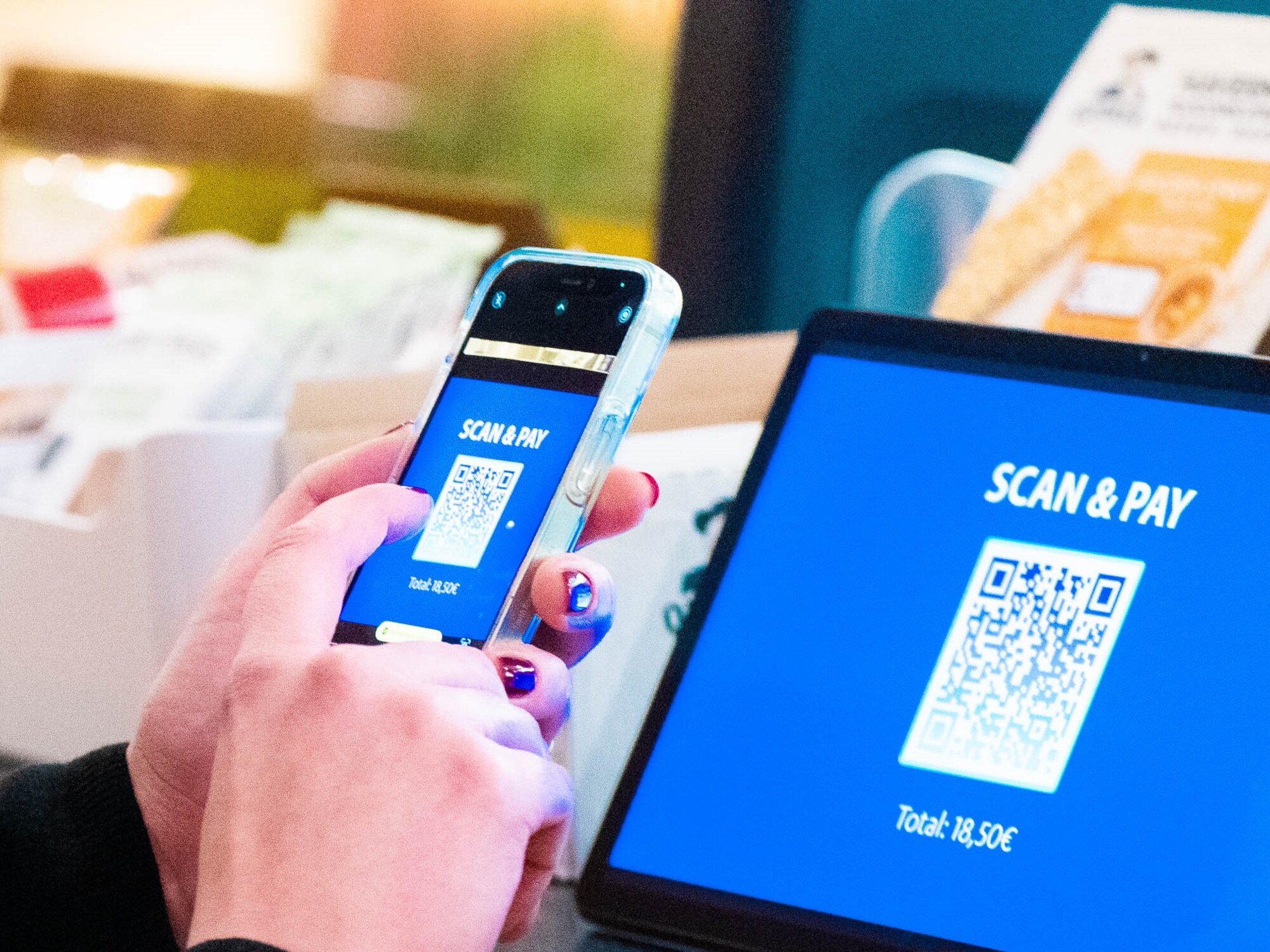
How a Lightning payment works
A Lightning channel starts with a funding transaction on the Bitcoin blockchain that locks bitcoin in an output both parties must sign to spend, a 2-of-2 multisignature as the Lightning protocol specification defines it. Each payment in the channel is a new pair of signed transactions that shifts the balance between the two sides, and only the latest state counts. Either party can close the channel at any time by publishing the latest state on the blockchain, and each side then receives its balance. Joseph Poon and Thaddeus Dryja described this design in the paper The Bitcoin Lightning Network, dated 14 January 2016.
To get paid, the receiver creates an invoice in the format of BOLT 11, the invoice standard of the protocol. The invoice carries a payment hash, the amount, a description and an expiry time, which defaults to one hour when the invoice sets none, and the node of the receiver signs the whole request. Invoices for bitcoin start with the prefix lnbc and usually appear as a QR code at the checkout. An invoice can also leave the amount open, for example for donations, and the payer then enters the amount in the wallet.
When payer and receiver share no channel, the wallet of the payer finds a route through other nodes and sends the payment as a chain of hash time-locked contracts. Every node on the route can claim its incoming payment only by passing the payment on to the next node, so no node along the way can keep the money. The onion routing rules wrap the route in layers of encryption, so each node learns only the node before it and the node after it, and a route can have up to 20 hops. A wallet may also split one invoice into several parts that travel over different routes, and the receiver settles them only once all parts have arrived.
Accepting Lightning payments in Europe
Swiss Bitcoin Pay, a company based in Neuchâtel, lets a business take bitcoin payments in a terminal app on a phone or tablet and through plugins for shop systems such as WooCommerce and PrestaShop. The provider charges 1 percent on amounts the merchant keeps in bitcoin and 1.5 percent on amounts it converts automatically into a fiat currency. Swiss Bitcoin Pay also pays the fees for moving funds from Lightning to the blockchain, and its merchants include Carrefour City stores in Rouen and Amiens and a café in Stuttgart.
Merchants who want no provider in the payment flow can run BTCPay Server, open-source payment software that a business hosts itself and that charges no fees of its own. Payments arrive directly in the wallet the merchant connects, and the software comes with a point-of-sale app and plugins for WooCommerce and Shopify. For Lightning, BTCPay Server runs its own node with Core Lightning, LND or Eclair, or it connects to an external node. The BTCPay Server documentation warns that funds held with a custodial Lightning service are at risk if that service goes bankrupt.
Under Plan ₿ Lugano, more than 360 merchants in the Swiss city accept bitcoin, and residents can pay all city dues and taxes in bitcoin. Shops and city offices in Lugano take these payments also over the Lightning Network.
MiCA and the BaFin view in Germany
Since 30 December 2024 the MiCA regulation governs firms that provide services in bitcoin to clients in the EU. Bitcoin has no identifiable issuer, so the issuer rules of MiCA do not apply to it, but the providers that serve clients with bitcoin are covered, as recital 22 of the regulation states. Keeping bitcoin or the private keys for clients counts as custody and administration, and sending bitcoin from one address to another on behalf of a client counts as a transfer service, and both need an authorization.
For Lightning, MiCA draws a line between custodial and non-custodial wallets and payment services. A custodial Lightning wallet or payment service holds the bitcoin of its users and takes on the duties of Article 75: a custody policy, a register of positions for each client, segregated client holdings and liability for losses it causes, capped at the market value of the lost bitcoin. A merchant that runs its own node holds only its own bitcoin, and recital 83 places providers of non-custodial wallet software and hardware outside the regulation.
In Germany, BaFin supervises these services, and Germany shortened the MiCA transition period to 31 December 2025. Since the EU-wide transition ended on 1 July 2026, only firms with a MiCA license may provide these services in the EU, as BaFin announced on 8 July 2026. For the payment itself, the BaFin guidance on the Payment Services Supervision Act states that bitcoin is not electronic money and that creating bitcoin and using it as a means of payment need no license. Trading bitcoin as an object of trade or investment beyond that use is regulated business that requires a license.
Fees and limits
Every node that forwards Lightning payments sets two fees per channel in its channel updates: a base fee in millisatoshis for each payment and a proportional fee in millionths of the forwarded amount. With a base fee of 1,000 millisatoshis and a rate of 100 millionths, a node would charge 1 satoshi plus 0.01 percent for each payment it forwards. The payer adds the fees of all nodes on the route to the amount of the invoice, while opening and closing a channel costs an ordinary Bitcoin transaction fee that depends on the demand for block space.
The protocol keeps a channel below 16,777,216 satoshis, about 0.168 bitcoin, unless both nodes support large channels, an option that lifts this cap. Each node also sets a minimum and a maximum size for a single payment part in each channel, and a channel accepts at most 483 pending payment parts from each side. A merchant can only receive as much as its channels hold on the side of its peers, so a shop that expects large incoming volumes buys inbound liquidity from a Lightning service provider or opens channels with enough capacity.
Upcoming payments events in Europe
What is the Lightning Network?
The Lightning Network is a network of payment channels between Bitcoin nodes that lets users send bitcoin without recording every payment on the blockchain. It relies on the rules of the Bitcoin blockchain to enforce the latest balance of each channel, so the two parties of a channel do not have to trust each other or the nodes that forward their payments.
How do I pay with bitcoin over Lightning?
A payer needs a wallet app with Lightning support, scans the QR code of the invoice at the checkout and confirms the amount shown. The wallet then finds a route, pays the fees of the forwarding nodes and receives the preimage of the payment hash as proof once the receiver has claimed the money. The bitcoin wallets used in Germany differ in whether they support Lightning and in whether the user or a provider holds the keys.
Lightning invoice or Lightning address?
A Lightning invoice is valid for one payment, carries a fixed amount or none and expires, after one hour by default. A Lightning address looks like an email address, and the wallet of the payer resolves it by calling a fixed web address on the domain of the receiver under the LNURL rules, which returns a fresh invoice. With a Lightning address, anyone can pay the same receiver again and again without asking for a new invoice each time.
Is a Lightning payment the same as a bitcoin payment?
A Lightning payment moves real bitcoin, but the transfer happens inside payment channels and reaches the blockchain only when a channel opens or closes. An on-chain payment is a Bitcoin transaction recorded in a block, while a Lightning payment is final once the receiver releases the preimage, which usually takes a few seconds.
Does a shop in Germany need a license to accept bitcoin?
A shop that accepts bitcoin as payment for its own goods and services needs no license, because BaFin treats the use of bitcoin as a means of payment as free of authorization. A license is required for the firms that keep bitcoin for the shop or exchange it into euros, and in the EU these firms need a MiCA authorization. Bitcoin in Germany covers the wider rules for holding and trading bitcoin.
Bitcoin Lightning payments and Finance Loop
Finance Loop covers Lightning payments in its Payments & Digital Money track and explains bitcoin to banks and asset managers in the masterclass Bitcoin for Investors. Finance Loop is also a founding member of the German Bitcoin association, the Bitcoin Bundesverband.
Finance Loop is a professional network and helps its members build skills and personal networks in these fields: Investment & Digital Assets, Payments & Digital Money, Digital Infrastructure & Sovereignty, and Risk & Compliance.