
Bitcoin Mining
Bitcoin mining is the process that adds new blocks of transactions to the Bitcoin ledger and creates new bitcoin at the same time. Miners run specialized computers called ASICs that repeat one calculation, the SHA-256 hash, trillions of times per second until one machine finds a result below the target the network has set.
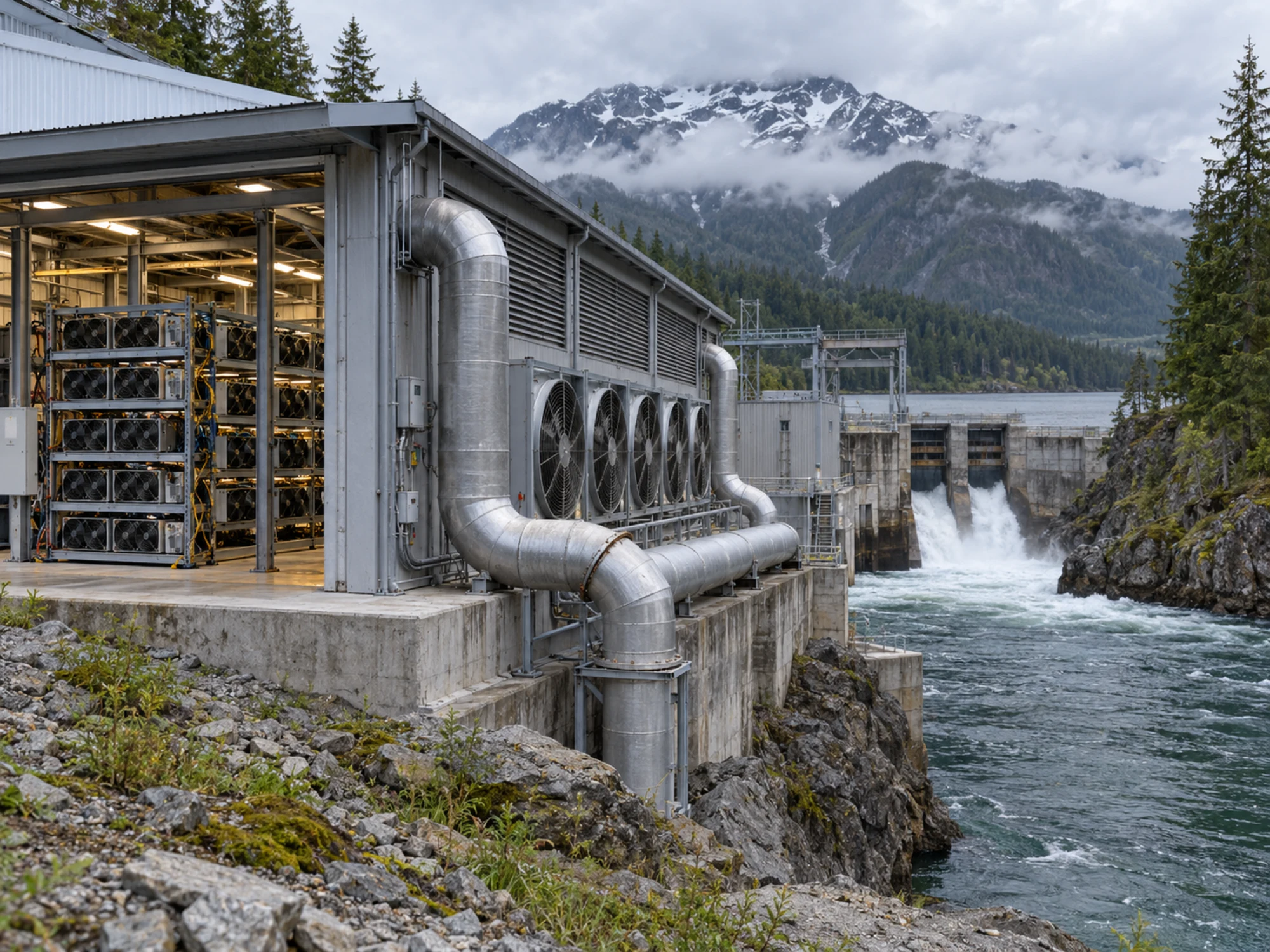
The miner that finds a valid block receives the block subsidy, currently 3.125 BTC, plus the fees of every transaction in that block. Mining today is an industrial business with listed companies, long-term power contracts and data centers in places where electricity is cheap or would otherwise go unused.
Proof of work and the difficulty adjustment
Every block contains a reference to the block before it, so changing an old transaction would mean redoing the work for that block and for every block after it. The Bitcoin white paper describes this chain of proof of work as the protection against a rewritten history: an attacker would need more computing power than all honest miners together.
The protocol aims for one block every ten minutes and recalculates the difficulty every 2,016 blocks, which is roughly every two weeks. When blocks arrived faster than planned, the target gets harder to hit, and when they arrived slower, it gets easier. On 16 October 2026 the difficulty rose by 5.92 percent to 140.58 trillion while the network ran at about 1,025 exahashes per second, according to Bitcoin.com News.
How a mining company earns money
The revenue of a miner has two parts: the block subsidy and the transaction fees. The industry measures both together as hashprice, the revenue a miner earns per petahash per second of computing power per day, and Luxor publishes it as the Hashprice Index. Hashprice falls when the bitcoin price drops, when more machines join the network and on the day of every halving, which cuts the subsidy in half overnight.
On the cost side, electricity is the largest item, followed by the depreciation of machines that lose their edge within a few years. The efficiency of a machine is stated in joules per terahash, so a miner with newer hardware and a lower power price keeps a margin when an older fleet has to switch off.
Mining pools and where the hashrate sits
A single machine would wait years for its own block, so miners combine their computing power in pools that share the rewards by contributed work. The pool assembles the block, and its payout scheme decides whether members carry the risk of unlucky periods themselves or the pool pays a fixed rate per unit of work.
The geography of mining moved after China banned it in 2021. The United States now hosts the largest share, with Texas as the best-known state because its grid operator pays large consumers to switch off during demand peaks. Miners also run at hydropower sites in the Nordics, in Canada and in Bhutan, where electricity would otherwise go unsold.
Energy sources and the numbers institutions ask for
The Cambridge Centre for Alternative Finance surveyed 49 mining companies in 23 countries for its Digital Mining Industry Report of April 2025, covering about 48 percent of the global hashrate. Sustainable sources made up 52.4 percent of the electricity used, 42.6 percent from renewables and 9.8 percent from nuclear power. Natural gas had become the largest single source at 38.2 percent, while coal fell to 8.9 percent.
The same study estimates the annual consumption at 138 terawatt hours, about 0.5 percent of global electricity use, with emissions of 39.8 megatonnes of carbon dioxide equivalent. Asset managers who report under the EU disclosure rules use such figures to explain a bitcoin position to clients who ask about its footprint.
Upcoming bitcoin seminars and events
Is bitcoin mining profitable?
Profitability depends on three numbers: the power price, the efficiency of the machines and the hashprice on a given day. A miner paying a few cents per kilowatt hour with current machines can earn a margin when one with expensive grid power and old hardware loses money, and every halving moves the line between the two groups.
What happens to mining when all bitcoin have been issued?
The subsidy halves every 210,000 blocks until it falls below the smallest unit, which the schedule reaches around the year 2140. From then on, miners are paid only from transaction fees, so the security budget of the network will depend on how much users pay to have their transactions included in a block.
How can an institutional investor get exposure to mining?
The common routes are shares of listed mining companies, financing of machines or power sites, and hosting agreements in which an investor owns machines that a specialist operates. Each route carries the bitcoin price risk plus the operating risk of the miner, which is why listed miners often move more than bitcoin itself.
Why does mining use so much electricity?
The energy use is the cost of the security model: miners compete by spending electricity, and an attacker who wants to rewrite blocks has to outspend all of them. The difficulty adjustment keeps blocks at ten minutes however much hardware joins, so more hashrate raises the cost of an attack and does not produce more bitcoin.
Bitcoin mining and Finance Loop
Finance Loop runs the Bitcoin for Investors masterclass for investors who need to judge bitcoin as an asset, starting with how the network works and how new coins enter the market. Dr. Mathias Linkerhand, a physicist and board member of the Bitcoin Bundesverband, teaches the course in Frankfurt, Munich and Berlin.
Finance Loop is a professional network and helps its members build skills and personal networks in these fields: Investment & Digital Assets, Payments & Digital Money, Digital Infrastructure & Sovereignty, and Risk & Compliance.