
Sanctions compliance in Germany
This page explains sanctions compliance in Germany for banks, payment firms and exporters: where the sanctions come from, which German authority enforces what, how the EU lists work, what the Russia measures demand and how screening should be set up. It also shows where sanctions specialists meet at Finance Loop events.
What sanctions compliance means for a firm in Germany
Sanctions compliance is the set of controls that stops a bank or company from moving money or goods to people, firms and countries under restrictive measures. The sanctions that apply in Germany come from three sources, as the Bundesbank guidance on financial sanctions explains: resolutions of the UN Security Council, regulations of the Council of the EU, and national measures of the Federal Ministry for Economic Affairs under the Außenwirtschaftsgesetz (AWG). EU sanctions regulations apply directly, with no German law in between, so a compliance team in Frankfurt or Munich reads the regulation itself.
The core of most regimes is a freeze plus a ban on making funds available. A listed person's assets may not be moved, transferred or used, and no one may pass money to that person, directly or indirectly. The freeze also covers funds that a listed person controls without owning them. "Funds" is a wide term here: it includes securities, loans, guarantees, letters of credit and dividends as well as cash and account balances.
Who enforces sanctions in Germany
Germany splits the work between three authorities. The Deutsche Bundesbank is responsible for financial sanctions: its Service Center for Financial Sanctions in Munich grants licenses where a regime allows exceptions and receives reports of frozen funds, and its foreign trade inspectors check banks on site. The Federal Office for Economic Affairs and Export Control (BAFA) handles embargoes on goods, technical assistance and other economic resources, and exporters send it license requests and questions about recipients through its ELAN-K2 portal.
The third is the Central Office for Sanctions Enforcement (ZfS), Directorate XI of the German customs administration in Cologne, set up under the Sanctions Enforcement Act II. It traces and secures assets of listed persons, keeps a register of their assets, which listed persons must report to it, and runs a whistleblower desk that accepts anonymous tips about sanctions breaches. Breaches can be fined or prosecuted under sections 18 and 19 AWG, and a contract that breaks a sanctions ban can be void under section 134 of the German Civil Code.
Russia sanctions and the German sanctions list
There is no separate German sanctions list for most cases. The names come from the annexes of the EU regulations, and the EU publishes a consolidated list of persons and entities under EU financial sanctions. The EU Sanctions Map shows which measures apply to which country, and the German search tool FiSaLis checks names against the consolidated EU list. National freezes, used for example to put UN listings into force quickly, appear in the official part of the Bundesanzeiger.
For most compliance teams in Germany, the Russia regime creates the largest part of the work. Regulation (EU) No 269/2014 holds the asset freeze against listed persons. Regulation (EU) No 833/2014 adds sector bans: on taking deposits from certain Russian persons, on trading in certain transferable securities, on new loans, and on providing crypto wallet, account or custody services to certain Russian persons. Payment specialists also watch the bans on financial messaging services, and exporters follow the goods lists that BAFA administers.
Sanctions screening and the compliance program
The Bundesbank expects firms in the financial sector to run IT-based screening systems, or other procedures that fit their business and risk, so that they can block accounts and assets without delay when a new name is listed and apply the bans to payments. The firm must assess a screening model before use and check it regularly during operation, which requires knowing its main assumptions and parameters. Outsourcing the screening leaves the responsibility with the firm.
The same guidance describes what a sanctions compliance program in Germany should contain: clear roles and escalation steps, written work instructions for areas such as payments, onboarding and trade finance, regular staff training, a compliance function that reports to management, an internal audit of the sanctions processes at least every three years (every year where risks are high) and documentation that an expert third party can follow. Crypto-assets count as funds under sanctions law, and the guidance names their pseudonymity as a specific risk, which the travel rule for crypto transfers is meant to reduce.
Upcoming events on sanctions, payments and compliance
Finance Loop, the meeting place for sanctions compliance
Finance Loop connects the finance, IT and AI communities and is the meeting place for people who deal with sanctions in payments, trade finance and digital assets. Events take place in Frankfurt and from time to time in Munich, Berlin and Hamburg.
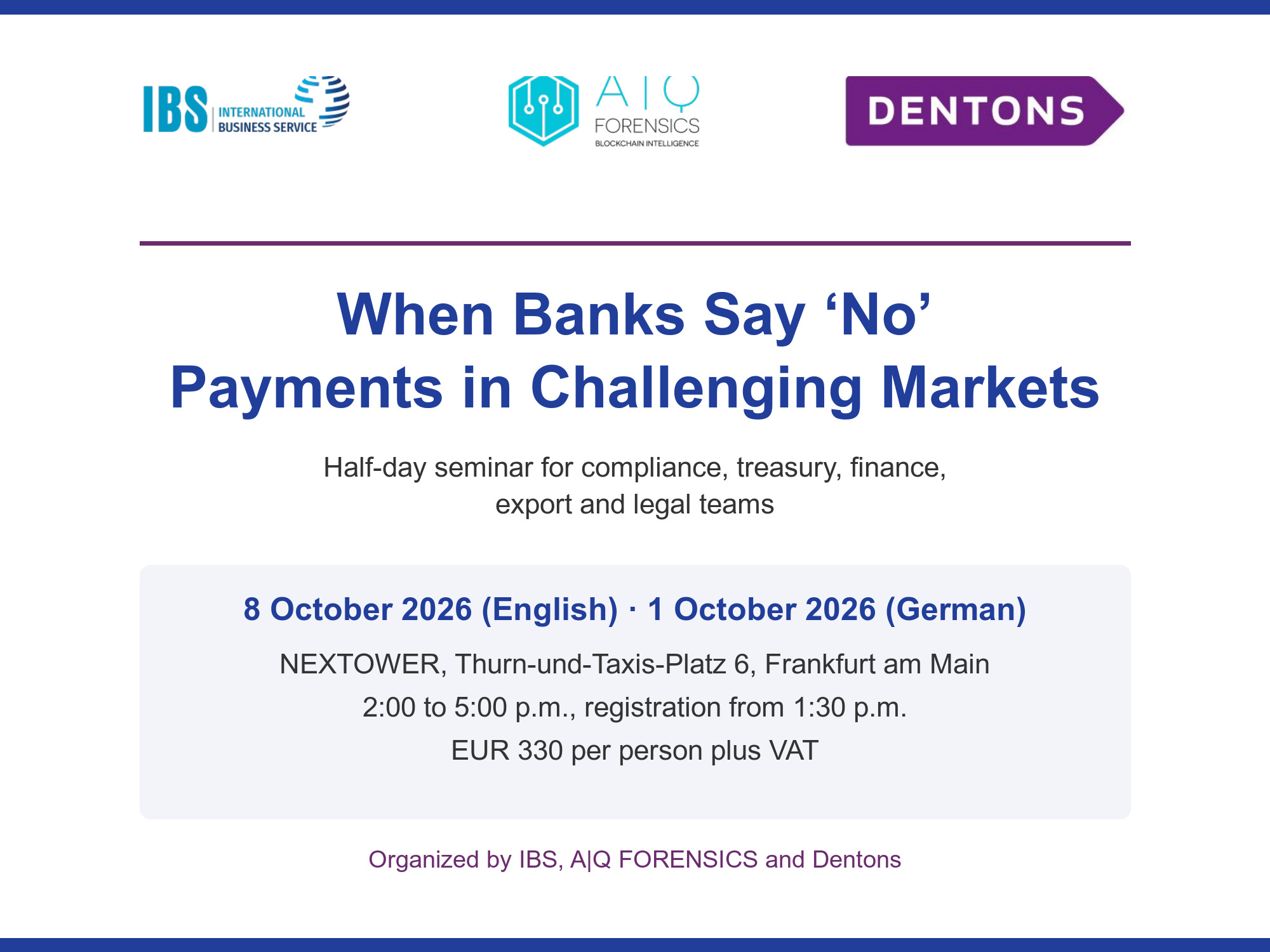
Finance Loop supports When Banks Say 'No', a half-day seminar at the NEXTOWER in Frankfurt on payments in challenging markets. Dr. Julia Pfeil of Dentons covers European and U.S. sanctions and the rules for high-risk countries, Harald Knosp of International Business Service covers de-risking and shifting payment routes, and Albert Quehenberger of A|Q FORENSICS shows how blockchain forensics traces crypto flows. Related pages: KYC in Germany, fraud prevention in Germany and MiCA in Germany.
Risk & Compliance
Payments & Digital Money
Investment & Digital Assets
What is sanctions compliance?
Sanctions compliance is a firm's process for keeping to the restrictive measures of the UN, the EU and national governments. In practice it means screening customers, owners and payment parties against sanctions lists, freezing funds of listed persons, refusing business that a sector ban forbids, reporting frozen funds to the authority and keeping records of every decision on a possible hit.
What is sanctions screening in AML?
Sanctions screening checks names against sanctions lists. AML checks look for suspicious money flows and lead to a report to the financial intelligence unit. The two run side by side in the same onboarding and payment processes, and the KYC and AML checks include a check against targeted financial sanctions. The legal basis differs: sanctions duties come from the EU regulations and the AWG, AML duties from the Geldwäschegesetz. A confirmed sanctions hit stops the payment, unless the regime allows an exception and the Bundesbank grants a license.
Where are sanctions compliance jobs in Germany?
Sanctions compliance jobs in Germany are at banks, payment institutions, insurers, crypto firms and exporters with their own trade compliance teams, and at law firms and consultancies that advise them. Frankfurt has many of the banking roles, and export control roles are spread across the industrial regions. Typical titles are sanctions analyst, sanctions compliance officer, trade compliance manager and screening specialist, the last one close to the IT team that tunes the screening system.
Is there a sanctions compliance conference in Frankfurt?
Sanctions topics in Frankfurt usually run inside payments and compliance seminars rather than at one dedicated conference. The calendar on this page and the Finance Loop events overview list the next dates.
Sanctions compliance and Finance Loop
At Finance Loop events, sanctions and AML specialists meet the payments, treasury and digital asset teams whose transactions they screen. More on the network is on the About page.
Finance Loop is a professional network and has the goal of driving the adoption of emerging technologies in finance, such as AI, tokenization, stablecoins, and DeFi. Finance Loop helps its members build skills and personal networks in these fields: Investment & Digital Assets, Payments & Digital Money, and Risk & Compliance.