
KYC in Germany
This page explains how know your customer checks work in Germany: the duties in the Geldwäschegesetz, the ways a bank may verify identity, the register of beneficial owners and what the new EU rules change. It also shows where KYC analysts and AML officers meet at Finance Loop events.
How KYC works at a bank in Germany
Know your customer (KYC) is the check a bank runs before it opens an account and keeps running while the account is open. German law calls these checks allgemeine Sorgfaltspflichten, and section 10 of the Geldwäschegesetz (GwG) lists five of them: identify the contracting party, find out whether a beneficial owner stands behind it, learn the purpose and intended nature of the business relationship, check whether the customer or the owner is a politically exposed person, and monitor the relationship. The same section requires the bank to update documents and data at intervals that depend on the risk. That is the "KYC update" or periodic review that customers of German banks get asked to complete.
The duties reach far beyond banks. Section 2 GwG names 16 groups of obliged entities, among them payment and e-money institutions, crypto service providers, life insurers, asset management companies, lawyers and notaries for certain transactions, real estate agents and traders in goods. BaFin supervises the financial firms among them, from its offices in Bonn and Frankfurt am Main.
Germany KYC requirements for companies and beneficial owners
When the customer is a company, the bank works through its ownership chain. For a legal entity, section 12 GwG accepts an extract from the commercial register, the founding documents or a direct look into the register. The beneficial owners are recorded in the Transparenzregister, the German register of beneficial ownership that section 18 GwG sets up and that Bundesanzeiger Verlag runs on behalf of the federal government.
The register is a starting point, never the whole answer. If the bank finds that the register entry differs from what it learned during onboarding, section 23a GwG obliges it to report the discrepancy to the register without delay. For KYC analysts at German banks, these discrepancy reports are part of daily work on corporate clients, next to the question of who controls a company through trusts, holdings or voting agreements.
KYC verification in Germany: ID card, eID and video ident
Section 12 GwG lists the ways to verify a person: a valid official photo ID such as a passport or national ID card, the electronic identity function of the German ID card under section 18 of the Personalausweisgesetz, a qualified electronic signature, an electronic identification system notified under the EU eIDAS regulation, and, for a basic payment account, the documents named in a separate ordinance.
Video identification is the method most people in Germany know from opening an account online. It rests on BaFin Circular 3/2017 (GW), which allows only trained staff of the obliged firm or of a provider it outsources to to run the video call. After its review, BaFin kept video ident as a "bridge technology" and said it would keep testing it against technical progress, including the use of AI. The Federal Ministry of Finance has published a draft ordinance (GwVideoIdentV) that would move the rules from the circular into an ordinance for all obliged entities and open the door to partly and fully automated procedures.
Several KYC providers that banks use for this are German companies: IDnow is based in Munich, WebID in Berlin and Nect in Hamburg, where it builds automated identification based on AI.
What changes with the EU AML package and AMLA in Frankfurt
Today the KYC duties of a German bank stand in the GwG, which transposes an EU directive. The EU has adopted a single rulebook, Regulation (EU) 2024/1624 (AMLR), which will apply directly in every Member State. Its Article 20 lists the customer due diligence measures, Article 22 the minimum identification data, and Article 19 the thresholds: EUR 10,000 for an occasional transaction and EUR 1,000 for crypto-asset service providers.
The new EU Anti-Money Laundering Authority, AMLA, has its seat in Frankfurt am Main. It will supervise a group of large cross-border banks and financial firms directly and coordinate national supervisors such as BaFin. For compliance teams in Germany this means two things to watch: the move from German to EU wording in their KYC policies, and a new supervisor in the same city as the ECB and many bank head offices.
Upcoming events on KYC, AML and compliance
Finance Loop, the meeting place for KYC and AML in Germany
Finance Loop is the meeting place for KYC analysts, AML officers and the people who build identification and screening software. It connects the finance, IT and AI communities, with events in Frankfurt and from time to time in Munich, Berlin and Hamburg.
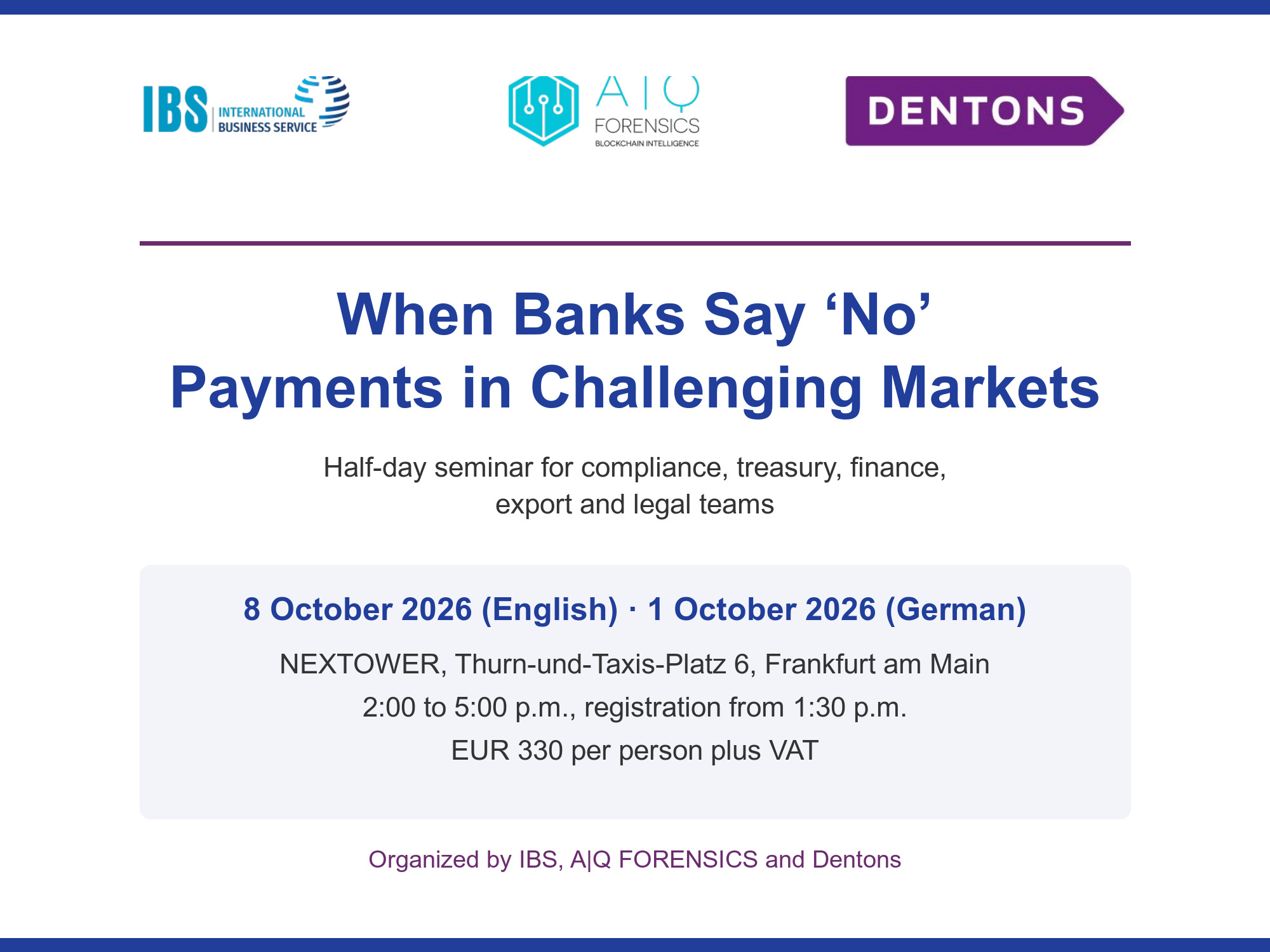
Finance Loop supports When Banks Say 'No', a payments seminar at the NEXTOWER in Frankfurt for compliance, treasury and legal teams, where Dr. Julia Pfeil of Dentons speaks on payments governed by sanctions and anti-money laundering laws. At the Bybit EU Crypto Evening at TechQuartier, supported by Finance Loop, Mykolas Majauskas, Senior Director of Policy, spoke on compliance under MiCAR. AI in compliance was a theme of KI Exchange in Hamburg. Related pages: sanctions compliance in Germany, fraud prevention in Germany and MiCA in Germany.
Risk & Compliance
Payments & Digital Money
Investment & Digital Assets
What is KYC in banking and in crypto?
In banking, KYC is the customer due diligence a bank carries out under the GwG: identity, beneficial owner, purpose of the account, PEP status and ongoing monitoring. In crypto the checks are the same, carried out by exchanges and custodians. The difference lies in the transfers: under the travel rule a crypto-asset service provider sends the name and ledger address of the sender with every transfer, so a platform without KYC data cannot move funds for its clients. The KYC vs AML answer goes through both in detail.
What does a KYC analyst do?
A KYC analyst collects and checks the customer file: ID documents, register extracts, ownership charts, the source of funds and the results of PEP and sanctions screening. The analyst decides whether the file is complete for the risk level, asks the client for missing papers and escalates cases with red flags to the AML officer. KYC analyst jobs in Germany are at banks, payment institutions, crypto firms and the consulting firms that run KYC remediation projects for them. Frankfurt, home to the head offices of Deutsche Bank and Commerzbank, has many of these teams.
How does KYC work in Germany for foreigners?
A foreigner opening an account in Germany goes through the same checks as a German citizen, usually with a passport instead of the German ID card. Anyone with lawful residence in the EU, including people without a fixed address and asylum seekers, has a right to a basic payment account (Basiskonto) under section 31 of the Zahlungskontengesetz, and the bank must decide within ten business days. For these accounts, section 12 GwG accepts the documents that a separate federal ordinance lists, for people who have no passport.
Is there a KYC conference in Frankfurt?
KYC and AML topics run as tracks and panels inside broader finance and payments events in Frankfurt rather than at one dedicated KYC conference. Finance Loop lists the seminars, meetups and conferences where compliance teams meet in the events overview and in the calendar on this page.
KYC and Finance Loop
Finance Loop brings KYC analysts, AML officers and regtech founders together with bankers, payment experts and AI engineers at Finance Loop events. More on the network is on the About page.
Finance Loop is a professional network and has the goal of driving the adoption of emerging technologies in finance, such as AI, tokenization, stablecoins, and DeFi. Finance Loop helps its members build skills and personal networks in these fields: Investment & Digital Assets, Payments & Digital Money, and Risk & Compliance.