
Stablecoins in Germany
This page explains stablecoins as German law treats them: the MiCA rules for e-money tokens, EURAU, the first BaFin-licensed euro stablecoin, how banks and asset managers here look at dollar stablecoins, and how a holder is taxed. Dated events are in the calendar below.
What a stablecoin is under German and EU law
Germany applies no separate national stablecoin law. It follows the EU's Markets in Crypto-Assets Regulation (MiCA), which does not use the word "stablecoin" at all. A token that tracks one official currency, such as the euro or the dollar, is an e-money token (E-Geld-Token). A token that tracks a basket of assets is an asset-referenced token. Under Article 48 of MiCA, only a bank or an e-money institution may issue an e-money token, and at least 30 percent of the reserve backing it must sit as bank deposits.
BaFin is the German supervisor for e-money institutions that issue these tokens, and it applies the same capital, safeguarding and reserve rules to a stablecoin issuer as to any other e-money institution.
EURAU: the euro stablecoin issued in Frankfurt
AllUnity, a company founded by DWS, Deutsche Bank's asset management arm, together with Flow Traders and Galaxy, issues EURAU from Frankfurt. AllUnity holds a BaFin e-money institution license and launched EURAU in 2025 as a fully reserved, MiCA-compliant euro stablecoin under a multi-bank reserve model. Deutsche Bank has named EURAU among the stablecoins it plans to hold in custody for institutional and corporate clients, alongside bitcoin and ether. For a treasury or asset management team in Germany, EURAU is the clearest example of a euro stablecoin built inside the domestic banking system rather than by a crypto-native firm.
On the dollar side, Circle issues USDC and its euro coin EURC under an e-money license from the French ACPR, which, like a German license, is valid across the EU under MiCA's single-license principle.
How stablecoins are taxed in Germany
The Federal Ministry of Finance treats a stablecoin as a crypto asset for private investors: sold after a holding period of more than one year, the gain is tax free, and a sale within the first year is taxed as other income. Because a euro stablecoin usually trades at parity, most private holders see little or no gain to tax, but the reporting duty stays the same as for any other crypto asset, and under DAC8 the exchange or custodian reports the transaction to the tax office.
What German banks and companies deal with now
The daily questions for banks and payment firms are less about whether to touch stablecoins and more about where they fit next to instant bank transfers and the planned digital euro. A treasury team asks whether a euro stablecoin settles a cross-border invoice faster than a SEPA transfer and at what cost. A bank asks whether to custody stablecoins for clients itself, as Deutsche Bank plans, or route the business to a partner. Compliance teams add MiCA's e-money token rules to a list that already includes the travel rule and DORA. Asset managers look at whether a euro stablecoin belongs in a fund's cash sleeve next to money market instruments, a question that did not exist before MiCA gave the token a clear legal status. See payments in Germany for how these rules connect to the broader payments license.
Upcoming events on stablecoins and digital money in Germany
Finance Loop and stablecoins in Germany
Finance Loop is the meeting place for people who work on stablecoins, digital euro and other digital money in Germany, Austria and Switzerland. It connects the finance, IT and AI communities and is a strategic partner of the Digital Euro Association, the Frankfurt think tank whose Digital Euro Conference puts stablecoins on the agenda next to central bank digital currency.
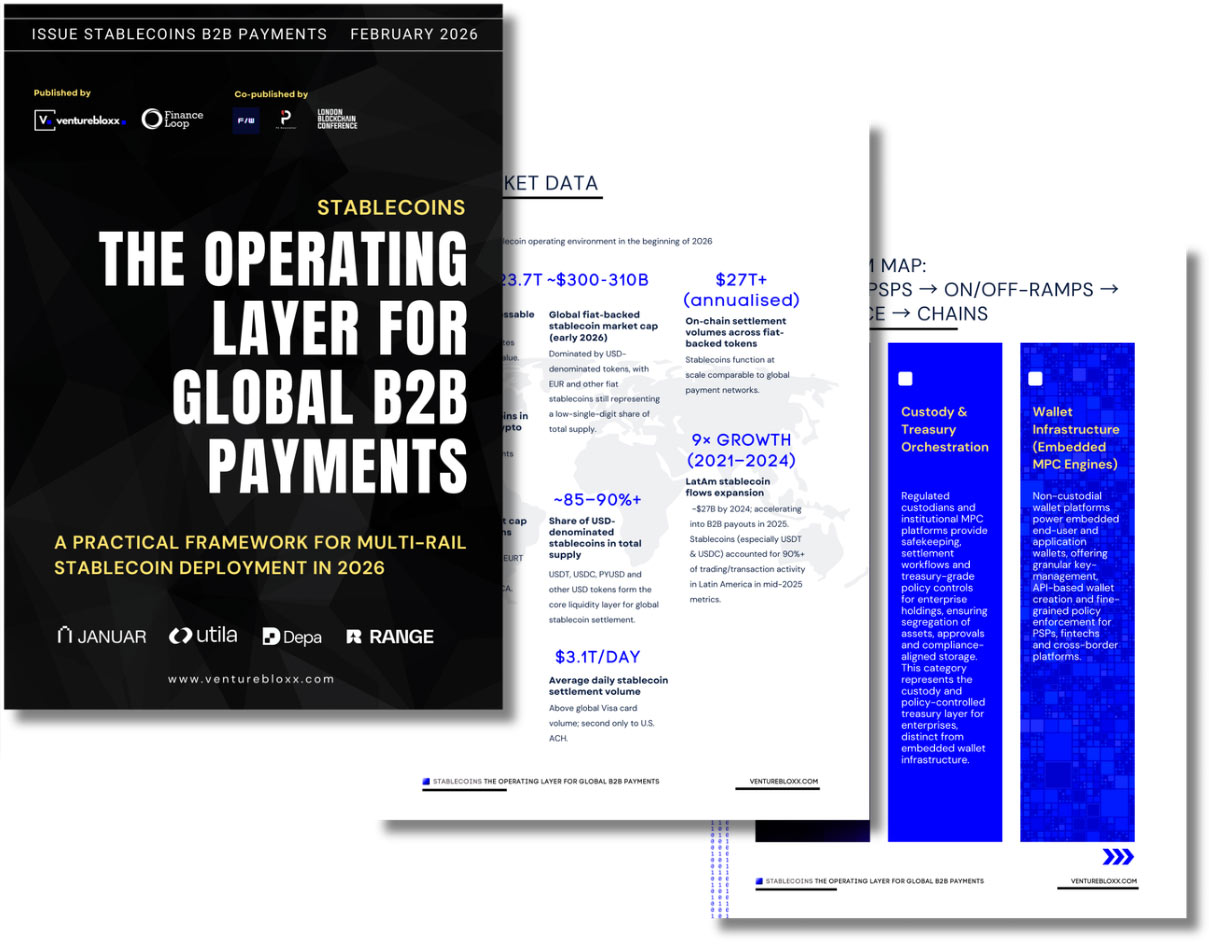
Finance Loop supported the Bybit EU x Circle Roadshow in Frankfurt, where two panels covered stablecoins, USDC and EURC, and covered a VentureBloxx report on stablecoins as the operating layer for global B2B payments. Related pages: payments in Germany, payments in Frankfurt and open banking in Germany.
Investment & Digital Assets
Payments & Digital Money
Risk & Compliance
Is there a euro stablecoin issued in Germany?
Yes. AllUnity, founded by DWS, Flow Traders and Galaxy, issues EURAU from Frankfurt under a BaFin e-money institution license. It launched in 2025 as a fully reserved euro stablecoin built to MiCA's e-money token rules, and Deutsche Bank lists it among the stablecoins it plans to custody for institutional clients.
Who may issue a stablecoin in Germany?
Under MiCA, only a credit institution or an e-money institution licensed by BaFin may issue an e-money token backed by the euro or another official currency. The issuer needs at least EUR 350,000 in initial capital and must hold at least 30 percent of the reserve as bank deposits. The stablecoin issuers answer in the knowledge hub goes through the full rule.
How is a stablecoin taxed in Germany?
A private holder in Germany pays no tax on a stablecoin sold after more than one year of holding, and pays income tax on a gain from a sale within the first year, the same rule the Federal Ministry of Finance applies to other crypto assets. A stablecoin held at parity to the euro usually produces little taxable gain, but the platform still reports the transaction under DAC8.
Stablecoins in Germany and Finance Loop
Finance Loop is a professional network and has the goal of driving the adoption of emerging technologies in finance, such as AI, tokenization, stablecoins, and DeFi. Finance Loop helps its members build skills and personal networks in these fields: Investment & Digital Assets, Payments & Digital Money, and Risk & Compliance.
It connects the finance, IT and AI communities in Germany, Austria and Switzerland, with events in Frankfurt, Munich, Berlin and Hamburg. If you work on stablecoins in Germany, you meet people from the same field at Finance Loop events.