
AI assistant for financial advisors
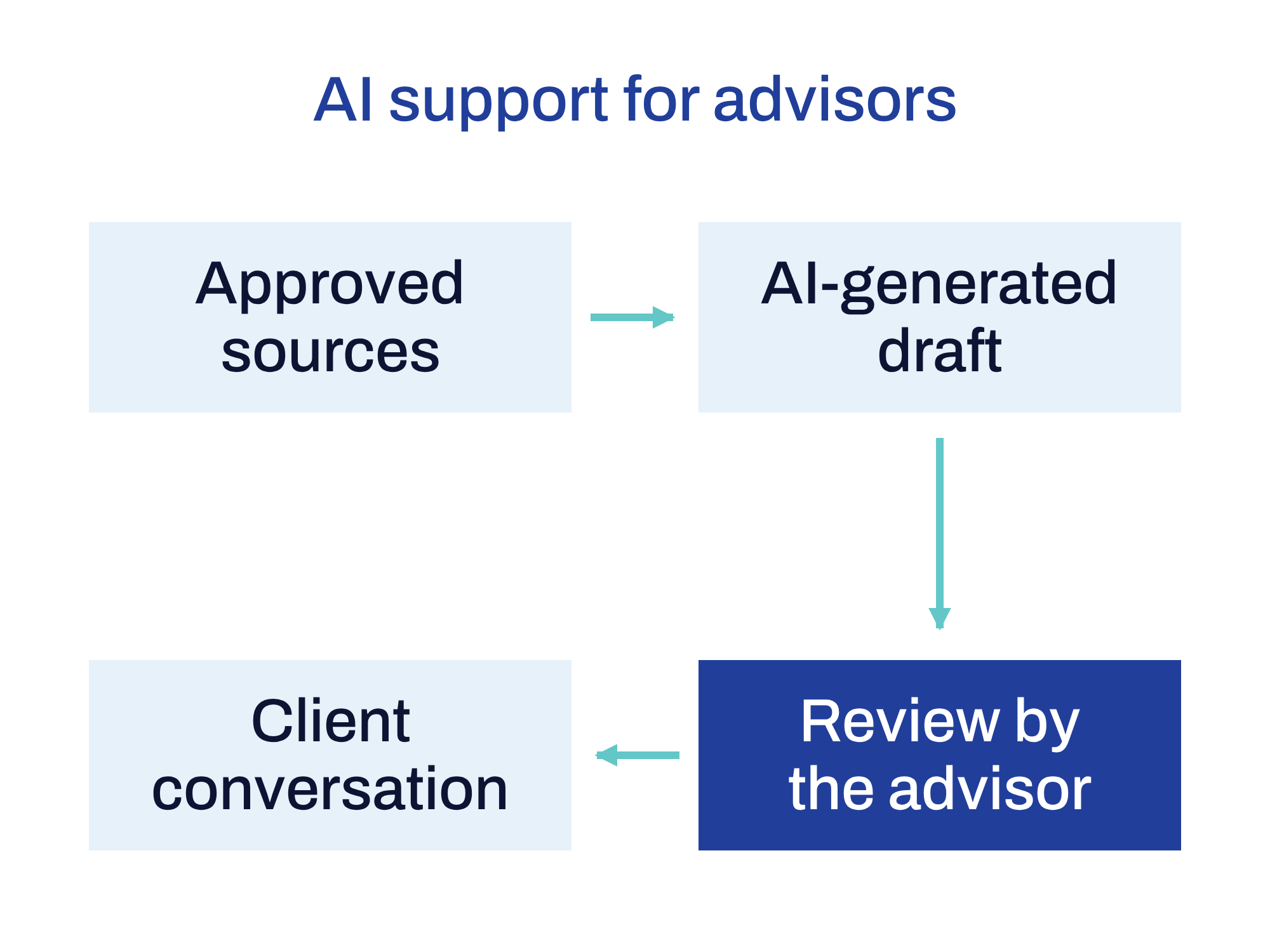
An AI assistant for financial advisors helps professional teams prepare client meetings, search approved research and draft follow-up communications. A wealth management copilot combines relevant information with a working draft that an advisor can inspect and correct. The advisor remains responsible for the conversation and the recommendation presented to the client.
Private banks and wealth management firms can connect these assistants to client records, portfolio information and their approved product universe. The design determines which information an assistant can access and which actions require a person. A useful evaluation therefore follows the complete advisory workflow, from meeting preparation through documented review and subsequent communication.
Meeting preparation and client context
A meeting briefing should help advisors identify relevant changes since their previous conversation. Upcoming maturities, recent client requests and portfolio movements can provide starting points for discussion. Each observation needs a visible date and an identifiable source so the advisor can check its relevance.
UBS uses AI tools to support advisors with client and portfolio information. The UBS deployment of STAAT Insights concerns the United States, while Conversational Insights serves Hong Kong and Singapore. Those examples illustrate advisor support without establishing availability in European markets.
Research retrieval with traceable sources
An assistant should connect an answer to the underlying approved research and relevant passages. Publication dates help advisors distinguish a current investment view from an outdated recommendation. Access controls must continue to apply when a conversational interface retrieves internal information.
BNP Paribas uses internal conversational assistants for investment advice workflows, including meeting preparation and specialized questions. The group also uses AI to draft explanations accompanying investment proposals in European entities. These applications separate finding information from drafting language for an advisor to review.
Investment ideas and product eligibility
Generating potential investment ideas requires current client context and the product universe available for distribution. Missing investment objectives, risk information or applicable restrictions should trigger review before a proposal advances. An assistant should distinguish an idea for investigation from a recommendation approved for presentation.
Advisors need to see the assumptions and exclusions behind a suggested investment. A polished explanation does not establish that positions, costs and eligibility data are accurate. Connecting the assistant to a portfolio management system requires clear ownership of those underlying records.
Meeting notes and follow-up communications
Morgan Stanley Debrief creates meeting notes and follow-up drafts with client consent. Advisors can edit the resulting email before deciding whether to send it. The system can also save meeting notes to Salesforce for subsequent reference.
A European implementation needs defined recording permissions and a process for correcting inaccurate notes. Testing should include incorrect speaker attribution, changed client instructions and incomplete recordings. Each correction needs an owner before the resulting text becomes part of the client record.
Human review and accountability
ESMA explains existing MiFID II obligations when investment firms use artificial intelligence. Organizational requirements and the duty to act in clients' best interests remain applicable. Management remains responsible for decisions involving AI within the provision of investment services.
An effective review screen should show the client context alongside the proposed output. Teams should record the reviewed version, material corrections and the person authorizing further use. AI governance in banking provides a broader framework for responsibilities, escalation and oversight.
Access, privacy and confidential information
An advisor assistant should receive only the client information needed for its defined purpose. The GDPR principles include data minimization, accuracy and limits on storage when processing personal information. Product teams need to apply these principles across retrieval, generation and retained outputs.
Procurement should establish where prompts, recordings and drafts are processed and retained. Contracts and operating procedures should address provider changes, access rights and deletion responsibilities. Tests should also examine whether retrieved material can expose restricted information across client relationships.
Evaluating an advisor copilot
A pilot should compare representative advisory tasks using outputs that experienced reviewers have checked. Preparation time belongs alongside factual errors, missing context and the corrections required before use. Faster drafting alone does not establish a benefit across the complete advisory process.
Test cases should include unavailable evidence and disagreements between otherwise credible sources. The assistant should communicate uncertainty and make the original material easy to inspect. Model validation in banking can inform the test design and documented acceptance criteria.
Can an assistant send advice directly to clients?
The internal copilot described here places a human review before client communication. Direct client interaction changes the operating model and requires controls appropriate to that service. Teams should decide the permitted actions before connecting an assistant to messaging or transaction tools.
Wealth management and responsible AI
Advisor assistants and Finance Loop
Finance Loop connects professionals working on emerging technologies across European financial services, with Central Europe as its current regional focus. Wealth management firms and technology providers can discuss introductions to relevant experts and opportunities for professional exchange.
Finance Loop is a professional network supporting business relationships across financial centers. Companies can contact Finance Loop about relevant introductions and professional exchange around AI-assisted advisory workflows and their intended markets.