
Account Abstraction
Account abstraction makes a blockchain account programmable, so software rules control how transactions are approved. An account can require several signatures, set spending limits and provide a way to replace a lost key. On Ethereum and compatible networks, ERC-4337 and EIP-7702 provide different ways to support these smart account functions.
Account abstraction helps wallet developers make blockchain accounts easier to use without giving one key unrestricted control. Wallet software can combine several transaction steps and arrange for fees to be paid in another token or by an application. These functions reduce the need for users to manage network fees and recovery entirely by themselves.
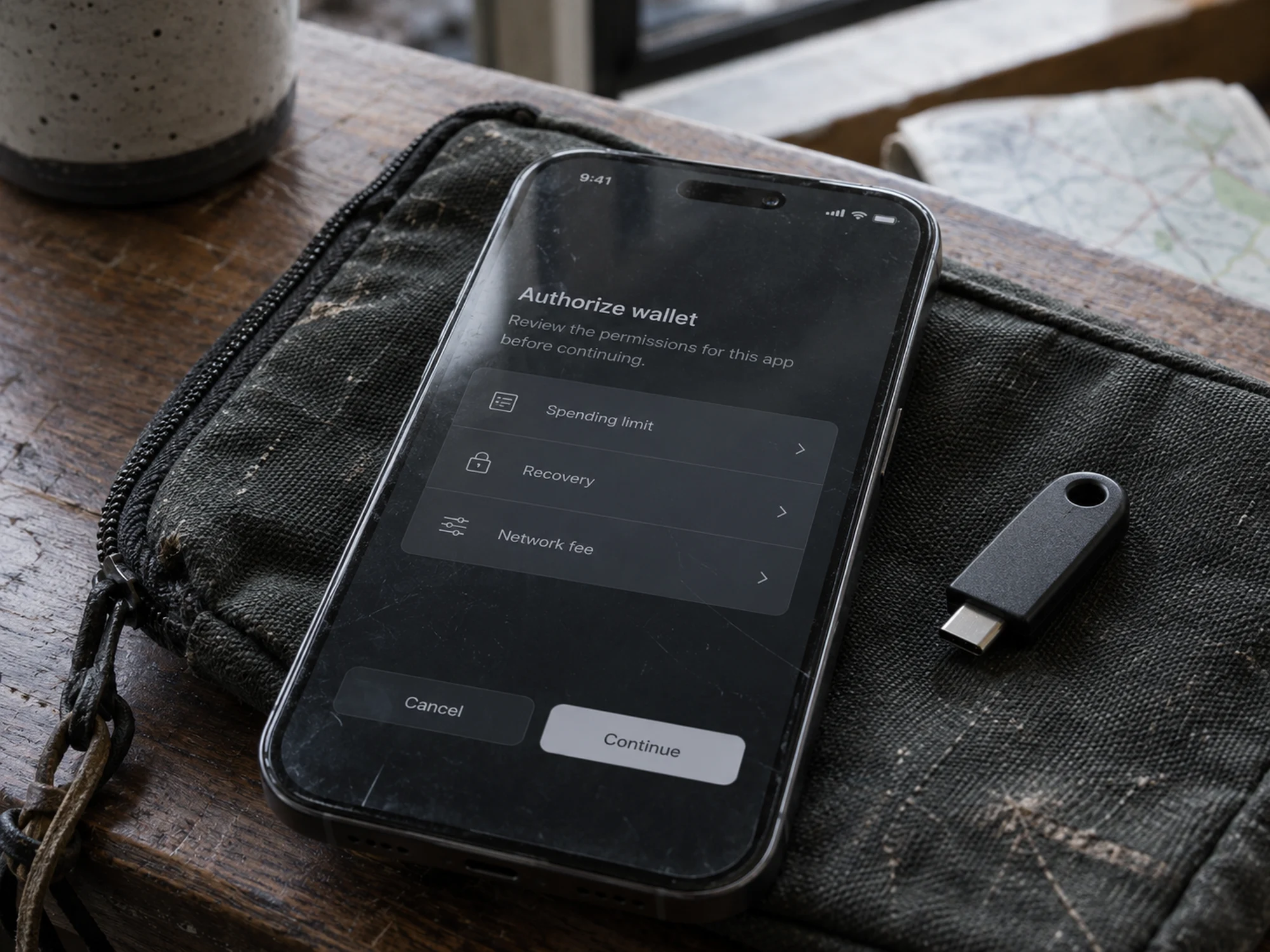
The problem with a single private key
A standard Ethereum account, an externally owned account, is a public and private key pair. Whoever holds the private key can do anything the account allows, and whoever loses it can do nothing. A lost key cannot be recovered, and a stolen key gives instant access to all funds. Every transaction also needs ether to pay the network fee, even when the user only holds a stablecoin.
A smart contract account keeps its logic in code and can require several signatures above a threshold, accept transfers only to trusted addresses, rotate a compromised key and let a third party pay the fee. The Ethereum Foundation counts more than 26 million smart wallets and 170 million user operations created so far.
Payments first: fees in stablecoins and batched steps
For a payment app, the ether requirement is the first hurdle. With account abstraction a contract called a paymaster pays the network fee and charges the user in another token, or the app pays it outright. Circle Paymaster lets users pay gas in USDC instead of the chain's native token, works with ERC-4337 smart accounts and with ordinary accounts upgraded through EIP-7702, and runs on Arbitrum, Avalanche, Base, Ethereum, OP Mainnet, Polygon PoS and Unichain; end users pay 10 percent of the gas fee per transaction.
Batching changes the transaction steps: approving a token and paying with it are two transactions on a standard account and one on a smart account. For a merchant or a treasury team this removes a failure point between the two steps. Recurring payments and spending limits follow from the same mechanism, because the account itself can check the rule before it signs.
ERC-4337 and EIP-7702: two routes to the same result
ERC-4337 adds a separate transaction flow on top of Ethereum without changing the core protocol. Users submit user operations, which are bundled into ordinary transactions and checked by an EntryPoint contract deployed on Ethereum mainnet on 1 March 2023. EIP-7702, part of the Pectra upgrade of May 2025, takes the other route and lets an existing account delegate its control to smart contract code, so users keep their address.
For institutions the difference matters at the key level: an MPC wallet splits one private key into shares, which the chain cannot see; account abstraction puts the approval rules on the chain, where an auditor can read them. Holding keys for clients involves licensing requirements for crypto custody.
Upcoming events on digital assets and payments in Germany
Finance Loop and account abstraction
The Bybit EU x Circle Roadshow in Frankfurt, supported by Finance Loop, held two panels on stablecoins, USDC and EURC, the tokens that paymasters now accept for fees. Finance Loop covers the wallet layer of digital assets on its pages on MPC wallets and stablecoin payments.
Payments & Digital Money
Digital Infrastructure & Sovereignty
What is account abstraction?
Account abstraction makes blockchain accounts programmable: rules in code decide who may sign, how fees are paid and how a lost key is replaced, instead of one private key that controls everything.
What is the difference between ERC-4337 and EIP-7702?
ERC-4337 creates new smart contract accounts and a separate flow of user operations without changing the core protocol of Ethereum. EIP-7702 lets an existing account hand its control to smart contract code, so the address stays the same.
What is a paymaster?
A paymaster is a smart contract that pays the network fee for a user operation. The paymaster can charge the user in a stablecoin such as USDC or let the app cover the fee.
Is a smart contract wallet safer than a normal wallet?
A smart contract wallet removes the single point of failure of one private key and allows recovery and spending rules. The smart contract wallet adds code risk, so the wallet contract needs a smart contract audit.
Account abstraction and Finance Loop
Finance Loop covers account abstraction in its Payments & Digital Money track, as the wallet layer that decides whether stablecoin payments work for merchants and treasury teams. Finance Loop brings people from banks, payment firms, custodians and wallet providers together at events in Frankfurt, Munich, Berlin and Hamburg.
Finance Loop is a professional network supporting the institutional use of emerging technologies in finance, such as AI, digital payments, cloud and blockchain solutions. Finance Loop helps its members build skills and personal networks in these fields: Investment & Digital Assets, Payments & Digital Money, Digital Infrastructure & Sovereignty, and Risk & Compliance.