
Crypto Market Making
Somebody has to be willing to sell when you want to buy. On a stock exchange that somebody is often a market maker with an obligation to quote both sides throughout the session, and the spread between its bid and its offer is what the liquidity costs. Crypto market making works the same way without the obligation: a firm quotes a bid and an offer on a book continuously because it chooses to, and the risk it takes on its own inventory sets how wide that spread is. The market maker definition in the knowledge hub covers the role under MiFID II.
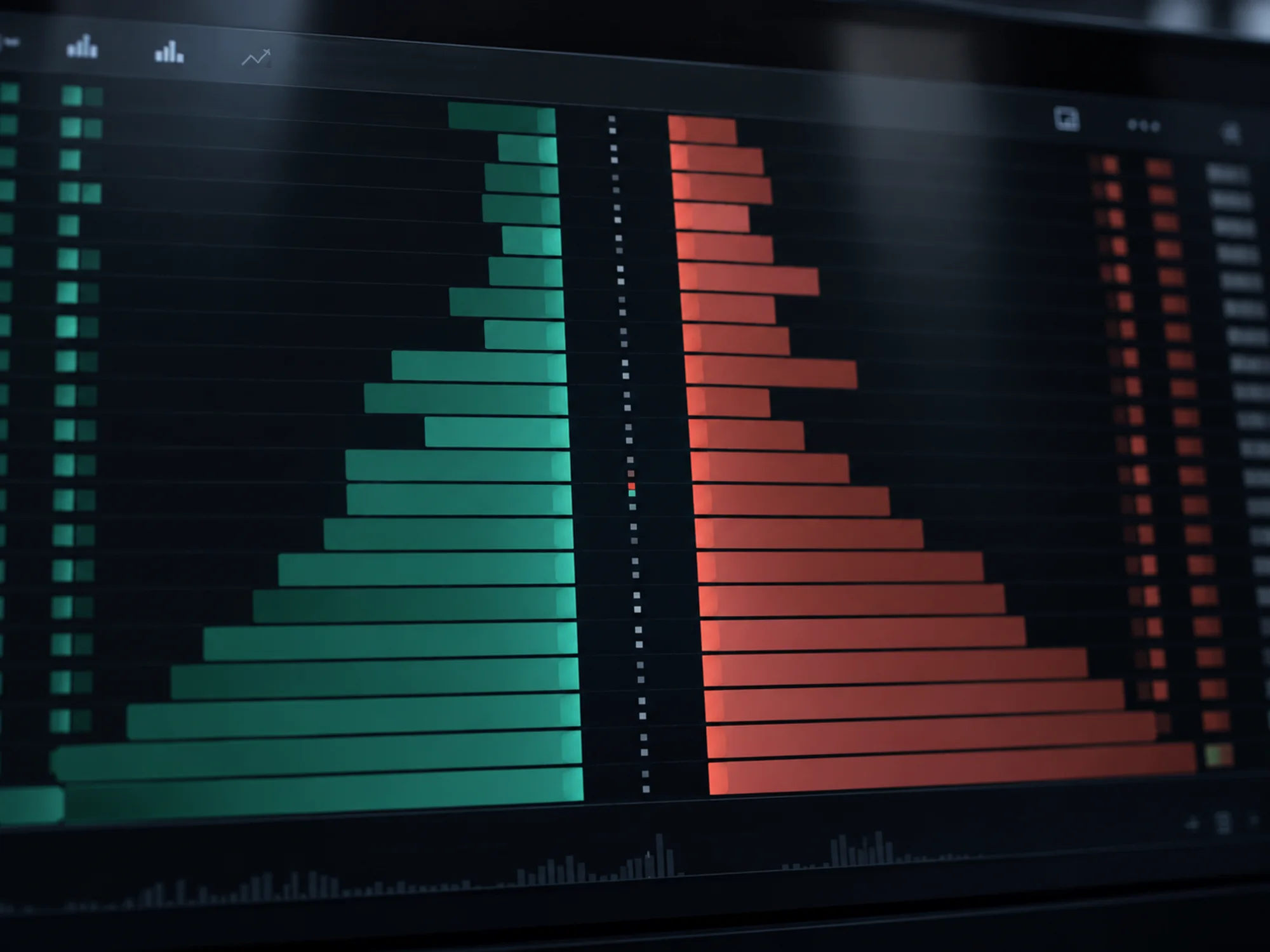
How a quote is built: spread, depth, inventory
A quote has three parameters. The spread is the distance between the bid and the offer, and it has to cover the expected cost of being wrong. The depth is how much size sits at each level, which decides how large an order the quote can absorb. The inventory is what the firm already holds, and it skews the quote: a maker that is long after a run of buyers lowers both sides to attract sellers and discourage more buyers.
The firm earns the spread when the flow is balanced, buying at the bid and selling at the offer repeatedly without taking a view on the price. It loses when the flow is one-sided, because the only reason everyone is selling to it may be that the price is about to fall. That asymmetry, not the operating cost, is what the spread prices.
Inventory risk and hedging across venues
Inventory risk is the exposure a maker holds between filling one side and finding the other. The hedge is usually not in the same instrument: a maker quoting a token on a spot book can offset the exposure with a perpetual future, or against a correlated asset when no derivative on the token exists.
Hedging across venues adds its own problems. The hedge sits on a different exchange with its own collateral, so the firm needs capital in several places at once, and it carries the credit risk of each venue. That is what the netting in crypto prime brokerage is meant to relieve. A maker without that arrangement prices the trapped capital into the spread.
Order books against automated market makers
A centralized exchange runs a limit order book, and makers compete on price and speed within it. A decentralized exchange usually runs an automated market maker instead: a pool holds two assets, a formula sets the price from their ratio, and anyone who deposits into the pool earns a share of the trading fees. There is no quoting decision; the formula answers every order mechanically. Some decentralized venues do run order books on chain, so the two models are not split along the centralized and decentralized line.
The difference shows up in who bears the adverse selection. A human maker widens its spread when it suspects informed flow. A pool cannot, so a depositor ends up holding more of whichever asset is falling, and the fees have to make up the difference. The mechanics of the pool are covered on liquidity pool.
What a token issuer contracts a market maker for
An issuer whose token is about to list needs someone quoting on day one, because an empty book makes the first trade arbitrary. The mandate is written as obligations: a maximum spread, a minimum size at each side, and a percentage of the trading session during which the quote must be live, measured per venue.
Two commercial structures are common. In the retainer model the issuer pays a monthly fee and the maker keeps its trading result. In the loan model the issuer lends the maker tokens for inventory and grants a call option over them at a set price, so the maker profits if the token rises. The second structure aligns the maker with the price going up, which is the part an issuer should think about before signing, because quoting a market and being long the token are different jobs.
Market abuse rules under MiCA that apply to quoting
MiCA prohibits market manipulation in crypto-assets admitted to trading, and several quoting practices fall under it by name. Wash trading, where the same beneficial owner is on both sides so volume appears without risk changing hands, is manipulation. So is spoofing, placing orders without intent to execute in order to move the price, and so is quoting to set a reference price used by another instrument.
A firm professionally arranging transactions has to run systems that detect and report suspected abuse. The practical consequence for a maker is record keeping: which algorithm quoted what, when, and on whose instruction, kept in a form a supervisor can read.
Why thin books produce the price gaps retail investors see
A gap on a chart is a book with nothing in between. When makers widen or withdraw, which they do fastest in a volatile minute, there is no resting size between the last price and the next one, so a market order prints far away from where the previous trade happened. The same mechanism produces the long wicks that liquidate leveraged positions, because a liquidation engine sells into whatever depth remains.
This is also why one asset's price differs between venues at the same moment. The arbitrage that normally closes the difference needs capital on both venues and a working transfer between them, and in a stressed minute one of the two is missing.
Do crypto market makers have an obligation to quote?
Only to whoever they contracted with. A designated market maker on a regulated stock exchange carries quoting obligations under the exchange's rules and MiFID II. A crypto maker's obligations come from its agreement with the venue or the token issuer, and outside those terms it can stop quoting at any moment. That is the difference a trader feels in a crash: the liquidity was voluntary.
Is market making the same as trading?
No, and the distinction is directional risk. A trader takes a position because it expects the price to move a certain way. A market maker aims to end each period flat, earning the spread on turnover instead of the move. In practice a maker always carries some inventory and therefore some view, and firms that let that inventory grow deliberately have stopped market making and started trading.
How does market making affect the price a retail investor pays?
Directly, through the spread and the depth at the moment of the order. A narrow spread with size behind it means a small order fills near the screen price. A wide spread or a shallow book means the same order pays more, and no fee schedule shows that cost. An investor can see it before trading by looking at the quoted spread and the size at the first few levels, which is what crypto market data feeds supply.
Crypto market making and Finance Loop
Finance Loop is the meeting place for the trading, risk and compliance people who quote these markets or supervise those who do. Finance Loop events on digital assets put market structure, the MiCA market abuse rules and execution quality on one agenda, and the subject belongs to the track Investment & Digital Assets.
Finance Loop connects the finance, IT and AI communities, so a desk building quoting infrastructure meets the venues and data providers at Finance Loop events.
Finance Loop is a professional network and has the goal of driving the adoption of emerging technologies in finance, such as AI, tokenization, stablecoins, and DeFi. Finance Loop helps its members build skills and personal networks in these fields: Investment & Digital Assets, Payments & Digital Money, Digital Infrastructure & Sovereignty, and Risk & Compliance.