
Merchant acquiring: who takes the card payment for you
If you accept cards, one licensed institution stands between you and the card networks, carries your chargebacks and decides when your money arrives. That institution is the acquirer. It holds the contract that lets you accept a brand, submits your transactions into the network, and settles the proceeds to your account after deductions.
Understanding the role matters because the acquirer's own risk sets your terms. A reserve, a settlement delay or a volume cap in your contract is the acquirer pricing the chance that you will not be there when a chargeback arrives.
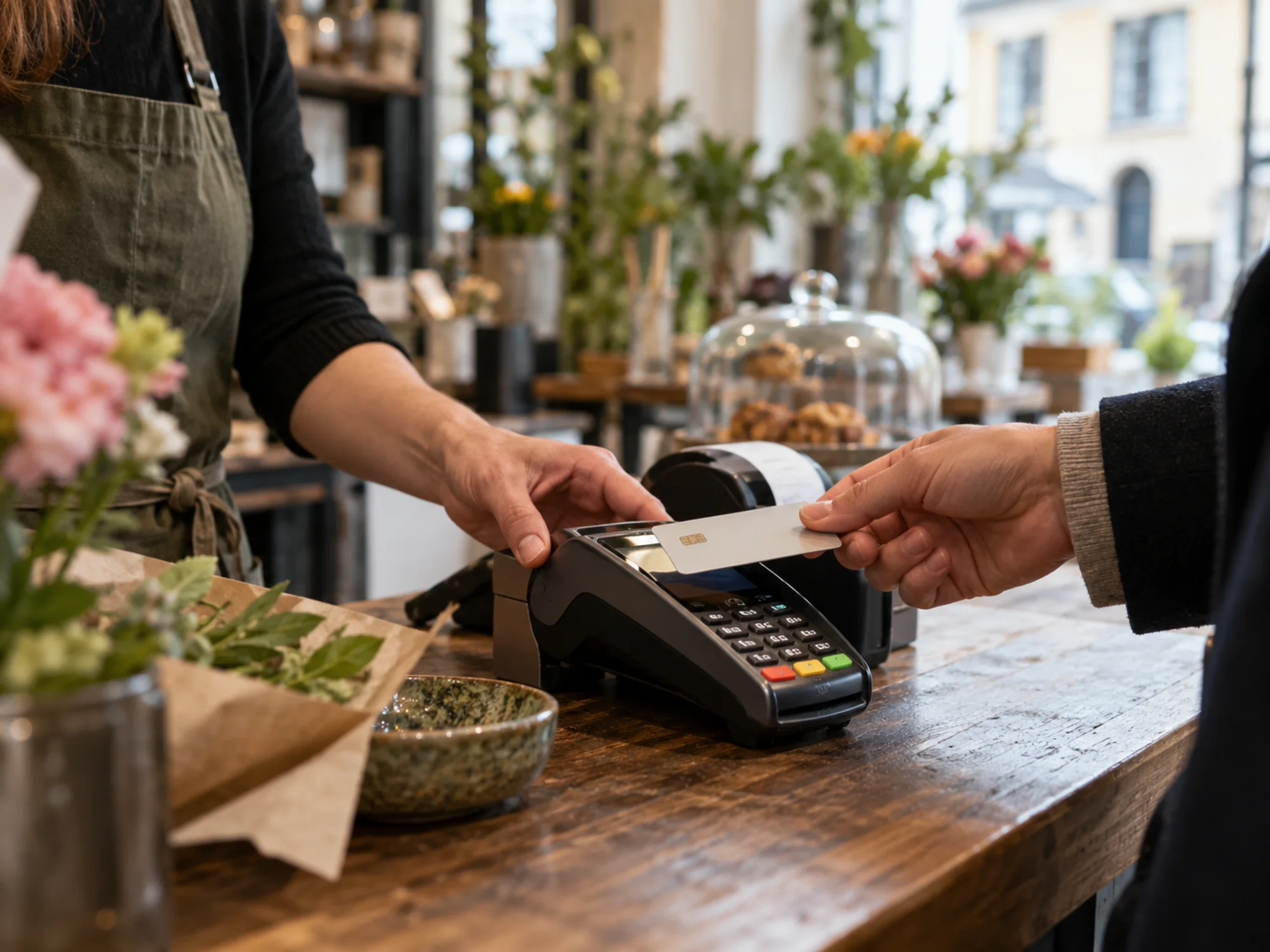
The four-party model and the acquirer's place in it
A card payment on an open network has four parties plus the network itself. The cardholder holds the account. The issuing bank issued the card, authorizes the transaction and carries the cardholder's credit risk. The merchant accepts the payment. The acquirer holds the merchant's acceptance relationship and settles to it. The network operates the authorization switch, writes the rules and publishes the fee schedules.
The glossary of the four-party model published by Spark contrasts this with the three-party model, where one company both issues the card and acquires the merchant. In that closed model no interchange flows between two banks, because there is only one; the network keeps the economics and carries the risk, and merchants typically pay more for acceptance.
Authorization, clearing and settlement
Three phases run on three different clocks, and merchants who confuse them misread their own reports. Authorization takes a few seconds: the terminal sends the request, the network routes it to the issuer, the issuer checks the account and answers, and a hold is placed on the funds. No money has moved.
Clearing follows within a day or two. The merchant batches the day's transactions, the acquirer sorts them by network, and the amounts and fee obligations are calculated. Settlement comes after that, typically one to two business days from the transaction: the issuer transfers the amount less interchange to the acquirer, and the acquirer credits the merchant less the agreed deduction. An authorization that never clears disappears, which is why a reconciliation has to compare clearing against settlement and not authorizations against payouts.
What the acquirer takes on
The acquirer carries two risks the merchant never sees priced separately. The first is the chargeback. When a cardholder disputes a transaction, the issuer credits the cardholder and debits the acquirer, and the acquirer recovers from the merchant. If the merchant is insolvent, has closed the account or was fraudulent, the acquirer absorbs the loss.
The second is delivery risk. A merchant taking payment for something it ships later has been paid for a promise, and if it stops trading the disputes arrive after the money has gone out. That is why travel, events and subscriptions are underwritten differently from a shop that hands goods over at the till. Finance Loop covers the dispute mechanics from the merchant side in card payments in Germany.
Which license acquiring needs in Germany
Acquiring card payments is a regulated payment service in Germany. Under the Payment Services Supervision Act it is the acquiring business, and a provider needs authorization from BaFin as a payment institution or has to be a credit institution. A company acquiring for merchants without that authorization is operating unlawfully, whatever it calls the service.
Two obligations follow that a merchant should ask about. Client funds have to be safeguarded, which means the money owed to merchants is held separately from the provider's own and is protected if the provider fails. And the provider has to identify its merchants and monitor them, which is why onboarding asks for ownership documents. Finance Loop covers the regime in payments regulation in Germany.
How the merchant discount breaks down
The deduction from a card payment has three layers, and only one of them is the acquirer's revenue. Interchange goes from the acquirer to the issuer and is set by the network, capped in the EU at 0.2 percent for consumer debit and 0.3 percent for consumer credit. The scheme fee goes to the network and is not capped. What remains is the acquirer's own margin.
The practical consequence is in how a contract quotes the price. A blended rate gives one number covering all three layers, which is simple and hides which layer moved when the number changes. Interchange-plus states the pass-through layers separately and the margin on top, which is comparable between offers and lets a merchant see a scheme fee increase for what it is. Finance Loop covers the layers in card scheme fees.
Settlement timing, reserves and rolling holds
Three instruments control the acquirer's exposure, and all three affect a merchant's cash. The settlement delay is the simplest: money held for a few days is money available to cover a dispute. A reserve is an amount held back at the start, sized during underwriting from the business model, the chargeback history, the time in business and the financial strength of the merchant. A rolling reserve holds a percentage of each day's volume for a fixed period and releases it continuously.
Chargeback ratios are the trigger that tightens all of them. The card networks monitor the share of disputed transactions per merchant, with thresholds around 1 percent at Visa and 1.5 percent at Mastercard, above which monitoring programs, fines and ultimately termination follow. A merchant close to a threshold should expect its terms to change, and reducing disputes is the only durable answer.
Where an acquirer ends and a payment facilitator begins
Both let a business accept cards, and the contractual position differs completely. With an acquirer the merchant has its own acceptance agreement and its own identifier in the network. With a payment facilitator the business becomes a sub-merchant under the facilitator's agreement, onboarding is faster, and the facilitator does the underwriting and holds the relationship.
The trade is control against speed. A sub-merchant depends on the facilitator's decisions, including its payout schedule and its tolerance for the business model, and it can be removed. A direct relationship takes longer to establish and survives a change of provider in a way a sub-merchant position does not.
What is the difference between an acquirer and a payment processor?
Licensing and liability. The acquirer is the regulated institution in the card network that holds the merchant's acceptance agreement and carries the financial liability for the transactions. A processor runs the technical work of routing, authorizing and clearing them. Many companies do both, which is where the confusion comes from, and the question that distinguishes them is which entity is liable for a chargeback.
How do I choose an acquirer?
On five criteria that have nothing to do with the headline rate. Whether the pricing is interchange-plus, so you can compare and see which layer changes. What reserve and settlement delay apply to your business model, in writing. Which currencies and which local payment methods the provider settles, since a missing local method costs more conversion than a fee ever will. What happens to your contract and your data if you leave. And who decides a dispute internally, because the quality of that process is what you actually buy.
Merchant acquiring and Finance Loop
Finance Loop is the meeting place for card acceptance in Germany, where a merchant's cost and cash flow are set by a contract most people in the business never read closely. Finance Loop brings together the acquiring and risk teams who write those terms and the merchants and platforms who live with them.
Finance Loop is a professional network and has the goal of driving the adoption of emerging technologies in finance, such as AI, tokenization, stablecoins, and DeFi. Finance Loop helps its members build skills and personal networks in these fields: Investment & Digital Assets, Payments & Digital Money, Digital Infrastructure & Sovereignty, and Risk & Compliance.