
Payment orchestration: one integration, several providers
If a provider outage stops your checkout, or a second acquirer means a second integration project, orchestration is the architecture that answers both. An orchestration layer sits above several gateways and acquirers and decides per transaction which one receives it, so a merchant integrates once and changes providers by changing a rule.
The layer does not process the payment. Authorization and settlement still happen at the provider, which means the merchant keeps every contract it had and adds one more dependency on top.
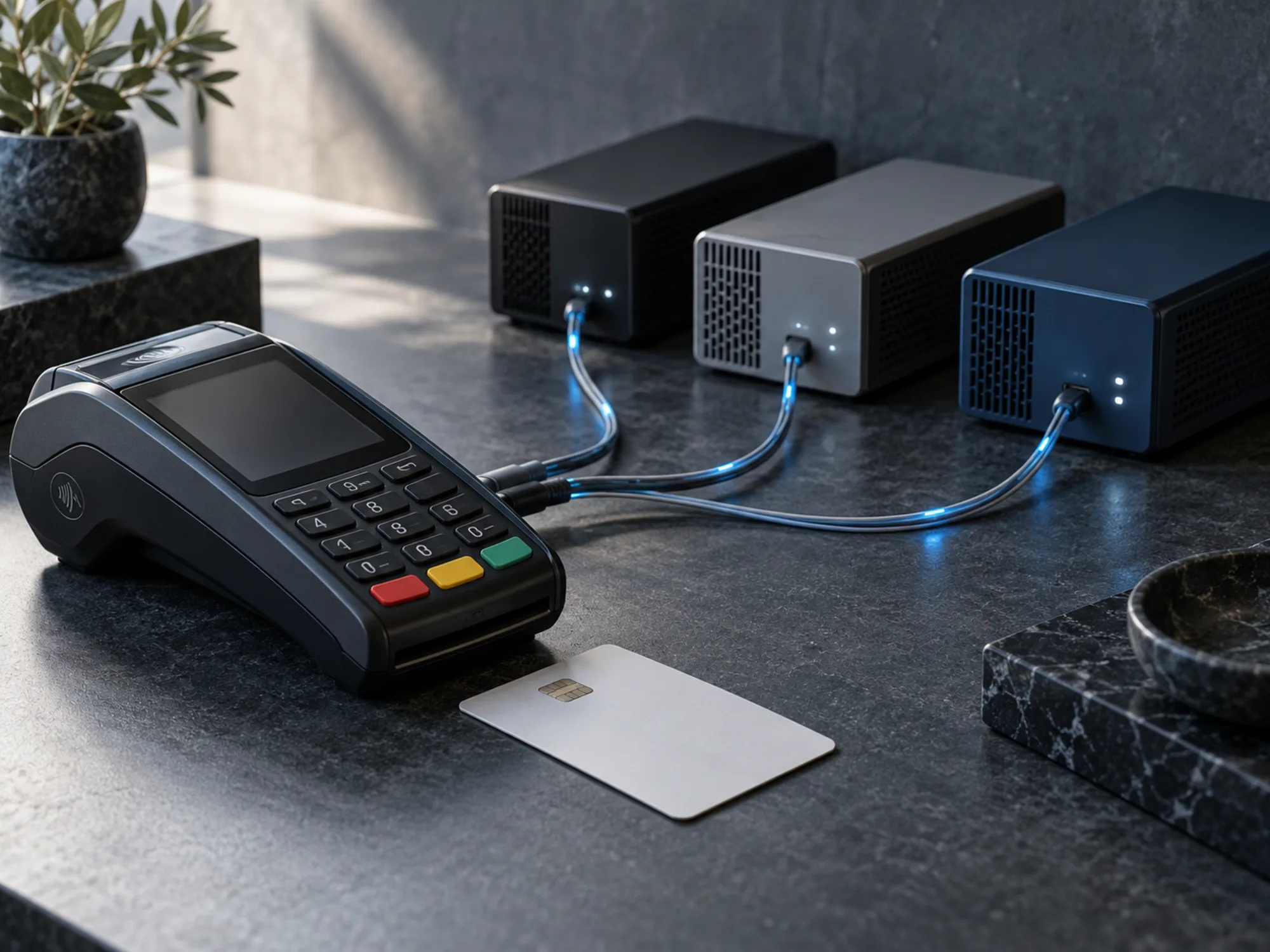
What the layer sits between
On one side is the merchant's own checkout and order system. On the other are the gateways, acquirers and alternative payment methods it has contracts with. The orchestration layer takes the payment request from the first side, applies its rules, and sends it to one of the second side, then normalizes the answers so the merchant's system reads one format instead of several.
That is the difference from a gateway. A comparison by SPD Technology puts it as one integration to one processor against a routing layer above many, and notes the consequence for a gateway: downtime at that provider is downtime for payments. Finance Loop covers the acquiring relationship underneath in merchant acquiring.
What smart routing optimizes for
A routing rule picks a provider from the attributes of the transaction. The glossary entry published by Spark lists the signals in use: geography, processing cost, live provider performance, card characteristics and transaction type. A rule can send European cards to a locally licensed acquirer, high-value transactions to the provider with the best record on them, and everything else to the cheapest.
The target has to be chosen, because cost and approval pull in different directions. Routing for cost sends volume to the provider with the lowest fees, which may approve fewer transactions. Routing for approval does the opposite. Spark reports vendors claiming authorization rate improvements of up to 12 percent against static routing, strongest in travel and subscriptions, and a claim from a vendor about its own product is worth measuring against the merchant's own baseline before it is believed. Finance Loop covers the fee side of the same decision in card scheme fees.
Failover, retries and where the argument ends
Failover is the clearest benefit. When the first provider times out or goes down, the layer sends the same transaction to the next one without asking the customer to enter the card again. Spark's example runs a 150 dollar transaction through a provider that times out and then through a second that approves, at roughly three seconds total.
Retries have limits that a sales deck tends to skip. A hard decline, where the issuer says the card is blocked or the account closed, is a final answer, and sending it to a second acquirer produces a second decline and a second paid authorization. Only soft declines are worth retrying, and the card networks impose their own retry rules with penalties for exceeding them. A layer that retries blindly raises cost and fraud exposure while the approval rate stays where it was.
Tokenization and who holds the card data
This is where orchestration changes more than routing. Without it, each provider keeps its own token vault, and a token from one provider is useless at another, so moving volume means asking customers to re-enter cards or arranging a vault migration. With it, the card data sits in one vault under the layer and every connected provider is served from it.
The same arrangement creates the dependency to think about hardest. The vault now holds the merchant's customer credentials, and the question to settle in the contract before signing is what happens to those tokens at the end of it: whether the merchant can have the data exported to another vault, in what format, and at what cost. Network tokens, issued by the card scheme instead of the provider, reduce the problem because they are not tied to one processor.
The consequence for PCI scope
Moving the card data out of the merchant's systems is the compliance argument for the layer. Gr4vy describes the effect as cardholder data residing with the orchestration provider while the merchant's databases hold only tokens, and reports merchants reducing their PCI assessment scope by 70 percent or more after migrating.
Scope reduction is not scope removal. The merchant still has to validate that the platform is certified, secure its own integration against it, control access to its systems and document all of it. And the checkout page matters more than the backend: a page that collects the card number in the merchant's own fields keeps the merchant in scope however the data is routed afterwards, while hosted fields or a redirect move that part out. Finance Loop covers the standard in PCI DSS 4.0.
Build against buy, and the risk in both
The build case is control. Routing logic is a set of rules and a provider abstraction, and a team that has integrated two acquirers already knows most of what it needs. SPD Technology puts a custom orchestration build at three to six months, and the cost after launch is the part that gets underestimated: every provider API change, every new payment method and every scheme mandate lands on the merchant's own roadmap forever.
The buy case is that someone else carries that maintenance, and the price is a layer in the authorization path that the merchant cannot fix when it breaks. Both options concentrate risk somewhere, in the merchant's own team or in a vendor, and the honest comparison is between those two places and not between a risk and none. SPD Technology observes that most platforms take up orchestration between 20 and 100 million dollars of annual processing volume, which is roughly where a second acquirer becomes a necessity instead of a plan.
How to judge whether it is worth it
Measure before buying, because the case rests on numbers the merchant already has. Take the current approval rate by card origin and by payment method, the share of declines that are soft, the hours of provider downtime in the past year and what they cost in abandoned orders, and the cost of the last integration project in developer weeks.
Those four numbers set the ceiling on what the layer can return. A merchant with one acquirer, a 96 percent approval rate and no outages is paying for failover it does not need, while a merchant on three acquirers in four markets with a manual routing table is doing the layer's work by hand. The answer is specific to the volume mix, which is why a provider's aggregate uplift figure says little about any one checkout.
What is the difference between a payment gateway and payment orchestration?
A gateway processes; an orchestration layer decides. The gateway takes the card details, authorizes with one acquirer and returns the result, and it is a party in the payment flow. The orchestration layer holds no acquiring relationship of its own and authorizes nothing: it chooses which gateway or acquirer handles each transaction and translates between them. A merchant with orchestration still needs at least one gateway underneath it.
Does orchestration raise authorization rates?
Sometimes, and by less than the headline numbers suggest. The gains come from three mechanisms: sending a transaction to the provider with the better record for that card origin, retrying soft declines under the network's rules, and failing over when a provider is down. None of them helps with a hard decline, an insufficient balance or a fraud block. A merchant should ask any vendor which share of its claimed uplift comes from failover during outages, because that part depends on how often the current provider fails.
Payment orchestration and Finance Loop
Finance Loop is the meeting place for payment architecture decisions in Europe, where a merchant's routing layer now sits between its checkout and every acquirer it works with. Finance Loop brings together the engineering and payment teams making that build-or-buy call and the people who have already lived with the answer.
Finance Loop is a professional network and has the goal of driving the adoption of emerging technologies in finance, such as AI, tokenization, stablecoins, and DeFi. Finance Loop helps its members build skills and personal networks in these fields: Investment & Digital Assets, Payments & Digital Money, Digital Infrastructure & Sovereignty, and Risk & Compliance.