
On-chain settlement
On-chain settlement means that the transfer of an asset, and sometimes the payment for it, is recorded on a blockchain and becomes final there. The ledger that records the trade and the ledger that holds the asset are the same, so no separate settlement system has to update its books after the trade.
Both parties and their auditors can check each transfer on the ledger, and it settles within seconds or minutes at any hour of the day. Because a confirmed transfer cannot be reversed, the controls move to the moment before the transfer, where firms check addresses, ownership and payment instructions.
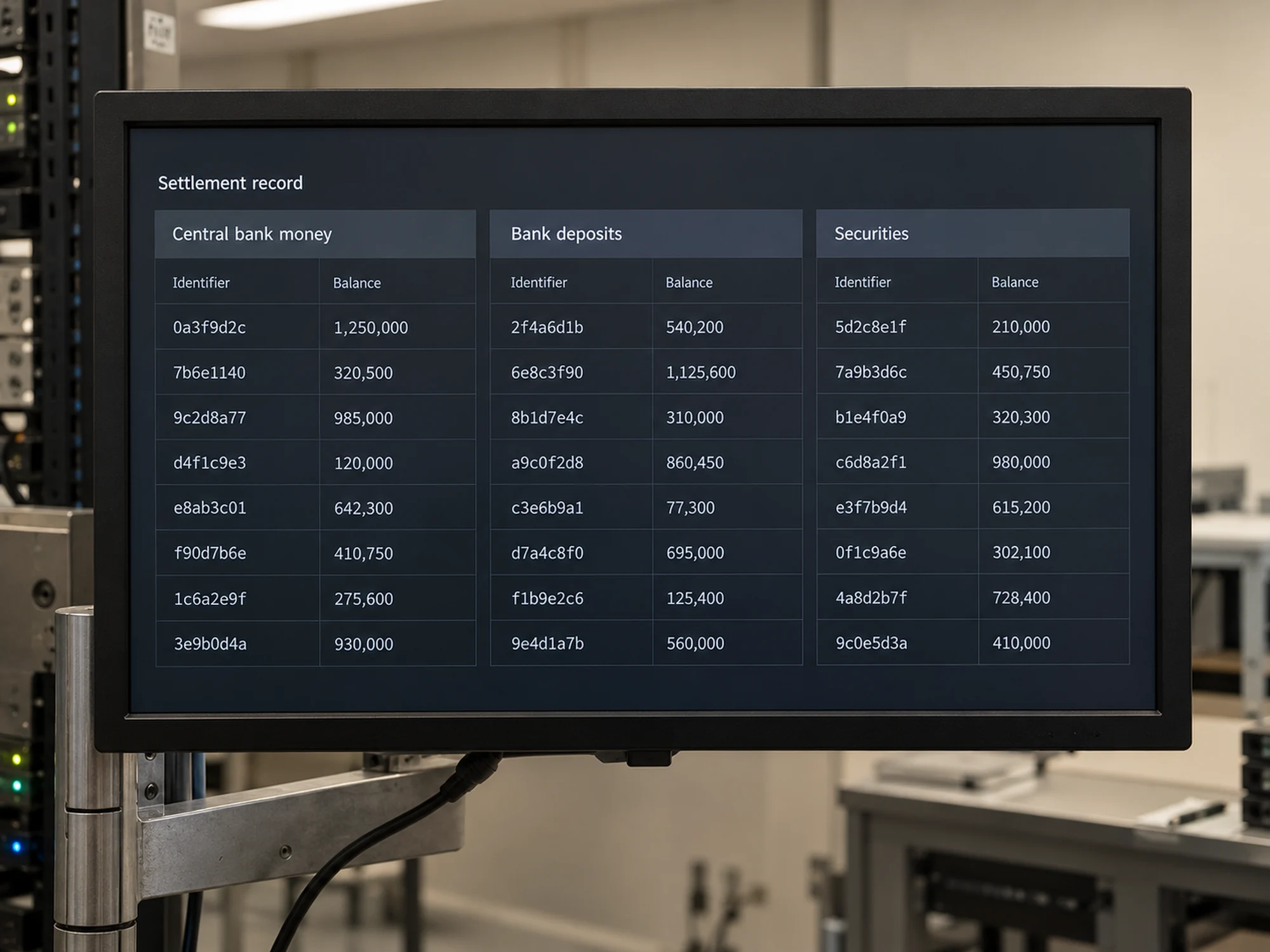
On-chain vs off-chain settlement
In off-chain settlement the trade is agreed in one place and the transfer happens elsewhere: on the books of a central securities depository, in a payment system such as TARGET, or in the internal ledger of an exchange or custodian that moves balances between its own clients. Many crypto trades settle off-chain in this sense, because both sides hold their coins at the same exchange or custodian, and only deposits and withdrawals touch the blockchain.
In on-chain settlement every transfer is a transaction on the blockchain itself. That removes the reconciliation between the trading record and the settlement record, and it ties the transfer to the fees, the confirmation time and the finality rules of the network.
Finality on a blockchain
Settlement finality is the moment from which a transfer can no longer be reversed. In the EU the Settlement Finality Directive protects transfer orders in designated payment and securities settlement systems against later insolvency proceedings. A public blockchain reaches finality in its own way: on Bitcoin each new block makes a reversal less likely, and many firms wait for six confirmations, about one hour, while Ethereum finalizes blocks after two epochs, about 13 minutes.
A permissioned ledger run by a bank or a market infrastructure defines finality in its rulebook, like any other settlement system. The DLT Pilot Regime of the EU lets market infrastructures run trading and settlement of tokenized securities on such ledgers under supervision.
Delivery versus payment on a blockchain
Delivery versus payment means that the asset moves only if the payment moves. On a single blockchain a smart contract can bind both legs into one transaction, so either both complete or neither does, which is called atomic settlement. The cash leg then needs money on the same ledger, such as a stablecoin, a tokenized deposit or central bank money.
When the asset and the cash sit on different ledgers, a bridge, a trusted coordinator or a central bank system has to link the two legs. The ECB launched Pontes on 21 September 2026 as the Eurosystem service that settles transactions on DLT platforms in central bank money. Appia is the longer-term project of the Eurosystem for the same purpose.
Controls before an on-chain transfer
A confirmed transfer to a wrong address is lost unless the recipient sends it back, so firms put their controls into the steps before a transaction is signed:
- Whitelisting: assets go only to addresses that were checked and approved in advance.
- Ownership checks: the counterparty proves control of its address with a small test transfer or a signed message.
- Change management: a new or changed address waits for a set delay and a call-back to a known contact.
- Approval rules: several people approve each transfer through multi-signature or MPC wallets.
For transfers of more than 1,000 euros to or from a self-hosted wallet, the EU travel rule requires a crypto-asset service provider to verify that its client owns or controls that address.
Upcoming events on digital assets and payments
On-chain settlement for funds
A fund that settles its crypto trades on-chain gets a record that its depositary can verify directly on the ledger. The depositary still needs the link between each address and its legal owner, which only the custodian and the records of the fund provide. Tokenized funds go one step further and settle subscriptions and redemptions on-chain against stablecoins or tokenized deposits, which shortens the time between an order and the issue of new units.
Which markets settle on-chain?
Crypto-assets settle on-chain whenever they leave an exchange or a custodian, and stablecoin payments between companies settle on public blockchains around the clock. Tokenized bonds, money market fund units and repo transactions settle on permissioned or public ledgers, partly under the DLT Pilot Regime. Since the launch of Pontes, participants in the euro area can settle such transactions in central bank money.
On-chain settlement and Finance Loop
Finance Loop brings settlement, custody and payments teams of banks and market infrastructures together at its events in Germany, Austria and Switzerland. Settlement on distributed ledgers belongs to the Digital Infrastructure & Sovereignty track of Finance Loop.
Finance Loop is a professional network and has the goal of driving the institutional use of emerging technologies in finance, such as AI, digital payments, cloud and blockchain solutions. Finance Loop helps its members build skills and personal networks in these fields: Investment & Digital Assets, Payments & Digital Money, Digital Infrastructure & Sovereignty, and Risk & Compliance.