
Tokenized ETFs
An exchange-traded fund is a fund whose shares trade on an exchange like a stock; in Europe most are UCITS funds bought through a bank or broker and held in a securities account. A tokenized ETF moves the share, or a claim that tracks it, onto a blockchain. The term covers two very different products, and an investor or a bank that distributes them needs to know which one it is dealing with. Dated events on the topic are in the calendar below.
Two products under one name
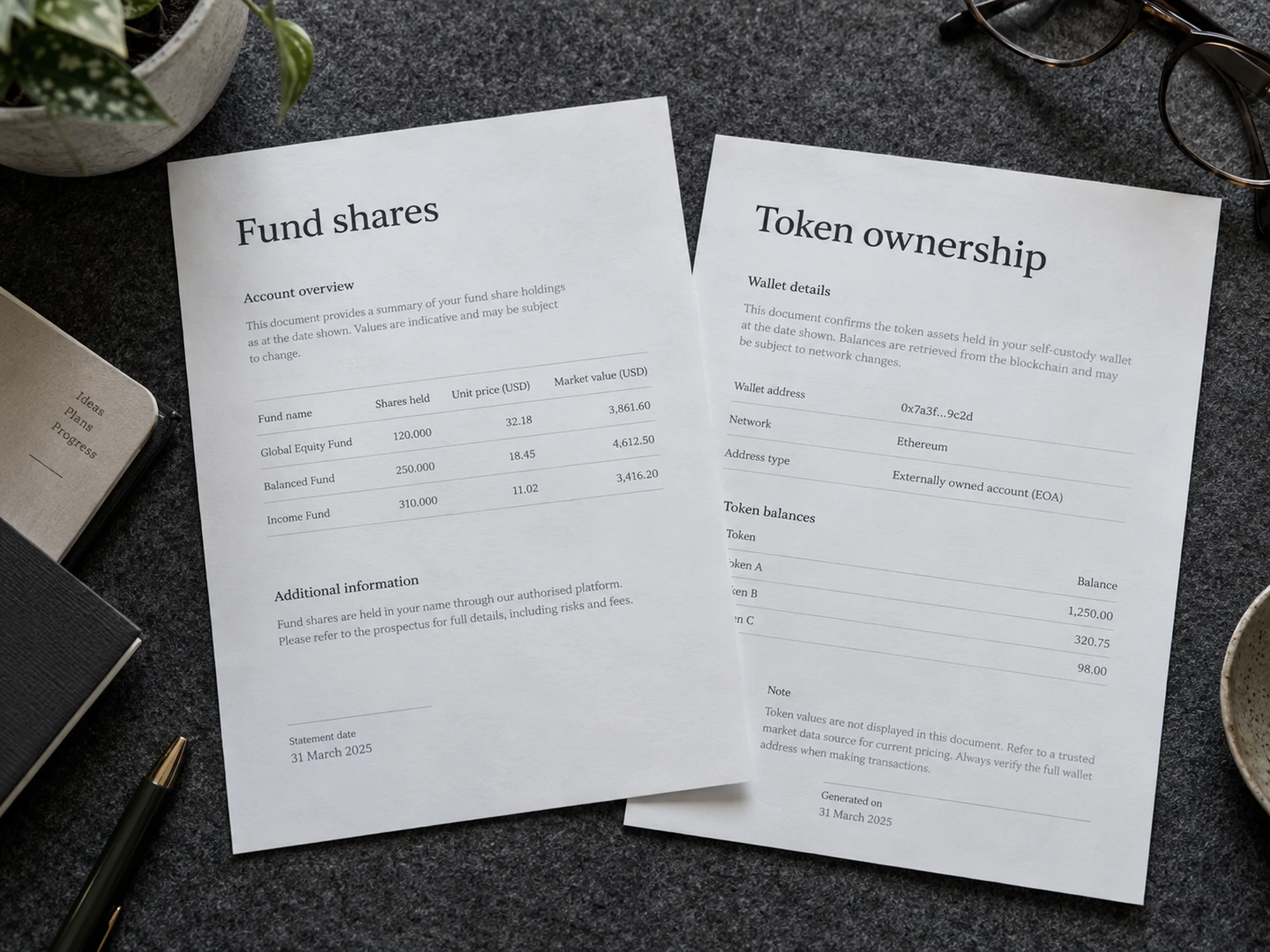
Chainlink separates the regulated tokenized ETF, where the token represents legal ownership of shares in a fund that holds stocks or bonds, from the synthetic tokenized asset, which tracks an ETF price through derivatives or collateral and does not always give ownership of the fund shares. The fund portfolio and its manager stay the same in the first case. In the second, the investor holds a claim on the token issuer.
The European ETF portal justETF writes in its guide to tokenised ETFs that holders of synthetic products have no ownership or voting rights and none of the investor protection of a mainstream ETF, such as compensation schemes. It lists counterparty risk on the derivative provider, wider spreads, prices that drift from the underlying market when that market is closed, and the risks of wallets and exchanges.
Tokenized ownership of fund shares
For a regulated product, the token replaces the record in the transfer agent's or depository's register, or runs next to it. Chainlink names trading around the clock, settlement in which asset and payment move in one step, fractions of a share and transfer checks for investor identification built into the token. An asset manager places the securities with a qualified custodian, and a technology provider issues the tokens.
The closest step in Europe so far came from the money market side. On August 4, 2026, BlackRock launched 12 tokenized share classes across six of its Institutional Cash Series funds, issued on Ethereum through Kinexys by J.P. Morgan, as Treasury Management International reported. The official shareholder register stays with the fund's transfer agent, and transfers are limited to approved investor wallets. For tokenized money market funds, the fund-tokenization model determines how approved investors transfer their shares.
The rules in the EU
A tokenized share of a UCITS fund is a fund unit and stays under the UCITS rules and MiFID II. MiCA does not apply to it, because MiCA excludes financial instruments. A synthetic tracker token is a different product: depending on its structure it is a certificate or a derivative under securities law, or a crypto-asset under MiCA, and the investor carries the issuer risk in each case. Trading venues for tokenized securities can operate under the DLT Pilot Regime, whose limit for UCITS funds is 500 million euros under management.
Upcoming events on investment and digital assets in Germany
Finance Loop and tokenized ETFs
The ETF investing page covers the classic ETF market in Germany. Finance Loop has a strategic cooperation with 21X, the Frankfurt venue that trades and settles tokenized securities, and the Multichain Asset Managers Association, which works on on-chain asset management, is an event and network partner of Finance Loop.
Investment & Digital Assets
Risk & Compliance
What is a tokenized ETF?
Either a share of a real ETF recorded as a token on a blockchain, or a token that tracks the price of an ETF through derivatives or collateral. Only the first gives ownership of fund shares.
Are tokenized ETFs available in Europe?
Tracker tokens on ETFs are offered on crypto platforms. Tokenized share classes of European UCITS funds exist so far mainly for money market funds, such as the BlackRock share classes launched on August 4, 2026.
Does MiCA apply to a tokenized ETF?
Not to a tokenized fund unit, which is a financial instrument under MiFID II and the UCITS rules. A tracker token can fall under MiCA if it is not a financial instrument.
What is the main risk of a synthetic tokenized ETF?
The investor depends on the issuer and the derivative provider, has no ownership or voting rights in the fund, and lacks the investor protection of a regulated ETF.
Tokenized ETFs and Finance Loop
Finance Loop covers tokenized ETFs in its Investment & Digital Assets track, next to tokenized funds, tokenized stocks and ETF investing. Finance Loop brings people from asset managers, banks, brokers and tokenization platforms together at events in Frankfurt, Munich, Berlin and Hamburg.
Finance Loop is a professional network and has the goal of driving the adoption of emerging technologies in finance, such as AI, digital payments, cloud and blockchain solutions. Finance Loop helps its members build skills and personal networks in these fields: Investment & Digital Assets, Payments & Digital Money, Digital Infrastructure & Sovereignty, and Risk & Compliance.