
Chainlink
Banks and asset managers that move a fund or a payment onto a blockchain still need the same numbers they used off-chain: a price, a reserve balance, a net asset value. Chainlink is an oracle network that carries that data onto a blockchain so a smart contract can read it. Swift, DTCC and asset managers such as Franklin Templeton have tested it with fund data for tokenized funds and with transfers of tokenized assets between blockchains.
Why banks need an oracle before they need crypto
A blockchain only knows what a transaction writes to it. A smart contract that manages a tokenized bond cannot call a bank's pricing system or read a fund administrator's spreadsheet on its own; every node on the chain has to compute the same result from the same input, and an outside system can answer two nodes two different ways. This limit has a name, the blockchain oracle problem, and Finance Loop's answer on blockchain oracles covers it in more depth. An oracle network closes the gap: it fetches a value such as a price, an exchange rate or a fund's net asset value from outside sources, and it writes that value to the chain so every contract reads the same number.
Chainlink describes itself as the oracle platform that brings capital markets onchain, and its network connects blockchains to real-world data, other blockchains, and public sector and enterprise systems. Before a bank moves a bond, a fund or a payment instruction onto a blockchain, it needs that data connection in place, which is why Chainlink's work starts in classic finance and extends into DeFi from there, not the other way around.
Data Feeds: prices onchain
Chainlink Data Feeds deliver price data to smart contracts. A lending protocol reads a feed to value the collateral behind a loan; a derivatives platform reads one to settle a contract. Chainlink states that the feeds are tamper-proof: several independent node operators pull a price from several data sources and aggregate it before it reaches the chain, so one bad source or one dishonest node does not set the reported price on its own.
CCIP: moving tokens and messages across chains
The Cross-Chain Interoperability Protocol (CCIP) lets a token or a data message move from one blockchain to another through Chainlink's network, instead of through a separate bridge for every chain pair. Chainlink introduced CCIP 2.0 in 2026, built, in Chainlink's own description, to meet institutional security, compliance and risk requirements. Swift, the global bank messaging network, used CCIP as the interoperability layer in its own tokenization experiments, described below.
Data Streams: prices for fast-moving markets
Chainlink Data Streams deliver low-latency market data, verified onchain but sent offchain first so an application only pays for the data it uses. Chainlink built the product for markets where a price changes faster than a standard onchain feed updates, such as perpetual futures trading.
Proof of Reserve: checking what backs a token
Chainlink Proof of Reserve verifies that the onchain supply of a token matches the reserves held to back it, off-chain or on another chain. A stablecoin issuer or a tokenized commodity fund can publish this check so that a holder, or a smart contract that accepts the token as collateral, reads the reserve figure directly instead of trusting a periodic attestation report alone.
VRF: randomness a smart contract can prove
Chainlink VRF, the Verifiable Random Function, gives a smart contract a random number together with cryptographic proof that the number was not manipulated. A lottery, a raffle among fund investors or an NFT mint uses VRF so that every participant can check the draw was fair after the fact.
Automation: contracts that trigger themselves
Chainlink Automation runs a smart contract's function automatically once a condition is met, such as rebalancing a vault at a set time or liquidating a loan once its collateral ratio crosses a threshold, without a person or a server sending the transaction by hand.
Functions: calling any API from a smart contract
Chainlink Functions lets a smart contract request data from any Web API and run custom off-chain computation, then bring the result back onchain. A developer who needs one specific figure, not a standing price feed, uses Functions instead of building a new oracle for it.
Chainlink and tokenized assets: Swift and DTCC
Chainlink's work with Swift, the network banks use to send payment messages, tested whether a bank could move a tokenized asset across several public and private blockchains through its existing Swift connection instead of opening a separate link to each chain. The experiments, run with banks including ANZ, BNP Paribas, BNY Mellon and Citi, plus the market infrastructures Euroclear, Clearstream and DTCC, used Chainlink as the connection point into the Swift network and CCIP to carry the transfer on to the destination chain.
With DTCC, the US clearing organization that reports processing more than two quadrillion US dollars a year, Chainlink built Smart NAV: a way to publish a fund's net asset value once through a single CCIP connection and make it available on any of several public and private blockchains. Asset managers named in the pilot include Franklin Templeton, Invesco, JPMorgan and State Street. A tokenized fund that publishes its NAV this way lets a lending protocol or a settlement system on any connected chain read the same figure DTCC calculated, without a separate data feed per chain.
Upcoming blockchain and digital asset events
Chainlink news
Chainlink Introduces CCIP 2.0: the update carries stricter security, compliance and risk controls built for institutional use of cross-chain transfers.
Swift Selects Chainlink as a Winner of the Swift Hackathon: Swift picked a Chainlink-built submission among the winning entries of its hackathon on bank connectivity to blockchains.
Chainlink: The End-to-End Interoperability Standard Required To Scale Tokenization: the post sets out how CCIP and Chainlink's other services combine to move a tokenized asset across chains and into existing bank systems.
How Chainlink Enables Onchain Golden Records for Tokenized Assets: the post explains how Chainlink keeps one authoritative record of an asset's data available across every chain that asset is issued on.
Chainlink's Work With Major Banking and Capital Markets Institutions: an overview of the bank and market infrastructure projects that use Chainlink, including the Swift experiments and the DTCC Smart NAV pilot.
Investment & Digital Assets
Risk & Compliance
What does Chainlink actually do?
Chainlink runs a network of independent node operators that fetch data such as prices, exchange rates or fund values from outside sources, agree on one value, and write it to a blockchain. A smart contract on that chain then reads the value the same way every other contract does, without connecting to the original data source itself.
Is Chainlink the same as an oracle?
Chainlink is one oracle network among several; Finance Loop's page on blockchain oracles also names Pyth and RedStone as operators of oracle networks. "Oracle" is the general term for a service that delivers outside data to a blockchain; Chainlink is a specific provider of that service.
What is Chainlink CCIP used for?
CCIP moves tokens and data messages from one blockchain to another through Chainlink's network. Swift used it as the interoperability layer in its bank tokenization experiments, and DTCC uses it to publish a fund's net asset value to several chains from a single connection.
Does Chainlink work with banks?
Yes. Chainlink's own blog names banks and market infrastructures including Swift, DTCC, Euroclear, Clearstream, BNY Mellon, Citi and BNP Paribas among the institutions it has worked with on tokenization and cross-chain data projects.
Related pages
Blockchains and firms that use Chainlink
Oracles and market data
Chainlink and Finance Loop
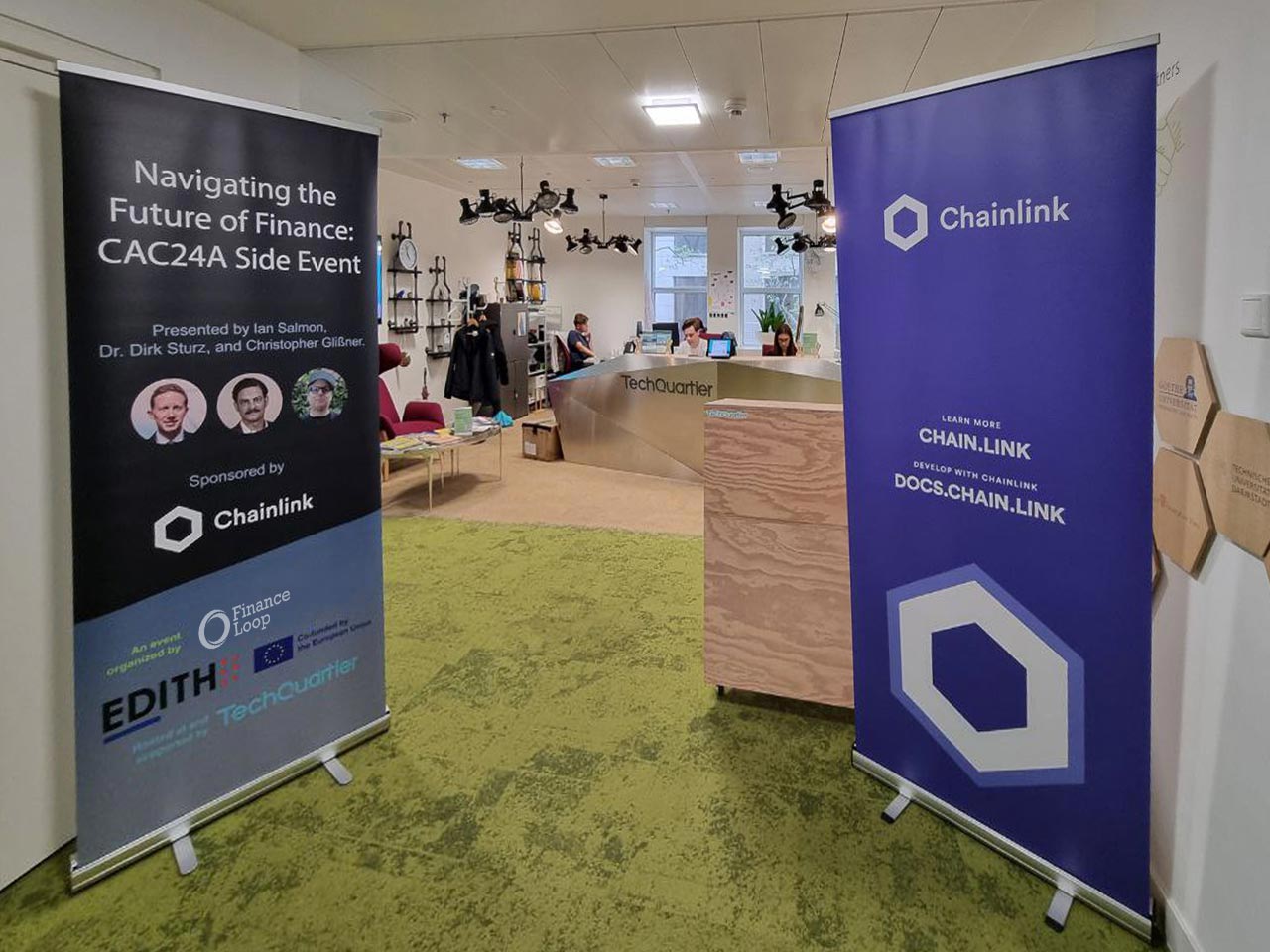
Chainlink sponsored Navigating the Future of Finance, a panel Finance Loop ran with TechQuartier in Frankfurt in April 2024, where Chainlink Labs capital markets advisor Ian Salmon spoke alongside FinPlanet and a Chainlink Community Advocate from Deutsche Telekom about decentralized oracle networks and capital markets. Finance Loop's report on the panel describes the evening, a pre-event of CAC 2024. Chainlink is also listed among Finance Loop's event and network partners. Chainlink Labs later joined the panel of Tokenization & On-Chain Capital Markets, a Point Zero Forum side event in Zurich, alongside 21X, Franklin Templeton, DFNS and AMINA, on tokenized asset infrastructure. Oracle networks sit in Finance Loop's Investment & Digital Assets track.
Finance Loop is a professional network and has the goal of driving the adoption of emerging technologies in finance, such as AI, tokenization, stablecoins, and DeFi.