
Tokenization in Germany
This page explains how tokenization of securities works under German law, which banks, exchanges and fintechs issue tokenized bonds, fund units and shares, and what BaFin requires from them. It also shows where people who work on tokenization in Germany meet. Dates of upcoming events are in the calendar further down.
What tokenization means in German finance
Tokenization of assets means that a bond, a fund unit or a share exists as an entry on a distributed ledger instead of a paper certificate in a vault. Ownership moves when the entry moves. The word has two other meanings that show up in the same searches: in card payments a token replaces the card number (see tokenization in payments), and in AI a language model splits text into tokens. This page is about assets.
In Germany the legal basis is the Electronic Securities Act (Gesetz über elektronische Wertpapiere, eWpG). It lets an issuer create a security without a paper global certificate and enter it in one of two registers: a central register kept by a central securities depository or a custodian bank, or a crypto securities register under section 16 of the act, which in practice runs on a blockchain. A security in a crypto securities register is a crypto security. It is a security in the full legal sense, so securities law, prospectus rules and MiFID II investor protection apply to it as they apply to a paper bond.
Crypto securities registers and BaFin
Keeping a crypto securities register is a financial service. A company that does it needs a BaFin license under section 32 of the Banking Act, and BaFin checks the register against the eWpG and the regulation on electronic securities registers (eWpRV). The register keeper can be the issuer itself or a third party. Cashlink is one such third party: it holds licenses as a crypto securities registrar and as a crypto custodian, and registers token-based bonds, funds and structured products for issuers.
Shares came later. The Future Financing Act (Zukunftsfinanzierungsgesetz) amended the Stock Corporation Act and the eWpG so that a stock corporation can issue electronic shares. Registered shares may go into a crypto securities register when the articles of association allow it; bearer shares may only go into a central register. This is what most people mean when they search for tokenized stocks in Germany: the real share of a German company, issued on a ledger, and no tracker token issued by a third party.
Companies that issue and build tokenized securities in Germany
Siemens issued a one-year digital bond of 60 million euros on a public blockchain under the eWpG and sold it directly to investors, without a paper global certificate or central clearing. Hauck Aufhäuser Lampe kept the register, and DekaBank, DZ BANK and Union Investment bought the bond. For real estate, BaFin approved a blockchain-based bond of the Fundament Group with a volume of 250 million euros on Ethereum, backed by properties in Berlin, Hamburg, Rostock, Jena and Fulda.
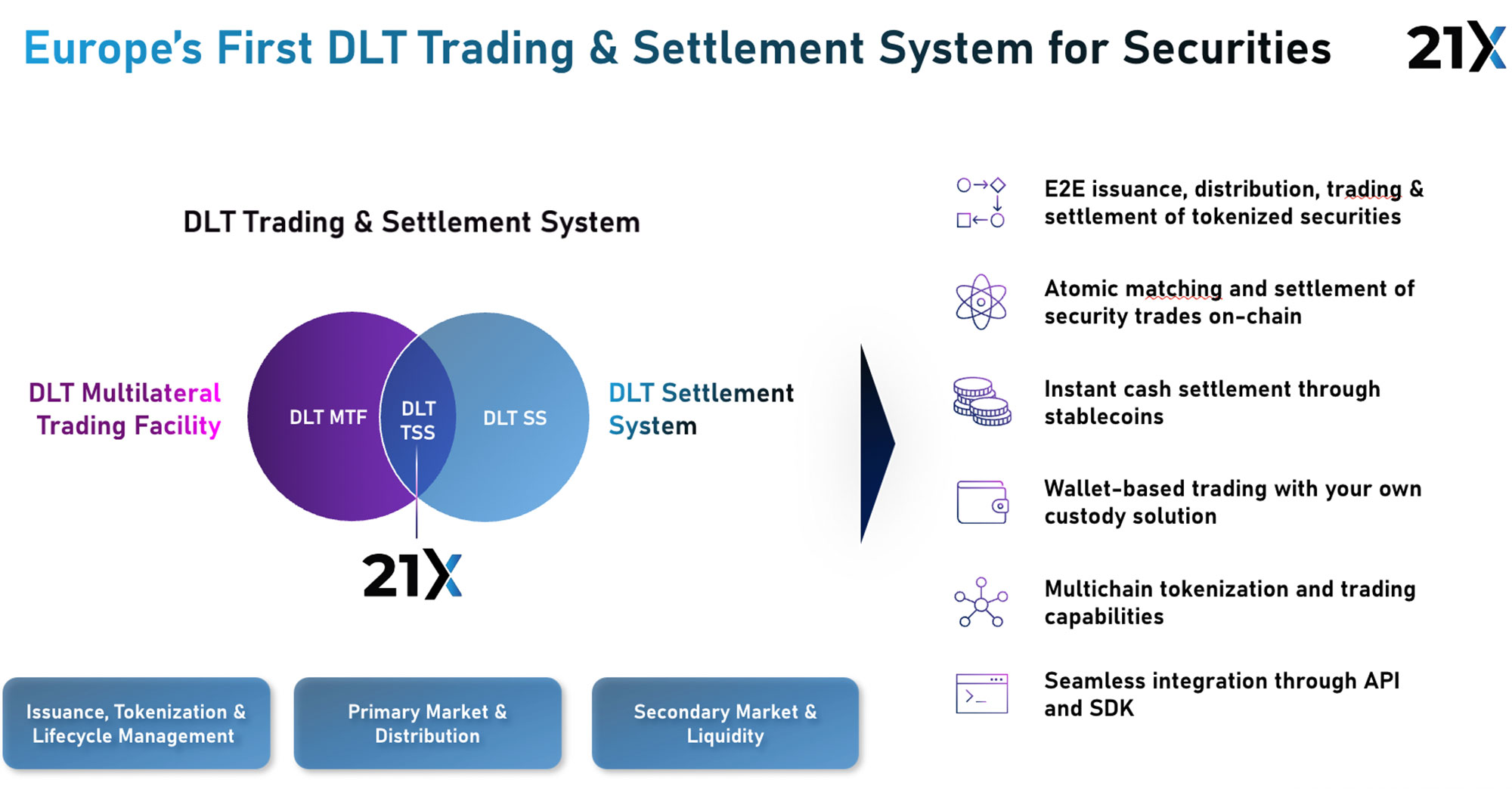
Clearstream, the post-trade arm of Deutsche Börse Group, runs D7 DLT for tokenized securities under the central securities depositories regulation, with commercial paper and medium-term notes as the first expected issues. 21X holds a BaFin license under the EU DLT Pilot Regime for a trading and settlement venue for tokenized securities. Gubbi AG runs the GDX Primary Market, which brings tokenized real-world assets to financial advisers through Fondskonzept AG.
Start-ups use tokens for their own equity. tokenize.it lets German start-ups raise money and run employee participation plans with the same fungible token, with tickets from 50 euros and without a notary for each investor.
What people in tokenization deal with right now
A tokenized bond needs a payment leg, and it settles fastest when the money also moves on a ledger. The Eurosystem runs Pontes, which links market DLT platforms with TARGET Services so that wholesale DLT transactions settle in central bank money, either with cash tokens on the Eurosystem ledger or through T2. Banks also look at tokenized deposits and euro stablecoins under MiCA for the same job.
Other daily topics are the choice between a central and a crypto securities register, custody of the private keys (a license of its own, see crypto custody), secondary trading, which needs a venue such as a DLT trading facility, and distribution: most private investors in Germany buy through banks and advisers, so a tokenized product has to fit their systems. If you move into this field from a bank or an asset manager, learn the eWpG and the difference between issuance and trading first.
Upcoming tokenization events in Germany
Finance Loop, the meeting place for tokenization in Germany
Finance Loop is the meeting place for people who work on tokenization at German banks, asset managers, exchanges, law firms and fintechs. It connects the finance, IT and AI communities, with events in Frankfurt and also in Munich, Berlin and Hamburg.
Finance Loop has been a partner of the Crypto Assets Conference of Frankfurt School and Deutsche Börse, where tokenization and market infrastructure take up much of the program, and of the Forum für Digitale Vermögenswerte, a German-language forum on tokenized securities, digital custody and MiCAR. Before one Crypto Assets Conference, CoreLedger, Finemetal and S-Pro explained at a real-world asset evening at TechQuartier how to tokenize gold and real estate. Finance Loop also lists the Frankfurt Forum on Digital Assets & Applications by d-fine, with panels on DLT market infrastructure, and in Munich the Digital Assets Day of Bundesblock, whose topics include tokenization and real-world assets. All upcoming dates are on the events page.
Investment & Digital Assets
Payments & Digital Money
What is tokenization in banking?
In banking, tokenization means issuing or holding financial assets such as bonds, deposits or fund units as tokens on a distributed ledger. A German bank can act as issuer, as register keeper under the eWpG, as custodian of the keys or as buyer, as DekaBank and DZ BANK did with the Siemens bond. In card payments the same word means replacing a card number with a token.
What is the eWpG?
The eWpG is the German Electronic Securities Act. It allows securities without a paper certificate, entered either in a central register or in a crypto securities register on a blockchain. Running a crypto securities register needs a BaFin license. The act covers bonds and fund units and, since the Future Financing Act, registered shares.
Can real estate be tokenized in Germany?
Yes, usually through a security that pays out rent or sale proceeds, most often a bond under the eWpG. The investor holds a claim against the issuer, not a share of the land register entry. The Fundament bond, backed by properties in five German cities, was the first blockchain-based real estate bond BaFin approved.
Are there tokenization meetups and events in Germany?
Yes. Frankfurt has the Crypto Assets Conference and evening meetups at TechQuartier, and Munich has the Digital Assets Day during the TUM Blockchain Conference. For a tokenization meetup in Frankfurt or Berlin, check the events calendar and the meetups page.
Tokenization and Finance Loop
Finance Loop brings together people from banks, asset managers, exchanges and fintechs who issue, register, hold and trade tokenized securities in Germany, Austria and Switzerland. At Finance Loop events they compare notes on the eWpG, custody and settlement.
Finance Loop is a professional network and has the goal of driving the adoption of emerging technologies in finance, such as AI, tokenization, stablecoins, and DeFi. Finance Loop helps its members build skills and personal networks in these fields: Investment & Digital Assets, Payments & Digital Money, and Risk & Compliance.