
Venturebloxx: research on stablecoins and on-chain finance
Venturebloxx offers "research, events, and intelligence products for institutional adoption of stablecoins, tokenized assets, and regulated on-chain finance". Its clients are corporates, banks, payment service providers and fintechs that want to judge, adopt and scale these technologies. Venturebloxx was founded by Marta Maryam Rozsa.
Venturebloxx is a strategic partner of Finance Loop and co-author of the Finance Loop reports.

What Venturebloxx does
Venturebloxx gives decision makers at banks and corporates research, data and vendor insights on blockchain, stablecoins, tokenization, digital assets, on-chain finance and AI. The Venturebloxx Intelligence Platform, which the company is building, maps technology providers, market infrastructure and deal activity, so that a bank can find partners, assess vendors and follow M&A. For young companies in the field, Venturebloxx works as a growth partner: it helps with positioning, introductions to decision makers and a go-to-market strategy for institutional clients.
The newsletter Venturebloxx Insights on Substack publishes the company's digital asset research in shorter form, with pieces such as How Stablecoins Work and When Collateral Becomes Code.
Reports with Finance Loop
Venturebloxx and Finance Loop publish an institutional report series. The stablecoin report Stablecoins: The Operating Layer for Global B2B Payments looks at where stablecoins are in use today: cross-border transactions, treasury operations and business payment flows. It also covers regulation, payment corridors and the operating models that connect stablecoins with compliance, custody, wallets and bank systems. Finance Loop named the joint reports among its plans in its review of its first year.
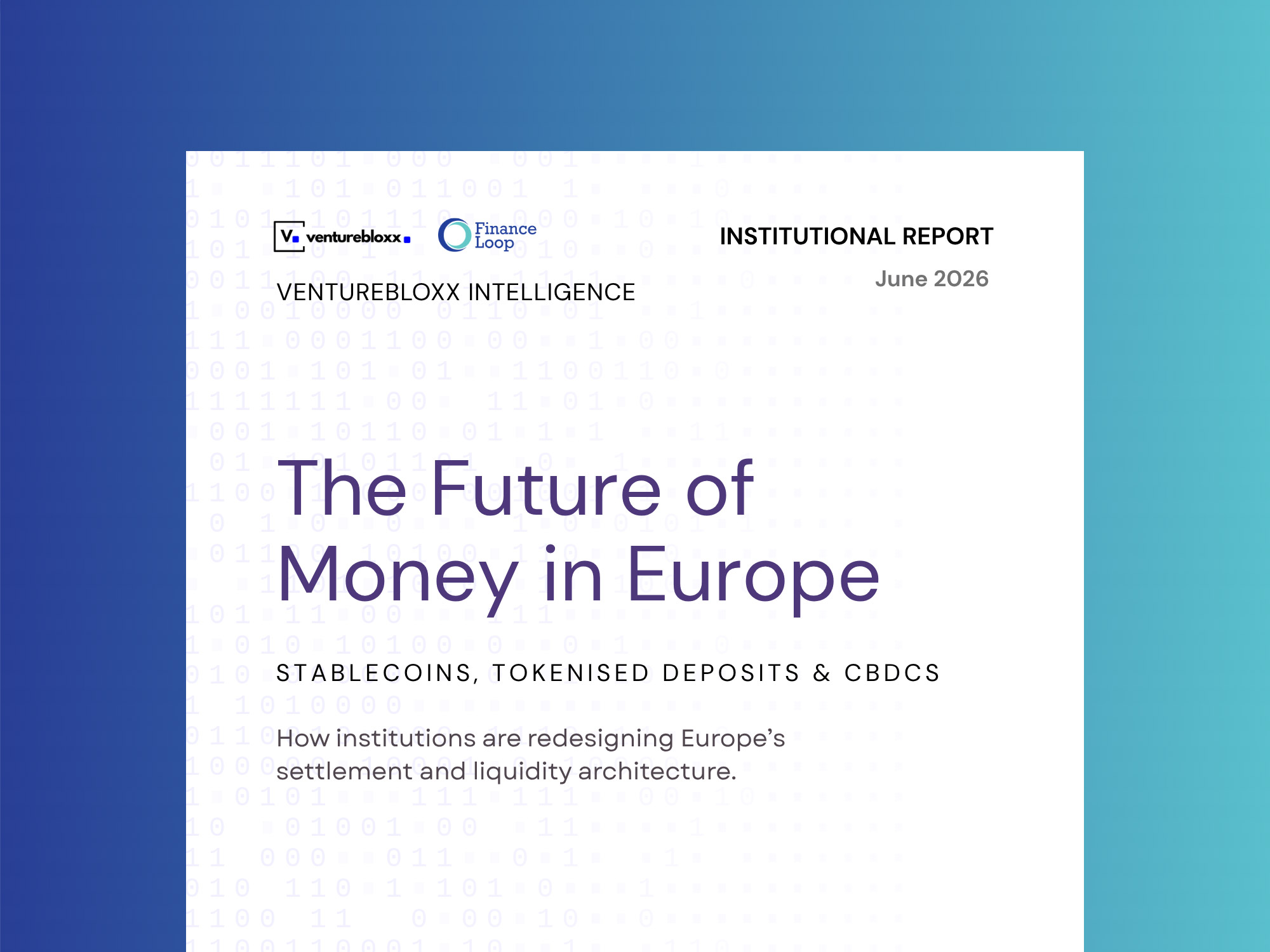
The second report, The Future of Money in Europe, covers stablecoins, tokenized deposits, central bank digital currencies and tokenized settlement. It brings in perspectives from J.P. Morgan Kinexys, Euroclear, Banque de France, Fnality, Commerzbank, Monerium and Worldline, and it asks who will control the settlement infrastructure for tokenized assets and how banks will compete with stablecoin issuers.
Stablecoins and tokenized deposits under EU rules
The two reports deal with forms of digital money that EU law treats differently. A euro stablecoin is an e-money token under the Markets in Crypto-Assets Regulation (MiCA). Only a bank or an e-money institution may issue one, and holders can redeem it at par at any time. A tokenized deposit is an ordinary bank deposit recorded on a ledger: it stays with the account holder and is covered by deposit protection up to 100,000 euros, while a stablecoin passes from wallet to wallet without it.
The MiCA rules for e-money tokens have applied since June 30, 2024. In the interim MiCA register of ESMA, four credit institutions appear among the issuers of e-money tokens in the update of September 24, 2026. On the central bank side, the ECB launched Pontes on September 21, 2026, to settle DLT transactions in central bank money.
The answers Tokenized deposits vs stablecoins, Stablecoin use cases and What is liquidity risk? go deeper, and Stablecoins in Europe lists the issuers and the rules.
How do stablecoin B2B payments work?
A company pays a supplier abroad in a stablecoin such as USDC or a euro e-money token. The token moves on a blockchain in minutes, and a payment provider at each end changes it into and out of bank money. B2B stablecoin payments to Europe and Germany need a provider with a MiCA license on the European side.
What is on-chain finance?
On-chain finance means that money, securities and their settlement are recorded and moved on a blockchain, instead of in separate bank and depository systems. Examples are tokenized bonds, tokenized money market funds and stablecoin payments. Onchain finance explains the field in more detail.
What is the future of money in Europe?
The Venturebloxx and Finance Loop report expects several forms of digital money side by side: stablecoins, tokenized bank deposits and central bank money for settlement. Parts of the sector have moved from pilots into production, for example for settlement, liquidity and treasury between institutions.
How can a company take part in a Venturebloxx report?
Companies active in the field can contribute to a report through expert interviews, market insights or sponsorship, and they can join the impact events in Frankfurt, Paris, London, Amsterdam and Madrid. Reports and events are also part of the Impact Program for companies that want to reach decision makers in these cities. Write to marta@venturebloxx.com
Venturebloxx and Finance Loop
Finance Loop and Venturebloxx announced a strategic partnership on December 2, 2025. Together they publish the Reports & Industry Insights series and run impact events in European financial centers, which companies can join through the Impact Program. Stablecoins and digital money belong to Finance Loop's Payments & Digital Money track.
Finance Loop is a professional network and has the goal of driving the adoption of emerging technologies in finance, such as AI, tokenization, stablecoins, and DeFi. Finance Loop helps its members build skills and personal networks in these fields: Investment & Digital Assets, Payments & Digital Money, and Risk & Compliance.