
Bitcoin Seminar Austria
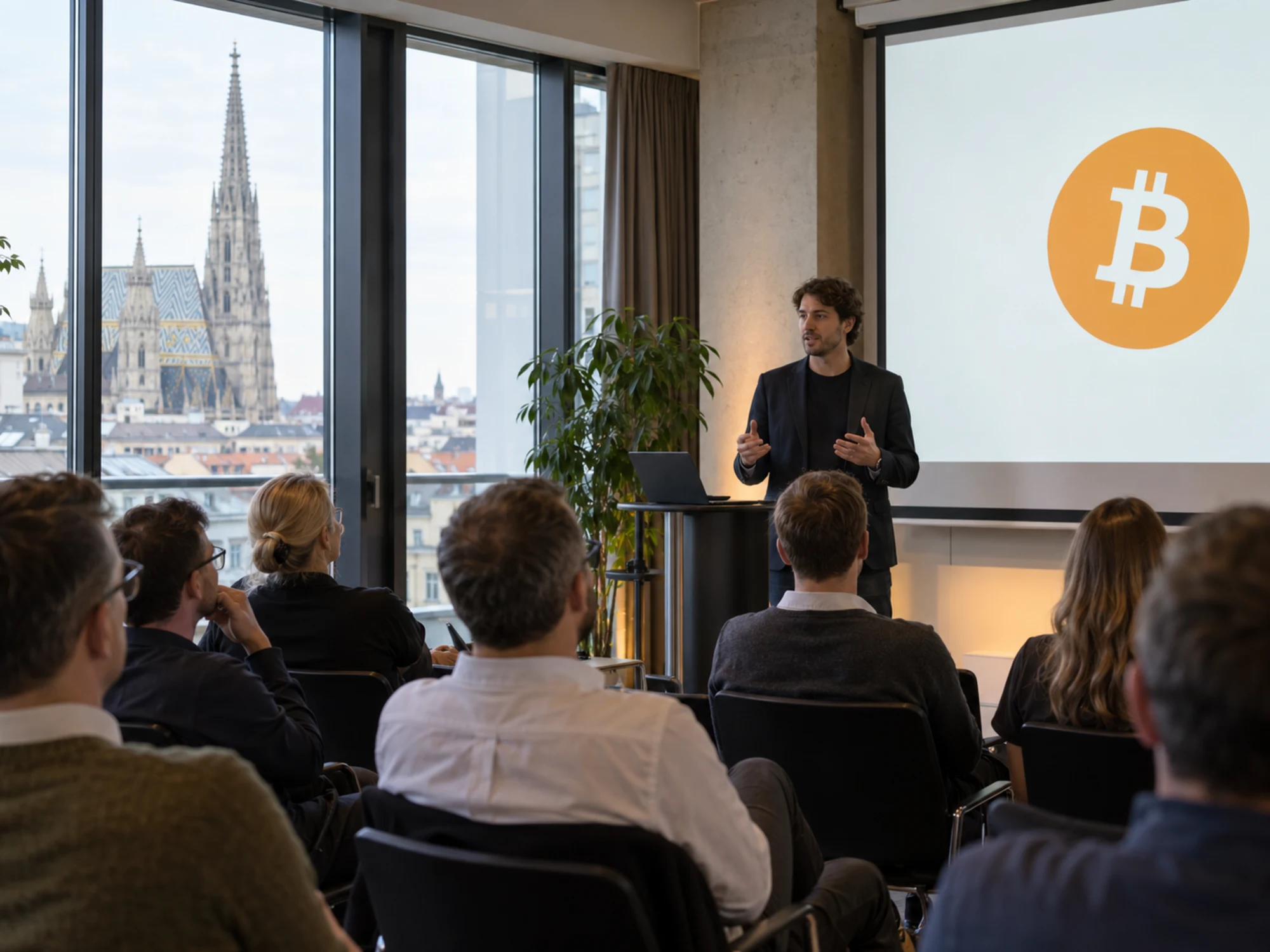
A Bitcoin seminar in Austria explains how Bitcoin works and what investors need to understand before holding it. Participants examine transactions, wallets and the distinction between owning coins directly and using an investment product. Bitcoin limits its total supply to 21 million coins, giving the asset a different issuance model from national currencies.
A seminar connects that technical foundation with the practical decisions involved in an investment. Custody arrangements, access to private keys and the possibility of large price movements affect how an investor holds Bitcoin. Austrian financial supervision and the European MiCA framework are also relevant when choosing a crypto service provider.
Why bitcoin is its own asset class
Bitcoin's supply is capped by its own code, not by a company or a central bank. The Bitcoin Core source rejects any amount above 21,000,000 BTC, and issuance follows a halving schedule that cuts the block reward roughly every four years until it reaches zero. That kind of fixed, rule-based scarcity has no equivalent in equities, government bonds or the euro, where the supply can grow through a new issue or a central bank's decisions. Bitcoin's fixed supply is the main reason allocators size bitcoin as its own line, separate from a broader crypto or technology allocation.
The U.S. Securities and Exchange Commission approved spot bitcoin ETFs on 10 January 2024, and the BlackRock iShares Bitcoin Trust alone held close to 67 billion US dollars in net assets by late September 2026. Under the EU's Markets in Crypto-Assets Regulation, Article 4(3)(b) waives the white paper duty for a crypto-asset created automatically as a reward for validating a distributed ledger, the way new bitcoin enters circulation, which sets it apart in EU law from a crypto-asset with a company behind it.
FMA supervision and MiCA in Austria
The Finanzmarktaufsicht (FMA) supervises crypto-asset service providers in Austria under MiCA since 30 December 2024. Providers that already offered crypto services before that date got a transition period, which Austria set to end by the close of 2025 at the latest, shorter than the 18 months MiCA allows member states to grant. A platform or custodian serving Austrian clients today needs either a MiCA license from the FMA or a passported license from another EU supervisor; bitcoin itself needs no issuer license, since crypto-assets without an identifiable issuer fall outside that duty; only the services around it, such as trading and custody, are licensed.
The travel rule adds a second layer that applies across the EU, Austria included: Regulation (EU) 2023/1113 requires a crypto-asset service provider to attach originator and beneficiary information to each transfer, in force since 30 December 2024. An Austrian investor moving bitcoin between licensed providers now goes through the same anti-money-laundering checks as a bank transfer.
How Austria taxes a bitcoin sale
Since 1 March 2022, Austria taxes income from cryptocurrency acquired after 28 February 2021 at a flat 27.5 percent, the same rate that applies to other capital income, under guidance from the Bundesministerium für Finanzen. Swapping one cryptocurrency for another is not a taxable event under this rule, only a sale into euro or another asset class triggers it. The legal basis sits in § 27b EStG 1988, which defines a cryptocurrency as a digital representation of value that no central bank or public authority issues or guarantees, and separates ongoing crypto income from realized gains.
That flat rate gives an Austrian investor a simpler starting point than the one-year holding-period test used in Germany, but it also means every disposal is taxable from euro one, with no equivalent of a small-gains exemption.
The risks a professional investor weighs
The same rules-based scarcity that makes bitcoin its own asset class also removes any mechanism to add supply when demand spikes, which is a direct driver of its volatility. An IMF note found that bitcoin showed little correlation with major stock indices before 2020, but that the correlation between bitcoin price volatility and S&P 500 volatility rose more than four-fold after the pandemic began, so it no longer diversifies a portfolio the way it once did.
The European Securities and Markets Authority warns that MiCA carries no investor compensation scheme for clients of crypto-asset service providers, so an investor whose provider cannot return the assets has no safety net comparable to deposit insurance. A BaFin survey from April 2026 found that most German crypto holders believed, wrongly, that bitcoin protects against inflation; BaFin points to bitcoin's volatility as the reason it does not, a finding that applies to Austrian investors as much as German ones.
Upcoming bitcoin seminars
Finance Loop and bitcoin for Austrian investors
Finance Loop is the meeting place for people who work on bitcoin and digital assets across Germany, Austria and Switzerland, and connects the finance, IT and AI communities with events in Frankfurt, Munich, Berlin and Hamburg. The Finance Loop Bitcoin for Investors seminar is built for investors, finance professionals and advisors who want a grounded case for bitcoin as an asset class, including custody models and how it fits a broader portfolio. Finance Loop has a long-term partnership with BTC-ECHO, the media platform for Bitcoin and blockchain in Germany, Austria and Switzerland.
Related pages: bitcoin in Germany, MiCA and crypto in Germany.
Investment & Digital Assets
Risk & Compliance
Does bitcoin need a license under MiCA?
Bitcoin itself does not need an issuer license under the MiCA framework. MiCA Article 4(3)(b) waives the white paper duty for a crypto-asset created automatically as a reward for validating the ledger, which covers how new bitcoin is issued. The license duty falls on the exchanges and custodians that trade or hold it for clients, which the FMA supervises in Austria.
How is a bitcoin sale taxed in Austria?
Income from cryptocurrency acquired after 28 February 2021 is taxed at a flat 27.5 percent since 1 March 2022, under § 27b EStG 1988. Swapping one cryptocurrency for another does not trigger tax; a sale into euro or into a different asset class does.
What should a new bitcoin investor learn first?
Investors should assess position size and custody arrangements before making a trade. Bitcoin's volatility means a small position by percentage can still move a portfolio's overall risk, and the choice between self-custody, a licensed exchange or a bank's custody service carries different risk profiles. The Finance Loop Bitcoin for Investors seminar works through position sizing, custody models and correlation with traditional assets in detail.
Bitcoin for Austrian investors and Finance Loop
Finance Loop is a professional network supporting the institutional use of emerging technologies in finance, such as AI, digital payments, cloud and blockchain solutions. Finance Loop helps its members build skills and personal networks in these fields: Investment & Digital Assets, Payments & Digital Money, Digital Infrastructure & Sovereignty, and Risk & Compliance.
Finance Loop connects the finance, IT and AI communities in Germany, Austria and Switzerland, with events in Frankfurt, Munich, Berlin and Hamburg. If you work on bitcoin or digital assets from Austria, you meet people from the same field at Finance Loop events.