
Bitcoin Seminar Switzerland
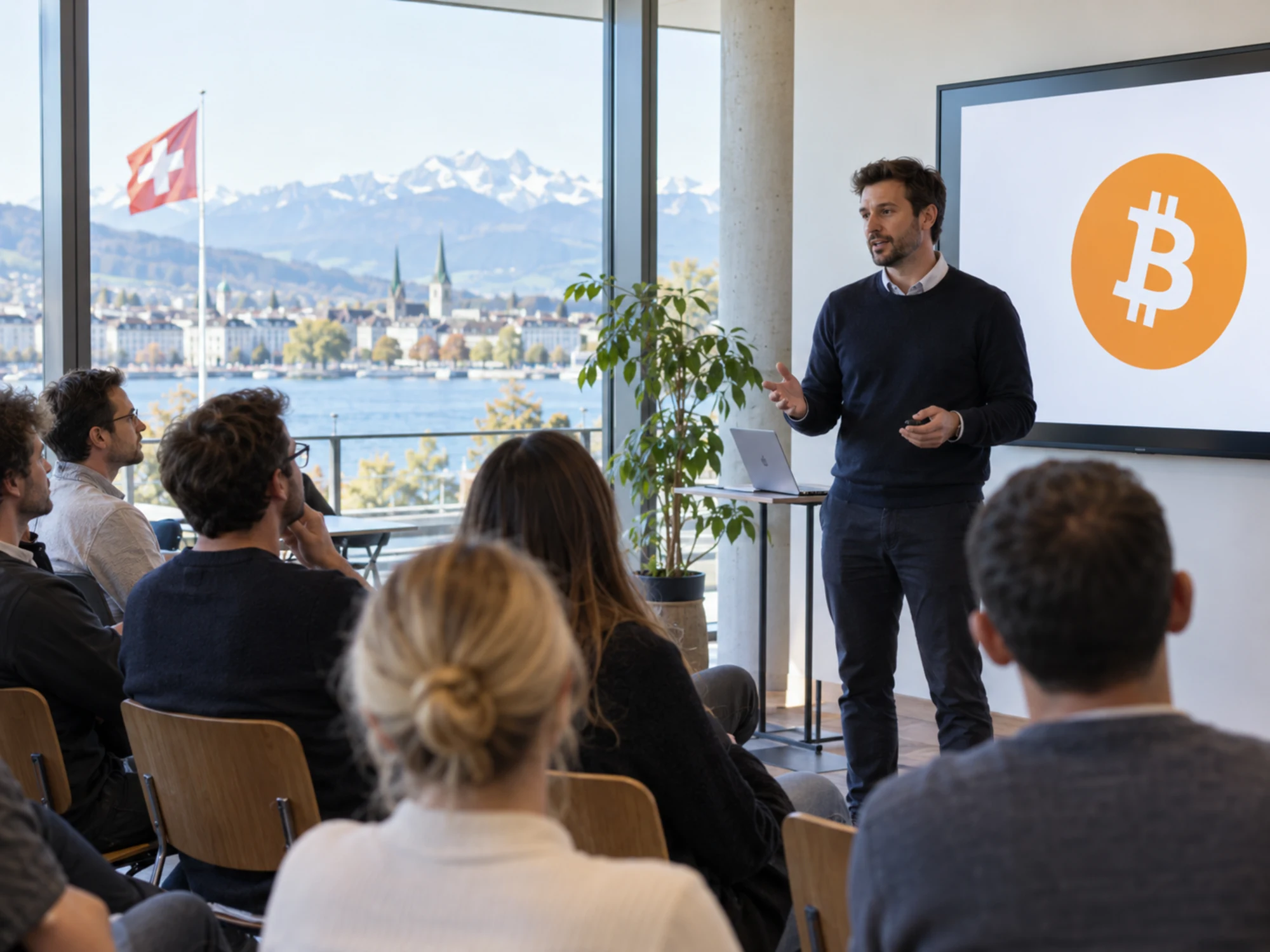
A bitcoin seminar in Switzerland explains how the digital currency works and how investors can hold it or gain exposure through a security. Bitcoin transactions are recorded on a shared ledger, and private keys control transfers of the coins. Understanding this ownership model helps investors distinguish direct ownership from a product held in a securities account.
Investors and advisors need to understand custody, price fluctuations and the legal structure of the service they use. Switzerland combines exchange-listed crypto products with bank and custody services, while FINMA distinguishes payment tokens from other token categories. The Swiss DLT Act also provides rules for separating eligible crypto assets from a custodian's bankruptcy estate.
Why bitcoin is its own asset class
Bitcoin's issuance follows rules written into its code, not a decision by a company or a central bank. The Bitcoin Core source sets the halving interval at 210,000 blocks, roughly four years, and rejects any total above 21,000,000 BTC. No other widely held asset, not a stock, a government bond or the Swiss franc, has a supply schedule fixed this way and enforced by thousands of independent nodes instead of a single issuer.
By June 2026, the SIX Swiss Exchange listed 384 crypto products, 217 of them crypto ETPs across 23 underlying assets, on the same regulated exchange that lists Swiss blue-chip equities. Bitcoin ETPs appear next to equity and bond ETFs on the same trading screen Swiss institutional investors already use.
FINMA token categories and the DLT Act
FINMA sorts crypto-assets into payment, utility and asset tokens. Bitcoin falls into the payment token category, which FINMA treats as "synonymous with cryptocurrencies": subject to anti-money-laundering rules, but not classed as a security. That distinction shapes which license a Swiss provider needs to offer bitcoin services, and it is why bitcoin trading in Switzerland runs through anti-money-laundering-regulated intermediaries, not securities dealers.
The Swiss DLT Act entered fully into force on 1 August 2021. The Swiss DLT Act created a license for DLT trading facilities and set rules for segregating crypto-based assets in the event of a custodian's bankruptcy, giving Swiss investors a legal basis for asset segregation that predates most other countries' crypto custody rules.
Who already offers bitcoin custody in Switzerland
Zürcher Kantonalbank offers bitcoin and ether trading and custody directly in its e-banking and mobile app, holding the private keys for clients itself; Thurgauer Kantonalbank became the first bank to use that service for its own clients. PostFinance opened crypto trading and custody to its customers on 21 February 2024, partnering with Sygnum and keeping custody inside Switzerland.
The risks a professional investor weighs
The absence of a central issuer that could smooth out supply also means demand shocks move the price with nothing to dampen them, which is the core of bitcoin's volatility. An IMF note found bitcoin showed little correlation with major stock indices before 2020, but that the correlation between bitcoin price volatility and S&P 500 volatility rose more than four-fold after the pandemic began.
The Basel Committee's standard for bank cryptoasset exposures, with an implementation date of 1 January 2026, puts bitcoin in Group 2, the category for unbacked crypto-assets, with a risk weight of up to 1250 percent and a total Group 2 exposure limit of 1 to 2 percent of a bank's Tier 1 capital. That treatment tells a Swiss investor how conservatively banks themselves are required to size any bitcoin exposure on their own balance sheet, a useful reference point for a portfolio allocation.
Upcoming bitcoin seminars
Finance Loop and bitcoin for Swiss investors
Finance Loop is the meeting place for people who work on bitcoin and digital assets across Germany, Austria and Switzerland, and connects the finance, IT and AI communities with events in Frankfurt, Munich, Berlin and Hamburg. The Bitcoin for Investors seminar from Finance Loop is for investors, finance professionals and advisors who want a grounded case for bitcoin as an asset class, including custody models and how it fits a broader portfolio.
Related pages: bitcoin in Germany and crypto in Germany.
Investment & Digital Assets
Risk & Compliance
How does FINMA classify bitcoin?
FINMA sorts crypto-assets into payment, utility and asset tokens. Bitcoin is a payment token, which FINMA describes as synonymous with cryptocurrencies generally: subject to anti-money-laundering rules but not treated as a security, unlike Switzerland's approach to some other token categories.
What does the Swiss DLT Act cover?
The DLT Act, fully in force since 1 August 2021, created a license category for DLT trading facilities and set rules for keeping crypto-based assets segregated from a custodian's own estate if that custodian becomes insolvent, a protection that predates equivalent rules in many other jurisdictions.
Can a Swiss bank hold bitcoin custody directly?
Zürcher Kantonalbank and PostFinance both offer bitcoin trading and custody through their own banking apps, with Zürcher Kantonalbank holding private keys itself and PostFinance partnering with Sygnum for custody kept inside Switzerland.
What should a new bitcoin investor in Switzerland learn first?
Custody and position sizing come before a trade. A Swiss investor now chooses between self-custody, a FINMA-supervised exchange, or a bank offering, each with a different mix of cost, control and legal protection under the DLT Act's segregation rules. The Bitcoin for Investors seminar from Finance Loop works through these choices, along with position sizing and correlation with traditional assets, in detail.
Bitcoin for Swiss investors and Finance Loop
Finance Loop is a professional network supporting the institutional use of emerging technologies in finance, such as AI, digital payments, cloud and blockchain solutions. Finance Loop helps its members build skills and personal networks in these fields: Investment & Digital Assets, Payments & Digital Money, Digital Infrastructure & Sovereignty, and Risk & Compliance.
Finance Loop connects the finance, IT and AI communities in Germany, Austria and Switzerland, with events in Frankfurt, Munich, Berlin and Hamburg. If you work on bitcoin or digital assets from Switzerland, you meet people from the same field at Finance Loop events.