
Crypto Compliance Training
A compliance officer trained on bank AML rules still has to learn a second layer before working on crypto: how a blockchain transaction differs from a wire transfer, what the travel rule requires at zero threshold in the EU, and how to read a wallet's history the way a colleague reads a bank statement. Crypto compliance training fills that gap, and it changes often, since the rules themselves are still being written.
What crypto adds on top of standard AML training
A general AML course covers customer due diligence, beneficial ownership and suspicious activity reporting, all of which still apply under the GwG and the incoming AML Regulation. Crypto compliance training builds on that base with topics a fiat-only course never touches: how the travel rule moves sender and recipient data between crypto-asset service providers, how blockchain forensics traces funds across wallets and exchanges, and how a self-hosted wallet changes the compliance picture compared with an account at a licensed custodian. The CASP license under MiCA also brings its own governance and risk-management requirements that a compliance officer moving into crypto needs to know cold.
The FATF Academy: training from the standard-setter itself
The FATF Academy offers on-demand online training directly from the Financial Action Task Force, the global body that set the original travel rule standard and extended it to virtual assets in 2019. Its course on virtual assets and virtual asset service providers explains the FATF Standards and how a country or a firm is expected to implement them, which makes it a useful starting point: the material comes from the body that wrote the rule, not from a commercial interpretation of it.
Where the rules keep moving: AMLR, AMLA and MiCA
Crypto compliance training has a short shelf life right now because the underlying law is still being finished. The AML Regulation applies fully from July 2027, and the new Anti-Money Laundering Authority, seated in Frankfurt am Main, still has roughly 23 technical measures to publish before then, most due by the middle of 2026. A training session that covered crypto AML a year ago may already be missing guidance AMLA has since issued, which is why compliance teams increasingly treat crypto training as an ongoing subscription, refreshed as new guidance lands, instead of a course taken once and filed away.
Who needs it, beyond the compliance department
Crypto compliance training is not only for dedicated AML officers. Relationship managers at banks that accept crypto-linked deposits, notaries who complete property sales funded by crypto proceeds, and treasury staff at companies holding crypto on their balance sheet all encounter compliance questions the training addresses, even though compliance is not their primary job. A short, focused session that explains source of funds documentation or the basics of KYC for crypto customers often serves this wider audience better than a full certification track built for specialists.
Upcoming events on compliance and digital assets
Finance Loop and crypto compliance training
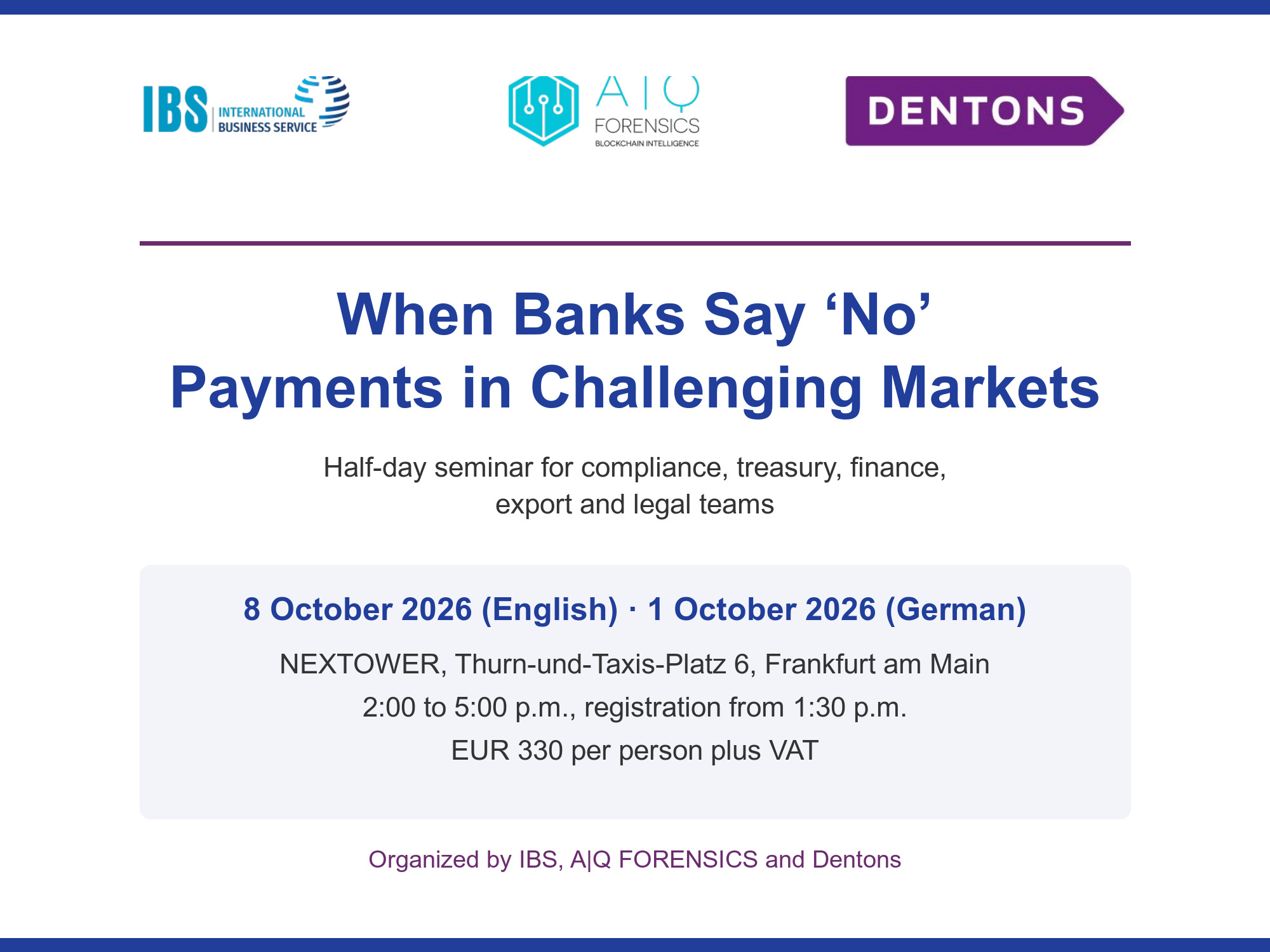
Finance Loop brings practical crypto compliance knowledge to its network through talks at events such as When Banks Say 'No' in Frankfurt, where Dr. Julia Pfeil of Dentons spoke on payments governed by sanctions and anti-money laundering law, and the Bybit EU Crypto Evening at TechQuartier, where compliance under MiCAR was the topic. For executives, EBS Executive School and the law firm HEUKING teach a German-language MiCAR program on the EBS campus in Oestrich-Winkel. Crypto compliance training sits in Finance Loop's Risk & Compliance track, next to crypto AML and KYC.
Risk & Compliance
Investment & Digital Assets
What does crypto compliance training cover?
Beyond standard AML topics, crypto compliance training covers the travel rule, blockchain transaction analysis, self-hosted wallet rules, and the licensing requirements of MiCA. Programs range from a short introductory session to a multi-day certification track for dedicated AML officers.
Who offers crypto compliance training?
The FATF Academy offers training directly from the body that set the global travel rule standard. Industry certification bodies and law firms also run courses focused on MiCA, the AMLR and travel rule implementation, aimed at compliance officers already familiar with general AML work.
How often should crypto compliance training be refreshed?
More often than general AML training, since crypto-specific EU rules are still being finalized. With the AML Regulation applying fully from 2027 and AMLA still publishing technical standards through the middle of 2026, a course taken a year earlier can already be missing current guidance.
Crypto Compliance Training and Finance Loop
Crypto compliance training shows up at Finance Loop's Frankfurt events as practical talks, most recently at When Banks Say 'No' and the Bybit EU Crypto Evening, where MiCAR compliance and payments law were both on stage. The topic sits in Finance Loop's Risk & Compliance track, alongside crypto AML and KYC.
Finance Loop is a professional network and has the goal of driving the adoption of emerging technologies in finance, such as AI, tokenization, stablecoins, and DeFi.