
Crypto ETF Staking
A bond fund earns a coupon while it holds the bonds, and the coupon costs it nothing in liquidity. A crypto exchange-traded product that stakes its holdings earns a reward too, and that reward does cost liquidity: the staked coins cannot be withdrawn on demand. The product's daily dealing promise and the network's unbonding period pull in opposite directions, and how an issuer splits the holding between them is the design decision behind every staking product.
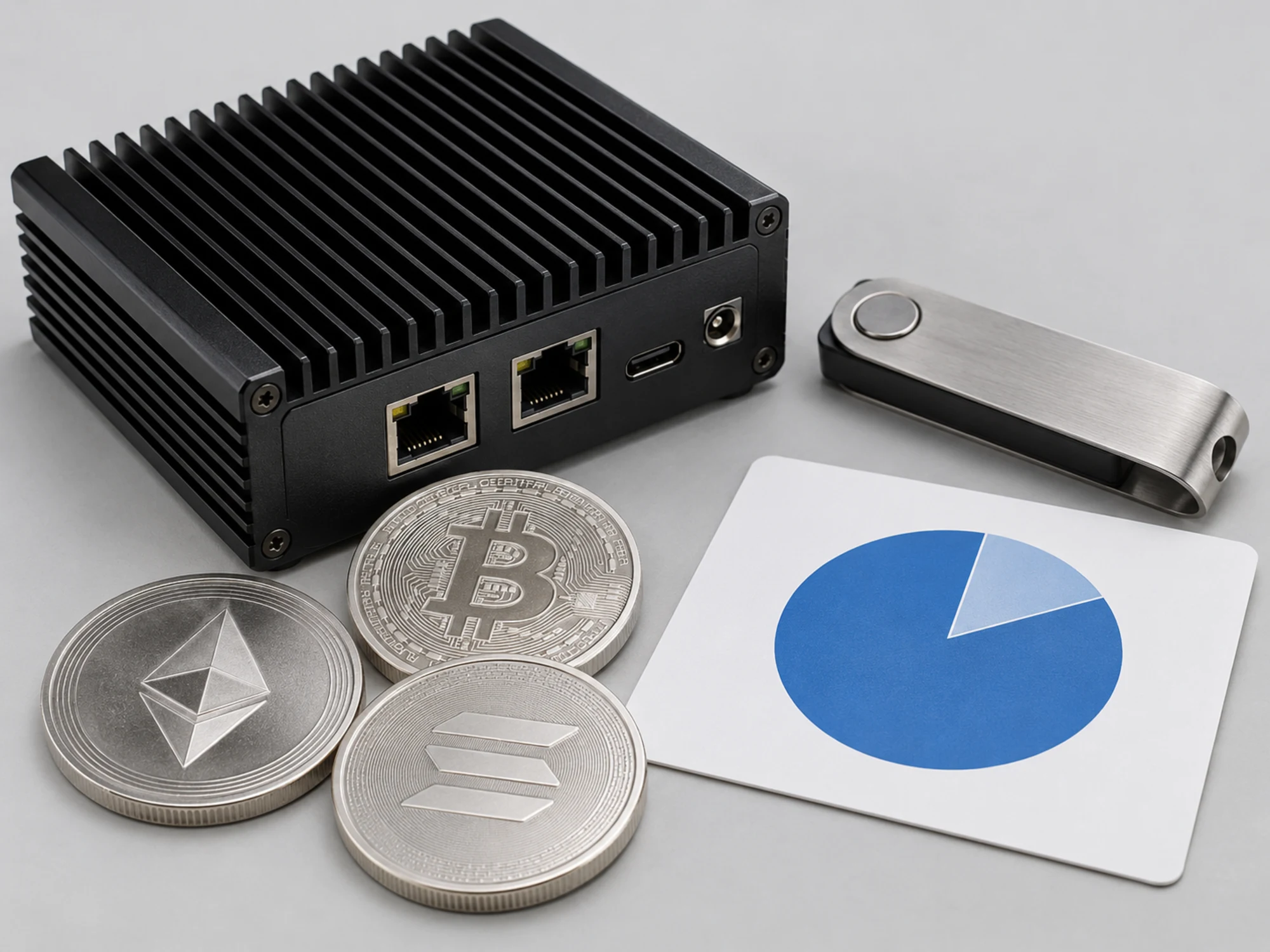
Why only a proof-of-stake asset can do this
Staking exists on networks where validators put up the asset itself as security for honest behavior and are paid for producing and attesting blocks. Ether and SOL work this way. Bitcoin does not: its blocks are produced by miners spending electricity, and no amount of bitcoin held in a wallet earns anything from the protocol.
That is why a bitcoin product has no staking variant, and why anybody offering a yield on bitcoin is lending it or selling options against it, which is a credit or market exposure instead of a protocol reward. The distinction sits on crypto staking.
The redemption problem: unbonding against daily liquidity
An exchange-traded product promises that an authorized participant can redeem units for the underlying, and that mechanism is what keeps the market price close to the net asset value. Staked ether cannot be handed over the same day: an exit runs through a queue that has taken from days to several weeks depending on how many validators leave at once.
Issuers reconcile the two with a liquidity buffer. A product stakes a defined share of its holding and keeps the rest unstaked and immediately available, with the staked share set high enough to matter and low enough to meet expected redemptions. Reported ranges run up to 95 percent staked for products that judge the buffer sufficient, and some newer products stake the entire holding and rely on borrowing or the secondary market to bridge a redemption. The share is stated in the product documentation, and it is the number to compare between two otherwise similar products.
Where the reward lands: total return or a distribution
Two routes. In the accumulating route the reward is added to the holding, the net asset value per unit rises, and the holder realizes it by selling the unit. In the distributing route the issuer pays the reward out in cash on a schedule, which gives the holder income and a taxable event on each payment.
European staking ETPs have mostly used the first route, and the figures are published per product: CoinShares states a fixed 1.25 percent annual staking reward on its physically staked ether product, and Bitwise states roughly 1.85 percent net on its ether staking ETP, as a comparison of European ether products records. Those net figures sit well below the gross network rate, because the operator fee and the unstaked buffer both dilute it.
The staking provider as a counterparty of the product
The issuer does not run validators itself. It appoints a staking provider, and that appointment introduces an exposure the non-staking version of the same product does not carry. If the provider's validators are slashed for signing conflicting blocks, the product's holding falls, and whether the provider makes that good depends on the contract between them.
A buyer therefore reads three things in the prospectus: who the staking provider is, whether the custodian or the provider holds the keys while the asset is staked, and what the issuer says about slashing liability. The same questions in an institutional setting are covered on institutional staking.
The European ETP wrapper against the US ETF wrapper
A European product is an exchange-traded note or certificate issued by a special purpose vehicle and backed by the coins, because UCITS rules forbid a fund concentrated in one asset. A US spot product is a trust under the securities rules. The difference matters for staking in one specific way: a US issuer had to wait for the regulator to accept staking inside the wrapper, while European issuers staked from the start.
That sequence reversed the usual assumption about which market moves first. Staking products existed in Europe and Canada for years before the first US spot ether product distributed a staking reward to its holders. The wrapper question in general is on crypto ETPs.
Is a staking ETP better than staking yourself?
It depends on what you are optimizing. Staking directly through a custodian keeps the gross reward minus the operator and custody fees, and you choose the operators. A staking ETP hands you a listed security you can hold in an ordinary securities account, with no key management and no validator selection, and it charges a management fee on top of the staking costs. The ETP also keeps part of the holding unstaked, so the reward per euro invested is lower by construction. An investor who cannot hold coins at all has no comparison to make.
How is a staking reward in an ETP taxed in Germany?
The product's own tax treatment governs, not the staking. A German private investor holding an exchange-traded note is taxed on the gain or the distribution under the rules for that security, which differ from the rules for coins held directly. An accumulating product with no distribution produces no taxable event until the unit is sold. Because the structures differ between issuers and the treatment follows the structure, the tax section of the product documentation is the source, and the German treatment of coins themselves is on crypto tax in Germany.
Can a bitcoin ETP pay out a yield?
Not from the protocol. Any yield on a bitcoin product comes from lending the coins to a borrower or from selling options against them, and both add an exposure the plain product does not have: the borrower may default, and the option caps the upside the holder was buying. A product doing either says so in its documentation, and the search term "bitcoin etf staking" has no product behind it for this reason.
Crypto ETF staking and Finance Loop
Finance Loop is the meeting place for the product, custody and risk people who build and distribute these wrappers. Finance Loop events on digital assets put the staking mechanics, the custody arrangement and the European product rules on one agenda, and the subject belongs to the track Investment & Digital Assets.
Finance Loop connects the finance, IT and AI communities, so an adviser comparing two staking products meets the issuers and the custodians at Finance Loop events.
Finance Loop is a professional network and has the goal of driving the adoption of emerging technologies in finance, such as AI, tokenization, stablecoins, and DeFi. Finance Loop helps its members build skills and personal networks in these fields: Investment & Digital Assets, Payments & Digital Money, Digital Infrastructure & Sovereignty, and Risk & Compliance.