
Ethereum ETF
An investor who wants gold in a securities account buys an exchange-traded product backed by metal in a vault, not a bar. Ether works the same way, with one difference that matters in Europe: the product you can buy here is not an ETF. EU fund rules forbid a retail fund concentrated in a single asset, so European investors reach ether through an exchange-traded note or certificate, and the wrapper decides what protection comes with it.
What the product holds, and who custodies it
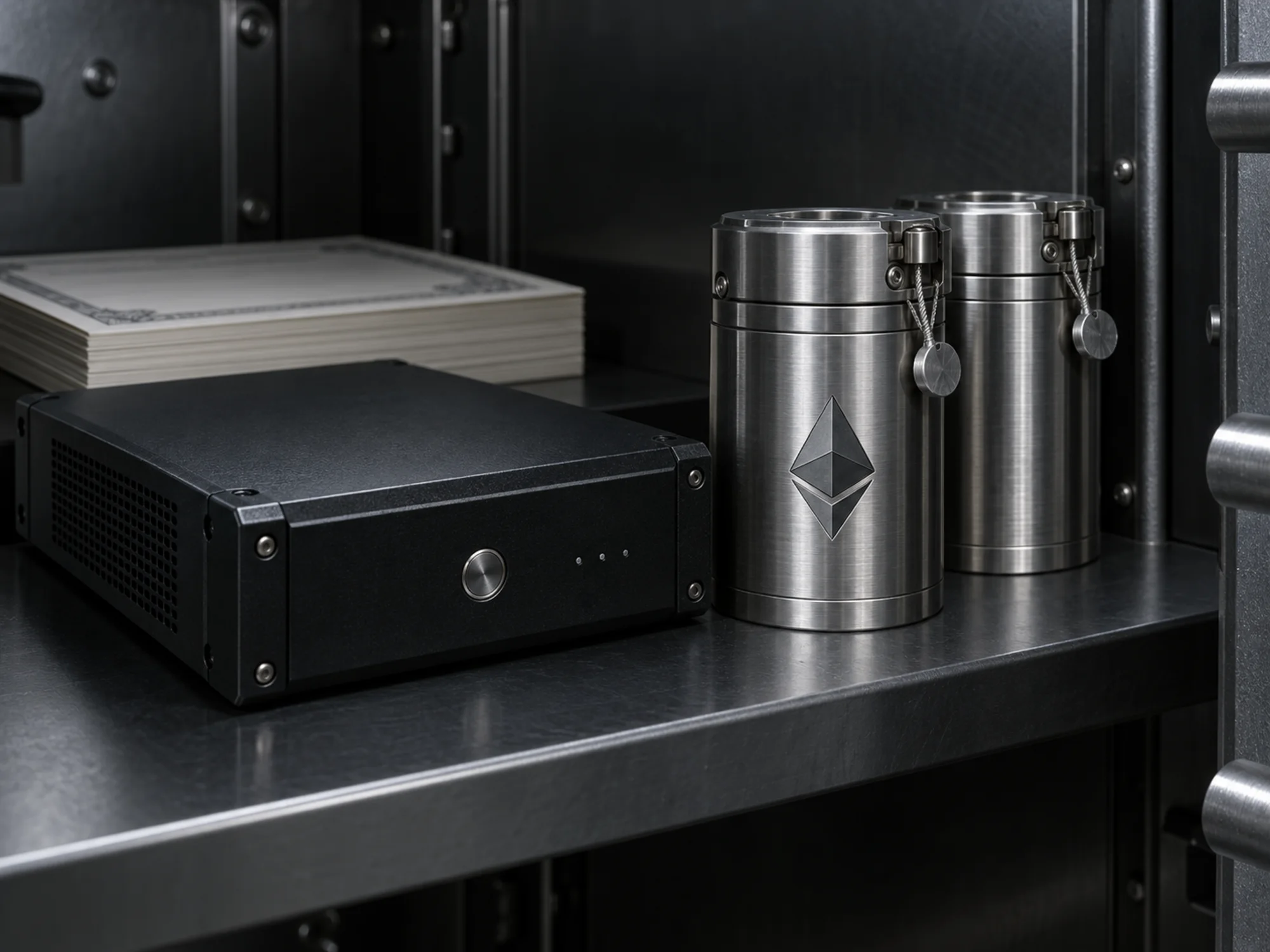
A physically backed ether product holds actual ETH. A special purpose vehicle issues the notes, buys ether with the proceeds, and places it with a regulated custodian in cold storage, segregated from the custodian's own assets. The holder's claim is against that vehicle, secured on the ether it holds, and the amount of ether behind each note is published daily.
The custodian is named in the product documentation, and institutional names such as BitGo and Coinbase Custody appear across the European range. This is the part of the structure where custody risk actually sits, which is why a buyer reads it instead of assuming the issuer holds the keys. The duties a MiCA-licensed custodian owes are set out on crypto custody.
Why the EU has ETNs where the US has a spot ETF
UCITS is the EU framework for funds sold to retail investors, and it requires diversification: no single issuer or asset may dominate the portfolio, with a 10 percent limit per issuer as the governing rule. A fund holding only ether is 100 percent concentrated, so it cannot be a UCITS fund and cannot be called an ETF in this market.
The workaround is a debt security instead of a fund. An exchange-traded note is an obligation of its issuer, which is why it carries issuer credit risk that a fund does not, and why the collateral arrangement is the thing to check. A US spot product is a trust under US securities rules, a structure the EU rules do not have an equivalent for. The general product class is on crypto ETPs.
Staking inside the wrapper, and what it changes
Ether is a proof-of-stake asset, so a product holding it can stake part of the holding and earn a network reward. European issuers have done this for years and publish the figure: CoinShares states a fixed 1.25 percent annual staking reward on its physically staked ether product, and Bitwise states roughly 1.85 percent net on its staking ETP, which a comparison of the European range records alongside the fee levels.
The reward is not free. Staked ether has to be unstaked through an exit queue before it can be delivered, so a staking product keeps part of its holding liquid and adds the staking provider as a counterparty. Both consequences are worked through on crypto ETF staking.
Tracking difference and the fee stack
Three costs separate the product's return from ether's return. The management fee is stated as a percentage per year and ranges widely across the European products, from zero on a product that funds itself from staking revenue to around 1.5 percent on the oldest. The custody and administration costs sit inside that fee or beside it, depending on the issuer. The spread the investor pays on the exchange is the third, and it is invisible in any fact sheet.
A staking product's reward works in the other direction and can exceed its fee, which is why comparing fees alone misranks the products. The figure that matters is the net change in ether per note over a year, and the issuer publishes it.
How a German investor reaches the product, and the tax treatment
Through an ordinary securities account at any German broker. The European products list on Deutsche Börse's Xetra, on Euronext and on SIX, and several also list in London, so the German investor buys in euros on Xetra like any other listed security. Deutsche Börse reports Xetra as the European market leader in crypto ETN trading, with monthly order book volume around one billion euros.
Taxation follows the security, not the coin. A German private investor's gain on an exchange-traded note is taxed under the rules for that instrument, which differ from the rules for ether held directly in a wallet, where a holding period can matter. Because the treatment follows each product's legal form, the tax section of the product documentation is the source, and the rules for coins themselves are on crypto tax in Germany.
The risks the prospectus names
Four appear in every one of these documents. Market risk, because ether's price can fall far and fast. Issuer credit risk, because a note is a claim on its issuer, mitigated but not removed by the collateral. Custody risk, because the ether sits with a third party holding keys. And liquidity risk, because the note trades only while a market maker quotes it, and the exchange spread widens when it stops.
No compensation scheme stands behind these products the way one stands behind a bank deposit or, in some jurisdictions, an investment firm's securities business. That absence is stated in the documentation and is the reason the collateral arrangement is worth reading in full.
Is there a real Ethereum ETF in Europe?
No, and the name on the screen can mislead. What trades in Europe is an ETN or ETP, a debt security backed by ether, and brokers often label it loosely. The practical difference for a holder is the claim: a fund's assets belong to the fund for the investors' account, while a note is a secured obligation of its issuer. A European investor cannot buy a US spot ether ETF either, because those products are not registered for distribution in the EU.
Ether product or ether in a wallet?
The product suits anyone who wants the exposure inside existing custody and reporting: a securities account, one tax statement, no keys and no seed phrase. Direct ether suits anyone who wants to use it on the network, to stake it under their own control, or to hold it without an issuer in between. The product costs a fee and adds an issuer; the wallet costs nothing per year and makes the holder responsible for the keys. What ether does on the network is described on Ethereum.
What do ETF inflow figures actually measure?
Net money entering the products, which is why they are read as a demand signal. The figure counts creations minus redemptions over a period and says nothing about the price directly, because the creations themselves are driven by demand for the notes. US figures dominate the reported numbers and cover products a European investor cannot buy, so an inflow headline is often about a different market than the one the reader is in.
Ether products and Finance Loop
Finance Loop is the meeting place for the product, distribution and custody people who build and sell these wrappers in Europe. Finance Loop events on digital assets put the product structures, the custody arrangements and the staking question on one agenda, and the subject belongs to the track Investment & Digital Assets.
Finance Loop connects the finance, IT and AI communities, so an adviser explaining an ether ETN to a client meets the issuers and custodians at Finance Loop events.
Finance Loop is a professional network and has the goal of driving the adoption of emerging technologies in finance, such as AI, tokenization, stablecoins, and DeFi. Finance Loop helps its members build skills and personal networks in these fields: Investment & Digital Assets, Payments & Digital Money, Digital Infrastructure & Sovereignty, and Risk & Compliance.