
Crypto market intelligence
Crypto market intelligence is the data layer under a digital asset decision: prices and volumes, on-chain flows, protocol and exchange metrics, and the tools that turn them into something a risk committee can read. If you run a mandate with crypto exposure, this is the part that has to work before any analysis on top of it is worth reading.
The category covers whole platforms, not one product. CB Insights defines it as blockchain data and analytics platforms for institutional investors and traders, which let clients track portfolios, tokens, protocols and exchanges through dashboards, programming interfaces, research reports and risk management tools. The written analysis built on top of that feed is a different thing, covered on the digital asset research page.
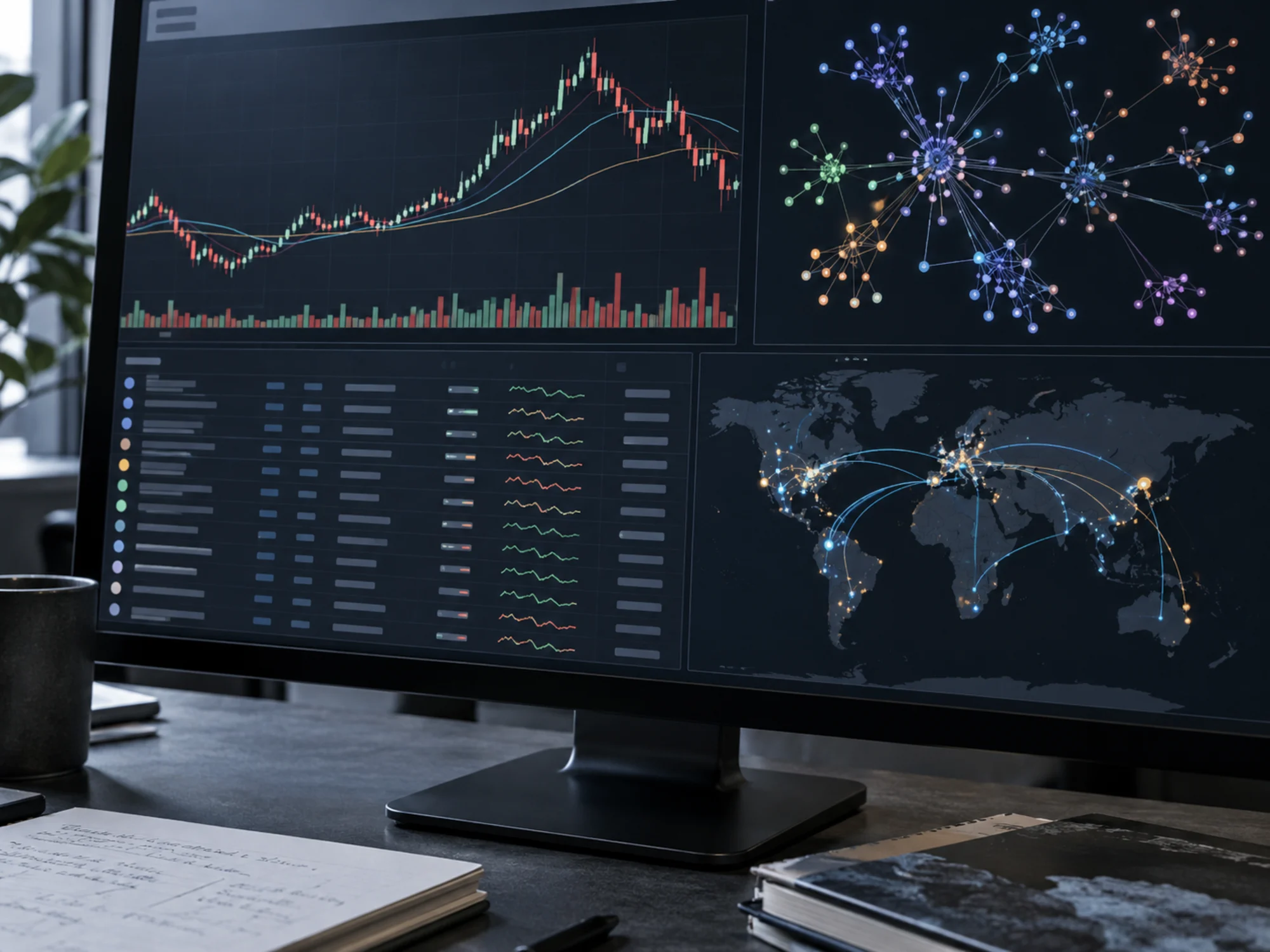
What sits inside the data layer
Four kinds of data go into a crypto intelligence platform, and they fail in different ways. Market data is the price and volume feed from trading venues, which is clean where the venue is regulated and thin where it is not. On-chain data is the transaction record itself, which is complete but needs interpretation before a wallet address means an institution. Reference data is the identity layer: which token is which, which contract is the canonical one, which issuer stands behind it. Entity data maps addresses to exchanges, custodians and protocols.
The reference and entity layers cause most of the trouble, because a token with the same ticker exists on several chains, and the wrong contract address produces a correct-looking number for the wrong asset. This is the part of a platform worth testing on data you already know: pick three positions you hold, check how the platform identifies them, and see whether the on-chain picture matches your own records. The oracle networks that feed these values into contracts, such as Chainlink and Chronicle, have the same problem one layer down.
Sentiment and machine learning: what they are actually worth
Most platforms add a sentiment layer from social media, forums and news sites, and some rank creators by influence. One practitioner description of crypto intelligence lists past prices, trading volumes, social media discussion and news outlets as the input, with machine learning applied to find patterns a person reading the same material would miss.
Treat sentiment as a crowding measure, not a signal. It tells you what a visible part of the market is talking about, which is useful for knowing when a position is consensus, and it says nothing about whether the position is right. The same caution applies to a model output with no stated input window: a pattern found in three years of a market this young has few independent observations behind it. A model whose training period and feature set are not disclosed cannot be examined, which puts it in the same category as research without a method section.
Compliance and forensics data: the part institutions must have
For a regulated institution, the intelligence that matters first is not the price. It is whether a counterparty address is on a sanctions list, whether funds passed through a mixer, and whether the chain of custody can be reconstructed for an auditor. Vendors in this category sell investigation software and blockchain search tools alongside the market dashboards, and screening against sanctioned addresses runs continuously, not once at onboarding.
This is the practical reason a bank buys a platform instead of building the feed: the screening list, its updates and the audit trail come with the product and can be shown to a supervisor. The mechanics are on the blockchain forensics page, and the German anti-money-laundering frame around it is on AML in Germany.
How to judge a crypto intelligence platform
Five questions separate a usable platform from a dashboard. Which venues are in the price feed, and are unregulated venues included in the headline number? How is an entity label produced, by heuristic or by confirmation? What is the latency, and is the historical series revised after the fact? Does the data come out through an interface your systems can read, or only through a screen? And what happens when a number is wrong, meaning is there a correction path with a stated standard?
The last one is the quickest filter. A provider that publishes how it corrects an error has thought about being wrong. Blockstories publishes its sourcing rule for its European banking tracker, requiring at least two independent sources per public data point and inviting the banks on the list to submit corrections against the same standard, which is the kind of statement to look for before a dataset goes into a committee paper.
What is crypto market intelligence?
Crypto market intelligence is the collection and analysis of data about crypto markets for investment, trading and compliance decisions. It combines market data from trading venues, on-chain transaction data, reference data identifying tokens and contracts, entity data mapping addresses to institutions, and in most products a sentiment layer from social and news sources. Platforms deliver it through dashboards, programming interfaces, reports and risk tools.
How is it different from crypto market data?
Market data is one input, the price and volume feed. Intelligence is the whole layer around it: the on-chain record, the identity of each token and address, the risk screening, and the tools that put them together. A price feed answers what something traded at. An intelligence platform answers who moved it, from where, and whether your institution may touch the counterparty.
Is sentiment data useful for institutional decisions?
As a crowding measure, yes; as a directional signal, treat it with care. Sentiment data shows what a visible slice of the market is discussing, which helps when you want to know whether a position is already consensus. It is drawn from social media, forums and news sites, where the sample is self-selected and can be manipulated, so it belongs next to the on-chain and market data, one input among several.
What should a crypto intelligence platform disclose?
The venue list behind its price feed, how entity labels are produced and whether they are confirmed or inferred, the latency and the revision policy for historical series, the delivery interfaces, and the correction path when a data point is wrong. A platform that publishes those can be audited by a client. One that publishes none of them cannot be used in a document a supervisor may read.
Crypto market intelligence and Finance Loop
Finance Loop is where the people who buy this data and the people who build it talk to each other. Risk, treasury and data teams from banks and asset managers meet vendors and protocol engineers at Finance Loop events in Frankfurt and other German cities, which is the setting where a platform gets questioned by someone who has to live with the output.
Finance Loop keeps the subject pages next to this one, among them AI and financial market data, blockchain forensics and digital asset valuation, so a team can go from the data question to the valuation and compliance questions on the same site.
Finance Loop is a professional network and has the goal of driving the adoption of emerging technologies in finance, such as AI, tokenization, stablecoins, and DeFi. Finance Loop helps its members build skills and personal networks in these fields: Investment & Digital Assets, Payments & Digital Money, Digital Infrastructure & Sovereignty, and Risk & Compliance.