
Anti-money laundering in Germany
Anti-money laundering in Germany rests on the Geldwäschegesetz (GwG): a bank, payment firm or crypto provider that suspects money laundering must report it to the Financial Intelligence Unit without delay, whatever the amount. The FIU's latest annual report counted 374,693 such reports, and the EU's new rulebook and the AMLA in Frankfurt are changing the rules around them.
Germany's anti-money laundering law
The German Anti-Money Laundering Act, the Geldwäschegesetz (GwG), sets the duties of every obliged entity: banks and payment institutions, life insurers, asset managers and crypto service providers, but also real estate agents, notaries and traders in goods. Money laundering itself is a crime under section 261 of the Criminal Code (StGB). For banks, section 25h of the Kreditwesengesetz adds the duty to run monitoring systems that flag unusual payments, which is where most regtech in German banks does its work.
The customer checks that open a relationship, from identity to beneficial owner, are covered on the KYC in Germany page. This page follows what happens after onboarding: monitoring, the suspicious activity report, and the authorities that receive it.
Suspicious activity reports and the FIU
Under section 43 GwG, an obliged entity must report to the Financial Intelligence Unit when facts suggest that an asset comes from a crime that can be a predicate offense for money laundering, that a transaction is linked to terrorist financing, or that a customer hid whether it acts for a beneficial owner. The report is due without delay and regardless of the value of the asset or the size of the transaction.
Germany's FIU, the Zentralstelle für Finanztransaktionsuntersuchungen (in German), sits within the customs administration and receives reports through its goAML portal. According to a summary of its latest annual report by PayTechLaw (in German), it recorded 374,693 suspicious transaction reports, about 41 percent more than the year before. Of roughly 160,000 obliged entities registered in goAML, only 4,062 filed a report in that year. The FIU now sets binding content rules for reports, with XML as the mandatory format and fields such as blockchain transaction IDs for crypto cases and land register data for real estate.
What the FATF found in Germany
The Financial Action Task Force last evaluated Germany in its mutual evaluation report. It credited Germany with significant reforms and a good understanding of the risks in real estate, banking and virtual assets, and it asked for more resources and priority at the operational level. The report pointed to Germany's heavy use of cash, with no general cash transaction limit, and to the risk that illicit cash is turned into property or precious metals.
It also warned that the focus on real estate and cash could make authorities overlook other risks, such as complex corporate structures with shell and foreign companies, and that law enforcement tended to focus on natural persons more than on foreign criminals and professional enablers. For a compliance team, those findings explain why German supervisors now ask harder questions about ownership chains and cross-border payments.
From the GwG to the EU AML package
Germany's GwG transposes EU directives. The EU has now adopted a single rulebook, Regulation (EU) 2024/1624 (AMLR), which will apply directly in every member state from July 10, 2027, and much of the GwG's content moves into it. The new EU Anti-Money Laundering Authority, AMLA, has its seat in Frankfurt am Main and will supervise a group of large cross-border financial firms directly, while BaFin keeps supervising the others. The crypto AML page covers what the AMLR means for crypto-asset service providers, and financial crime in payments covers payment institutions.
Upcoming events on AML and compliance in Germany
Finance Loop, the meeting place for AML in Germany
Finance Loop is the meeting place for AML officers, investigators and the people who build monitoring and screening software. It connects the finance, IT and AI communities in Germany, Austria and Switzerland, with events in Frankfurt, Munich, Berlin and Hamburg.
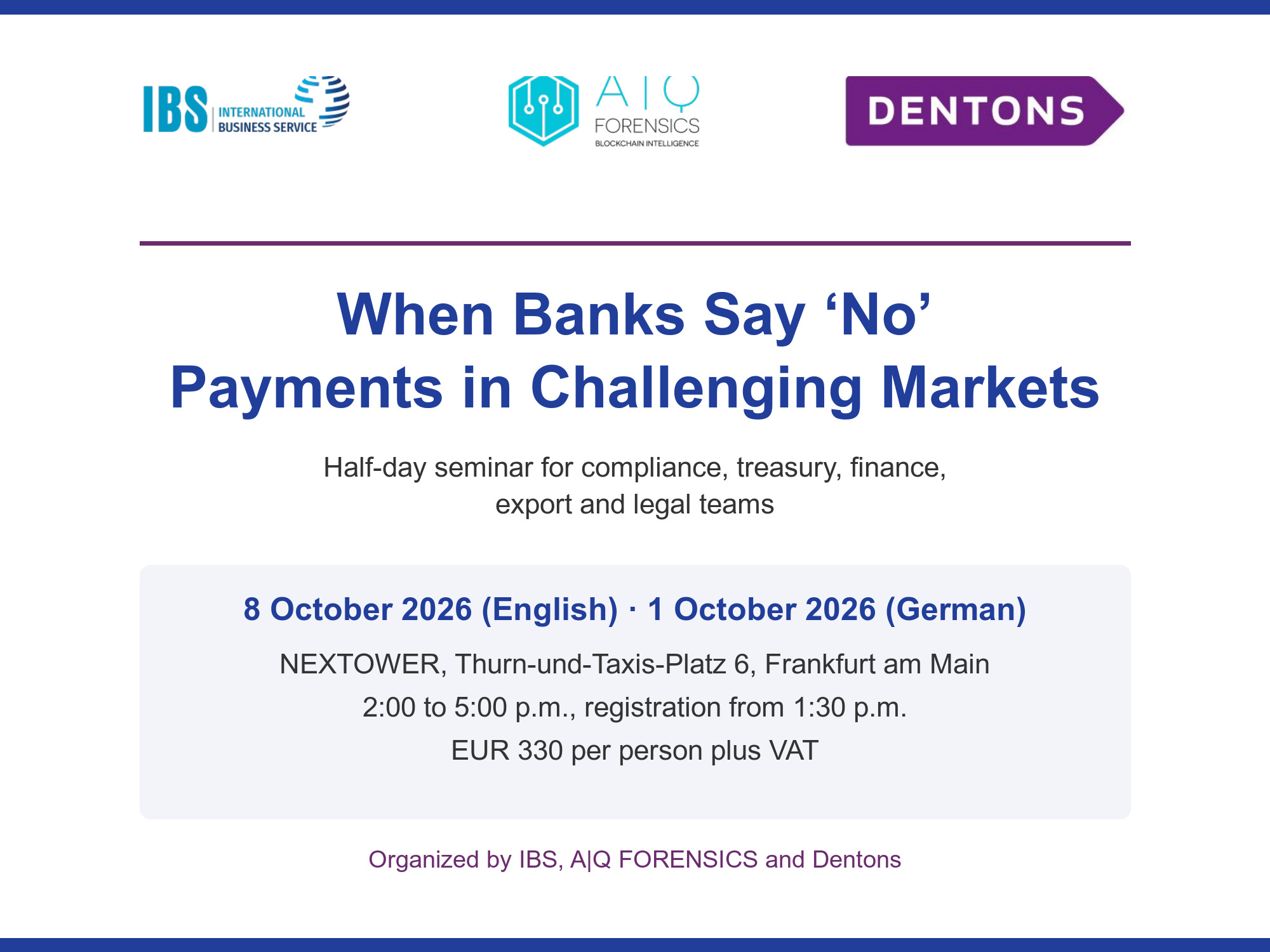
Finance Loop supports When Banks Say 'No', a seminar at the NEXTOWER in Frankfurt where Dr. Julia Pfeil of Dentons speaks on payments governed by sanctions and anti-money laundering laws and a third talk shows how blockchain forensics traces crypto flows. At the Bybit EU Crypto Evening at TechQuartier, supported by Finance Loop, compliance under MiCAR was on the agenda.
Payments & Digital Money
Investment & Digital Assets
What is the German anti-money laundering act?
The Geldwäschegesetz (GwG) is Germany's anti-money laundering law. It lists the obliged entities, sets their customer checks and internal safeguards, and requires them to report suspicious transactions to the FIU under section 43. Much of it moves into the EU's AMLR once that regulation applies.
What does the FIU in Germany do?
The FIU receives and analyzes suspicious transaction reports from obliged entities through the goAML portal and passes relevant cases to law enforcement. It sits within the German customs administration and publishes an annual report on the number and type of reports.
What does AMLA in Frankfurt do?
AMLA, the EU Anti-Money Laundering Authority seated in Frankfurt am Main, coordinates national AML supervisors and will directly supervise a group of large cross-border financial firms. National authorities such as BaFin continue to supervise all other firms.
Is there an AML meetup in Frankfurt?
AML topics in Frankfurt mostly run inside payments and compliance seminars, such as When Banks Say 'No', and at crypto compliance evenings. For structured training, the Frankfurt School's Certified Compliance Professional offers an AML specialization. Current dates are in the events overview.
AML in Germany and Finance Loop
AML belongs to Finance Loop's Risk & Compliance track. The When Banks Say 'No' seminar in Frankfurt, supported by Finance Loop, brings sanctions and anti-money laundering law together with payments practice and crypto tracing.
Finance Loop is a professional network and has the goal of driving the adoption of emerging technologies in finance, such as AI, tokenization, stablecoins, and DeFi. Finance Loop helps its members build skills and personal networks in these fields: Investment & Digital Assets, Payments & Digital Money, and Risk & Compliance.