
Crypto price discovery: where a single price comes from
In equities a share has one official closing price, set by the exchange that lists it. A crypto asset has none. Bitcoin trades on dozens of venues at the same moment, each with its own order book, its own fee schedule and its own set of customers, so the number you see on a chart is something somebody calculated. Who calculated it, over which window and from which venues decides whether a fund may use it for a net asset value or a clearing house for a settlement.
This is the mechanism behind the numbers. For the firms that sell the data, Finance Loop keeps a separate overview at crypto price feed providers, and for the feeds, APIs and MiCA duties at crypto market data.
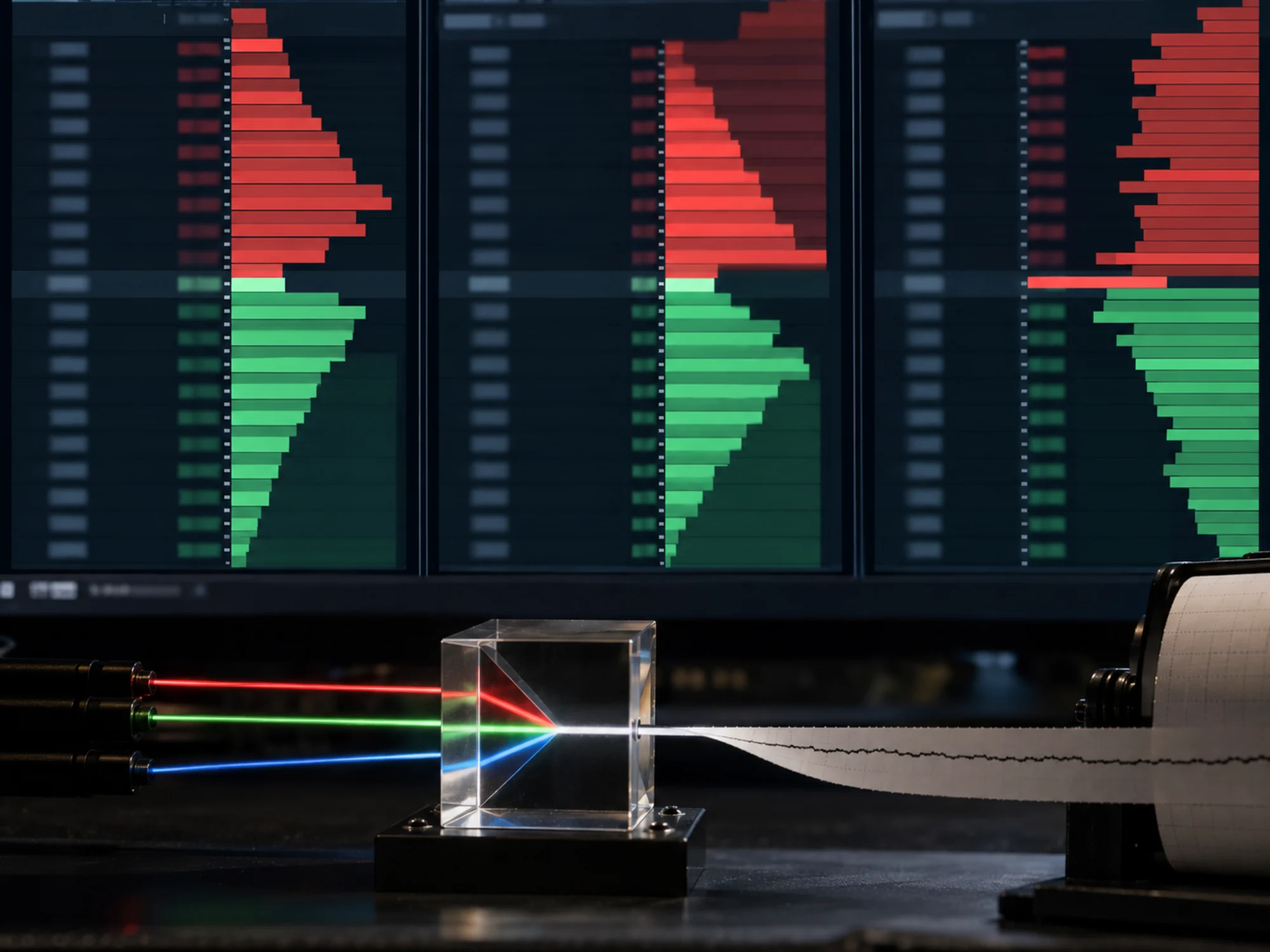
Why a fragmented market has no single price
A fragmented market has as many prices as it has venues, and all of them are correct at the same time. The spread between two exchanges is an arbitrage opportunity, and arbitrage closes it, but only as fast as money and coins can move between the two. When a venue restricts withdrawals, when a fiat rail is slow, or when local demand runs hot, the gap stays open for hours. The academic work on this is older than most crypto index products: Igor Makarov and Antoinette Schoar's study Price Discovery in Cryptocurrency Markets finds that when markets become segmented, the venues with the large arbitrage spreads stop contributing much to price discovery at all.
Crypto adds a second structure on top. On an order-book exchange a price is the point where a bid meets an ask. On an automated market maker the price falls out of the pool's reserve ratio and the curve the pool uses, and it moves because someone traded against it, not because someone quoted it. Arch Lending's glossary entry on price discovery lists both alongside periodic auctions and over-the-counter negotiation, which are the two mechanisms people forget. An index that mixes the two has to decide what a trade on each is worth as evidence.
How a reference rate is built
A reference rate turns many venue prices into one number with a published recipe, and the recipe has four decisions in it. First, venue selection: which exchanges count as constituents, measured by volume, by the integrity of their reported trades and by whether a professional firm can actually trade there. Second, the observation window: a snapshot at one instant, or a period. Third, the weighting: by volume, so a venue with real turnover counts more than a thin one. Fourth, the treatment of outliers, which is where manipulation resistance is won or lost.
The CME CF Bitcoin Reference Rate shows what the four decisions look like when they are written down. Its methodology observes trades on its constituent exchanges during a one-hour window, splits that hour into twelve five-minute partitions, takes the volume-weighted median of the trades inside each partition, and publishes the arithmetic mean of the twelve. CF Benchmarks explains the design aim: a single large trade can only move the median of the one partition it fell into, and a burst of trades in a few minutes can only move the partitions it touched. A snapshot at 16:00 has no such defense, because the one trade that prints at 16:00 is the price.
A median instead of a mean does most of the work here. A mean follows an extreme print; a median ignores it unless the volume behind it is large enough to shift the middle of the distribution. That is why institutional crypto benchmarks reach for medians and partitions, and why a page that quotes a single exchange's last trade is not giving you a benchmark.
What the EU Benchmarks Regulation requires
A number used in a financial instrument in the EU is a benchmark in law, and the firm that calculates it is an administrator that needs authorization. The EU Benchmarks Regulation puts the administrator under a competent authority, and ESMA keeps the public register of who is authorized and who supervises them. Within two weeks of entering that register, an administrator has to publish a benchmark statement for each benchmark, which states what the benchmark measures and what discretion the administrator keeps.
For a reader this register is the practical test. A crypto index that an ETP prospectus names, or that a derivative settles against, points at an administrator you can look up. An index that appears only on a website with no administrator behind it is a data product, which is a different thing, and a fund cannot use it the same way.
Where a fund's NAV and a derivative's settlement get their price
A fund's net asset value needs one price per valuation point, chosen before the fact and applied without discretion, because the investor who subscribes and the investor who redeems both deal at it. That rules out a live mid-price and points at a rate fixed in a published window. A European crypto ETP works the same way, and the prospectus names the index it tracks. Finance Loop covers the product side at crypto ETP and the institutional process at institutional crypto.
A derivative settles against a rate for the same reason, with the added point that the contract's buyer and seller are on opposite sides of any manipulation. A cash-settled futures contract on bitcoin is a bet on what the index will read at expiry, so the index's partition structure is part of the contract's risk, not a detail of the data vendor's product.
The onchain version of the same problem
A lending protocol that liquidates a position needs a price, and it cannot read a chart. It reads an oracle, and the oracle faces the four decisions above with two extra constraints: it publishes on a blockchain, which costs gas and takes block time, and whoever can move its number can take money out of the protocol. The design answers are the ones you already know, in another form: several independent data sources, an aggregation step that takes a median and not a mean, and a deviation threshold that decides when a new value is worth publishing.
Finance Loop's pages on the oracle side are Chainlink and Chronicle, and the commercial data vendors sit at crypto price feed providers. The order book answer in the knowledge hub explains the microstructure that every one of these numbers starts from.
Where the price is actually made: spot, perpetuals and OTC
The venue that sets the price is often not the one a reference rate measures. Perpetual futures are the most heavily traded crypto derivative, with daily turnover above 100 billion dollars, and a trader who wants leveraged exposure reaches for a perpetual before a spot order. That makes the perpetual order book the place where new information arrives first, and the spot market the place that follows.
The link between the two is the funding rate. A perpetual has no expiry, so nothing forces it back to spot except a periodic payment between the two sides: when the contract trades above spot the longs pay the shorts, when it trades below the shorts pay the longs, and the crowded side carries the cost. The reference price the funding calculation uses is sampled from the order book at a fixed interval and averaged over the charge window, which is the same partition idea that a benchmark uses, applied to a different purpose. A large enough gap invites the cash-and-carry trade, buying spot and selling the future, and that trade closes the gap.
Over-the-counter desks are the third place, and the hardest to see. A block trade negotiated bilaterally never touches a public order book, so it contributes nothing to the visible price while moving the inventory that the visible price depends on. A periodic auction, where orders collect and clear at one price at one moment, is the fourth. A methodology that reads only continuous spot order books is measuring one of four mechanisms.
What breaks price discovery: thin books, wash trading, fake volume
Price discovery works to the extent the market is liquid, and it degrades in the obvious direction when it is not. In a thin book a single order of ordinary size moves the price several percent, and the resulting print is a fact about the book's depth and not about what the asset is worth. For a small token, the price you read may reflect one trade a day.
Two deliberate distortions matter more for a methodology. Wash trading is a trader selling to himself to inflate a venue's reported volume, and it hits an index at the weighting step, because volume weighting rewards the venue that reports the most. A pump and dump works by moving the price itself on a venue with a thin book, and it hits the index at the aggregation step, where a median absorbs it and a mean does not. This is why constituent selection asks whether the reported trades are credible, and not only how large they are. Finance Loop covers the tracing side at blockchain forensics and the market abuse rules at crypto market data.
Information asymmetry does the rest. A venue's own staff, a large holder and a protocol's developers know things the order book does not yet show, and in a market with no disclosure regime comparable to the one for listed equities, that knowledge arrives as a trade. MiCA's market abuse rules apply to crypto assets admitted to trading in the EU and address exactly this, which is new enough that the enforcement record is still short.
What is price discovery in crypto?
Price discovery in crypto is the process by which trading across many venues converges on a price for an asset, and the reason it needs explaining is that the convergence is never complete. Supply and demand meet separately on each exchange, arbitrage pulls the venues toward each other, and the residual differences are what an index methodology has to resolve into one number.
Where does the bitcoin price come from?
Every bitcoin price you read comes from trades on specific exchanges, aggregated by whoever published it. A price on a retail app is usually that app's own venue or its liquidity provider. A price in a fund document is a licensed benchmark with a named administrator and a published window. A price on a data aggregator is a composite whose constituent list the aggregator chooses. The three can differ by more than a spread at the same second, and each is right about what it measures.
What makes a crypto benchmark manipulation resistant?
Three properties, and none of them is secrecy. The observation period is long enough that one trade is a small part of it. The aggregation uses a median, so an extreme print outside the middle of the distribution is discarded instead of being averaged in. And the constituent venues are chosen so that a trader would have to move real volume on several of them at once to shift the result, which costs more than the manipulation is worth. A published methodology is a requirement here, because an unpublished one cannot be audited for these properties.
Is a crypto index the same as a price feed?
No. A price feed delivers observations, usually trades and quotes per venue, at the rate the subscriber pays for. An index applies a methodology to observations and publishes one value with a timestamp and a name. A firm can buy a feed and compute its own number, but then it is the administrator of that number, with everything that follows from the Benchmarks Regulation if a financial instrument uses it. Finance Loop keeps the index product side at crypto index.
Why do exchanges show different bitcoin prices?
Because each exchange has its own order book, its own currency pairs and its own set of people able to trade there. Moving value between two venues takes a transfer and a settlement, and until that is done a price difference cannot be arbitraged away. Withdrawal limits, slow fiat rails, local regulation and a venue's own credit risk all widen the gap, which is why the difference is largest on venues serving a single country and smallest between the large dollar venues.
Do crypto futures lead the spot price?
Often, yes. Perpetual futures carry the larger share of crypto turnover, so a trader acting on news frequently moves the perpetual first and the spot market follows through arbitrage. That has a practical consequence for anyone reading a chart: a spot price is a lagging observation of a process that happened in the derivatives book, and a reference rate built only from spot trades inherits that lag by design.
Crypto price discovery and Finance Loop
Finance Loop brings together the people who argue about these methodologies for a living: index administrators, data vendors, fund operations teams and the risk managers who have to defend a valuation. Finance Loop is the meeting place in Frankfurt for the Investment & Digital Assets track, where pricing and valuation of digital assets come up in every session. Finance Loop members reach the index and data specialists directly instead of through a sales channel.
Finance Loop is a professional network and has the goal of driving the adoption of emerging technologies in finance, such as AI, tokenization, stablecoins, and DeFi. Finance Loop helps its members build skills and personal networks in these fields: Investment & Digital Assets, Payments & Digital Money, Digital Infrastructure & Sovereignty, and Risk & Compliance.