
Lending and credit in Germany
Granting loans in Germany is banking business, so a lender needs BaFin permission under the Kreditwesengesetz. Two changes now reach every lender: the new EU Consumer Credit Directive brings buy now, pay later into consumer credit law, and a ruling from the EU Court of Justice put credit scoring under the GDPR's rules on automated decisions.
Who may grant loans in Germany
The Kreditwesengesetz (KWG) counts the lending business among the banking activities, and section 32 KWG requires written or electronic permission from the supervisor, BaFin, for anyone who wants to run banking business in Germany on a commercial basis. A digital lender in Germany therefore either holds a banking license itself or works with a bank that books the loans.
The market splits into consumer credit, mortgages and lending to small and mid-sized companies (SME lending). Digital lending platforms have moved into all three. Teylor, for example, runs an online lending platform for SMEs with business loans, leasing and factoring. Crowdlending and peer-to-peer lending platforms match borrowers with private or institutional investors. Whether such a platform needs the full KWG license depends on whether it grants the loan itself or only arranges it, and asset-based lending against receivables or equipment follows the same test.
The new Consumer Credit Directive and buy now, pay later
The EU rewrote its consumer credit rules in Directive (EU) 2023/2225. Member States must apply it from November 20, 2026, according to the law firm A&O Shearman. Its largest change for the German market is scope: buy now, pay later products, which were often exempt because of their small amounts or zero interest, now clearly fall under consumer credit law. That brings creditworthiness checks and pre-contract information to the checkout of an online shop.
Germany's government has presented a draft bill to transpose it. Next to changes in the Civil Code, the package plans a new supervisory law for consumer credit in sales financing, the Absatzfinanzierungsaufsichtsgesetz (AbsFinAG), which Bird & Bird describes as bringing BNPL schemes under comprehensive regulation. A retailer that offers payment by installments at its checkout, and the fintech behind the button, should read the draft now.
Credit scoring after the SCHUFA ruling
Germany has a credit score, and most people know it as the SCHUFA score. SCHUFA, based in Wiesbaden in the Rhine-Main area, is a leading German credit reference agency. In case C-634/21, referred by the administrative court in Wiesbaden, the EU Court of Justice ruled that producing a repayment probability score is itself an automated individual decision under Article 22 GDPR when lenders rely heavily on the score to grant, refuse or end a contract. The duty then falls on the agency as well as on the lender.
A second layer comes from the EU AI Act, which lists AI that assesses the creditworthiness of natural persons or sets their credit score as high-risk. A lender that uses machine learning for credit decisions in Germany now answers to BaFin for the model, to data protection authorities for the decision, and to the AI Act for documentation and human oversight. Scoring of companies stays outside that high-risk category.
From bank loans to DeFi lending
Classic bank lending and crypto lending share a vocabulary but little else. A bank loan rests on a credit check and the bank's own capital under Basel rules. DeFi lending protocols lend against crypto collateral worth more than the loan and liquidate it automatically when its value falls, with no credit check at all. Tokenized collateral is where the two worlds meet, and the collateral answer in the knowledge hub explains what counts as security in each.
Upcoming fintech and finance events in Germany
Finance Loop and lending in Germany
Finance Loop is the meeting place for people from banks, lending fintechs and investors who deal with credit, capital and regulation. It connects the finance, IT and AI communities in Germany, Austria and Switzerland, with events in Frankfurt, Munich, Berlin and Hamburg.
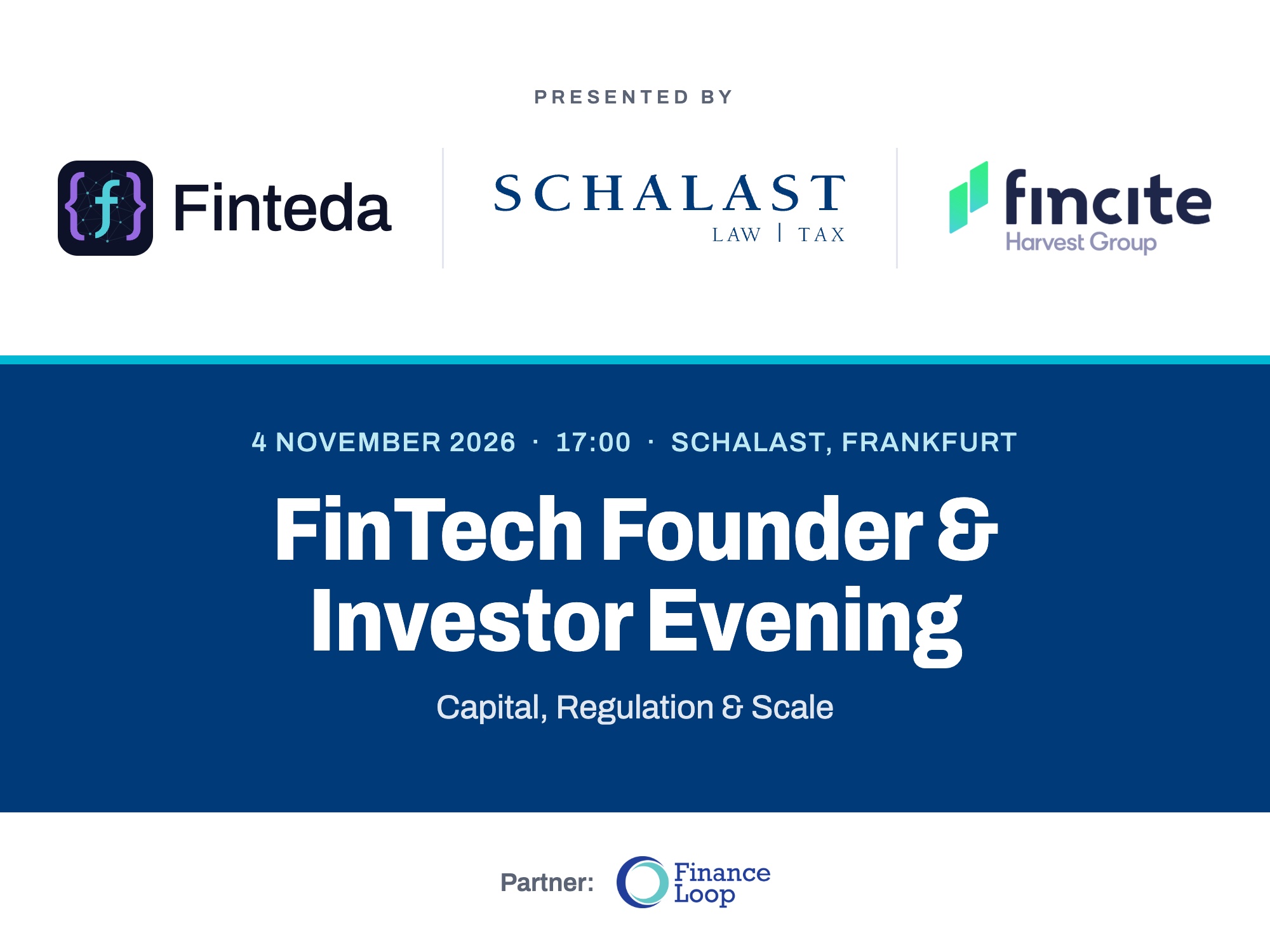
Finance Loop is a partner of the FinTech Founder & Investor Evening in Frankfurt, presented by Finteda, the law firm Schalast and Fincite, where Teylor CEO Patrick Stäuble joins a talk on capital and regulation. Credit models also come up on the pages AI in banking in Germany and open banking in Germany, since account data now feeds many credit checks.
Risk & Compliance
Payments & Digital Money
Investment & Digital Assets
Does Germany have credit scores?
Yes. Credit reference agencies such as SCHUFA in Wiesbaden compute scores that banks, landlords and online shops use. Since the EU Court of Justice's ruling in case C-634/21, such a score can count as an automated decision under Article 22 GDPR when a lender relies heavily on it.
Is buy now, pay later regulated in Germany?
It is moving under regulation. The EU's Consumer Credit Directive 2023/2225 brings BNPL clearly into consumer credit law, with creditworthiness checks and information duties, and Germany plans a new supervisory law for sales financing, the AbsFinAG, alongside its transposition.
Do lending platforms need a license in Germany?
A platform that grants loans itself runs banking business and needs BaFin permission under section 32 KWG. A platform that only arranges loans for a bank that books them works under a different license, so the role decides.
Lending in Germany and Finance Loop
Lending runs through Finance Loop's Risk & Compliance track, where credit risk, AI scoring and the new consumer credit rules sit, and reaches the Investment & Digital Assets track through collateral and DeFi lending. The FinTech Founder & Investor Evening in Frankfurt, with Finance Loop as a partner, brings a lending platform's CEO on stage.
Finance Loop is a professional network and has the goal of driving the adoption of emerging technologies in finance, such as AI, tokenization, stablecoins, and DeFi. Finance Loop helps its members build skills and personal networks in these fields: Investment & Digital Assets, Payments & Digital Money, and Risk & Compliance.