
Open banking Switzerland
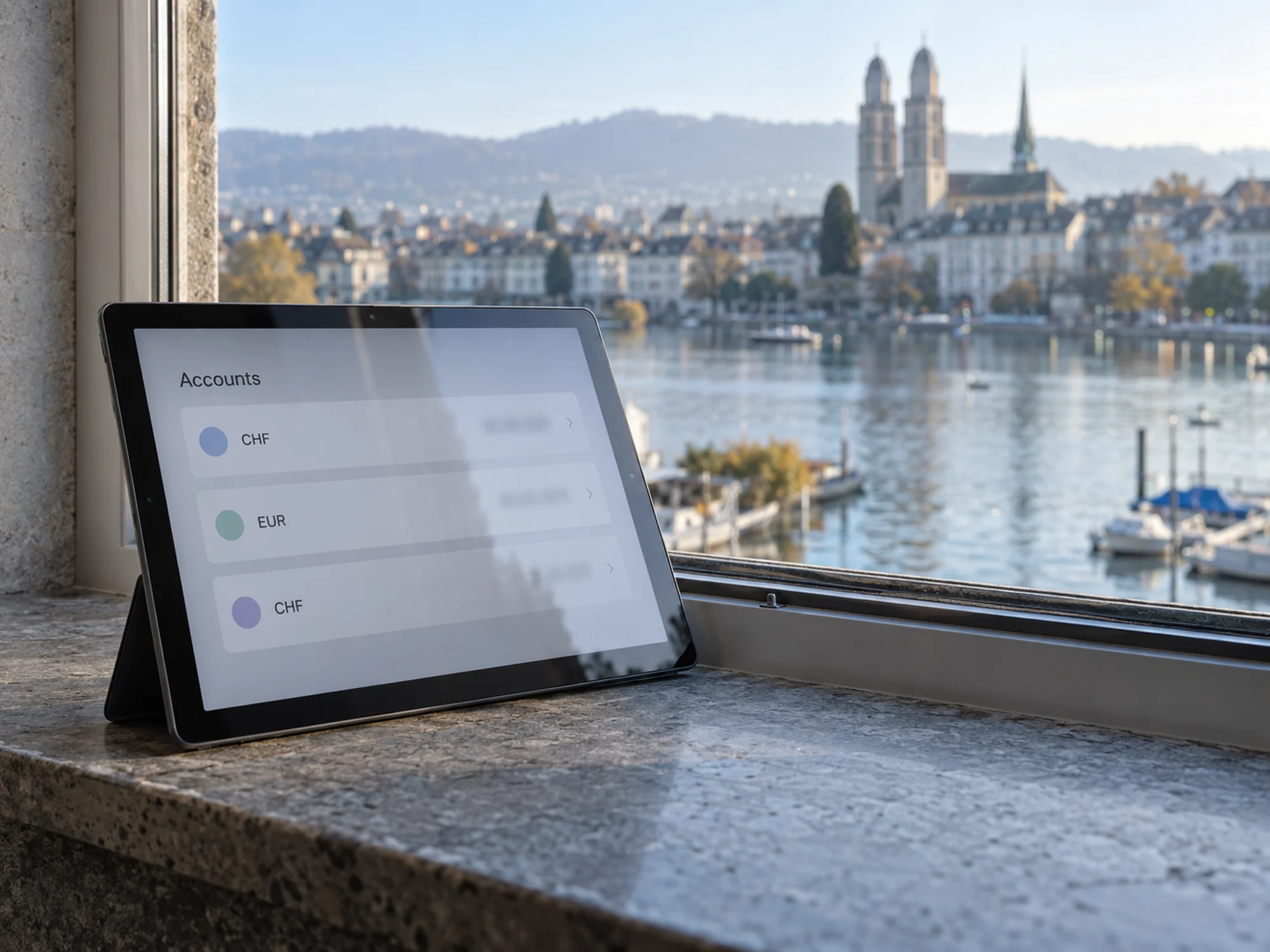
Open banking in Switzerland allows customers to share account information between participating banks and financial service providers. The customer decides whether to enable the connection, which uses technical interfaces to exchange the agreed data. Swiss open banking develops through cooperation within the financial industry, including multibanking services that bring accounts from different banks into one app.
Open banking gives customers a consolidated view of their finances and makes account information available for services such as budgeting and expense analysis. Banks and fintechs agree how their systems connect and how customer permissions are handled. Switzerland's industry-led approach makes the availability of a particular service dependent on the institutions and providers taking part.
A market-led approach with federal targets
Unlike the EU and the UK, Switzerland does not require financial institutions to give third parties access to client data on request. On 16 December 2022 the Federal Council published open finance objectives: at most one recommended standard per business area, interfaces opened at the client's request for all secure third-party providers, other financial institutions included, in at least the main business areas, with data in real time and, where appropriate, write access as well as read access.
In June 2024 the Federal Council judged the progress sufficient and proposed no regulation. The Federal Council's review of 12 December 2025 was mixed: it counted the banks' multibanking initiative as progress, saw slow movement elsewhere, insurance included, and asked the Federal Department of Finance to define measurable indicators. Statutory duties remain an option.
bLink and the multibanking launch
bLink is the open banking platform of SIX, the operator of the Swiss stock exchange and payment systems. bLink handles the data exchange between banks and third-party providers, always with the customer's explicit consent. Swiss Fintech Innovations started the multibanking initiative in 2022, and numerous banks signed a memorandum of understanding coordinated by the Swiss Bankers Association in May 2023.
Multibanking for private customers went live on 25 November 2025, with eight banks and two fintechs at launch and more than 30 banks providing the interfaces. A customer sees accounts at other banks in their own bank's app or a third-party app. Details, including what PostFinance offers, are on multibanking.
Standards: Common API and OpenWealth
Without a regulator's technical rules, Swiss banks agree on industry standards. Swiss Fintech Innovations defines common API standards for payments, lending and pensions, as the Swiss Bankers Association describes. In wealth management, the Zurich-based OpenWealth Association maintains an open API standard that connects banks and wealthtechs, with APIs for custody data, customer management and order placement.
The difference from the EU is the access right. In the EU a bank must open its payment account interface to every licensed provider, usually on the Berlin Group standard. A Swiss bank decides by contract which third parties it admits. FIDA would not apply in Switzerland.
Upcoming events on payments and open banking
Finance Loop and open banking in Switzerland
Finance Loop is the meeting place for people who build and supervise open banking in Germany, Austria and Switzerland, and it brings Swiss and German teams together where their work crosses the border. Finance Loop connects the finance, IT and AI communities, with events in Frankfurt, Munich, Berlin and Hamburg.
Finance Loop partnered with GFTN for the Point Zero Forum 2026 at the Kongresshaus Zurich. The Zurich scene is described on fintech in Zurich, and the Swiss rules for digital assets on crypto regulation in Switzerland.
Does PSD2 apply in Switzerland?
No. Switzerland is not part of the EU, and PSD2 does not apply there. Swiss banks have no legal duty to open account access to third parties; they do so by contract, mostly over the bLink platform of SIX.
Is there an open banking law in Switzerland?
Not at present. The Federal Council set open finance targets in December 2022 and has so far relied on the industry to meet them. In December 2025 it kept that course and announced measurable indicators to track progress.
What is bLink?
bLink is the open banking platform of SIX. bLink standardizes the data exchange between Swiss banks and third-party providers and is the technical base of the multibanking service that Swiss banks launched for private customers in November 2025.
Open banking in Switzerland and Finance Loop
Finance Loop covers open banking in Switzerland in its Payments & Digital Money track, next to open banking in Germany, FIDA and multibanking. Swiss and German bank, fintech and wealthtech teams meet at Finance Loop events.
Finance Loop is a professional network supporting the institutional use of emerging technologies in finance, such as AI, digital payments, cloud and blockchain solutions. Finance Loop helps its members build skills and personal networks in these fields: Investment & Digital Assets, Payments & Digital Money, Digital Infrastructure & Sovereignty, and Risk & Compliance.