
PensionTech
PensionTech is technology for administering pension arrangements, collecting pension records and calculating retirement scenarios. Financial institutions and pension providers use these systems to exchange information and give customers a clearer view of their entitlements. Product teams need to distinguish the underlying records from the assumptions used to estimate future income.
Pension information can span several employers and different public or private arrangements. A digital overview brings available information together, while a projection adds assumptions about future contributions or retirement dates. Building either service requires a defined coverage boundary, reliable identity matching and a clear route for correcting incomplete records.
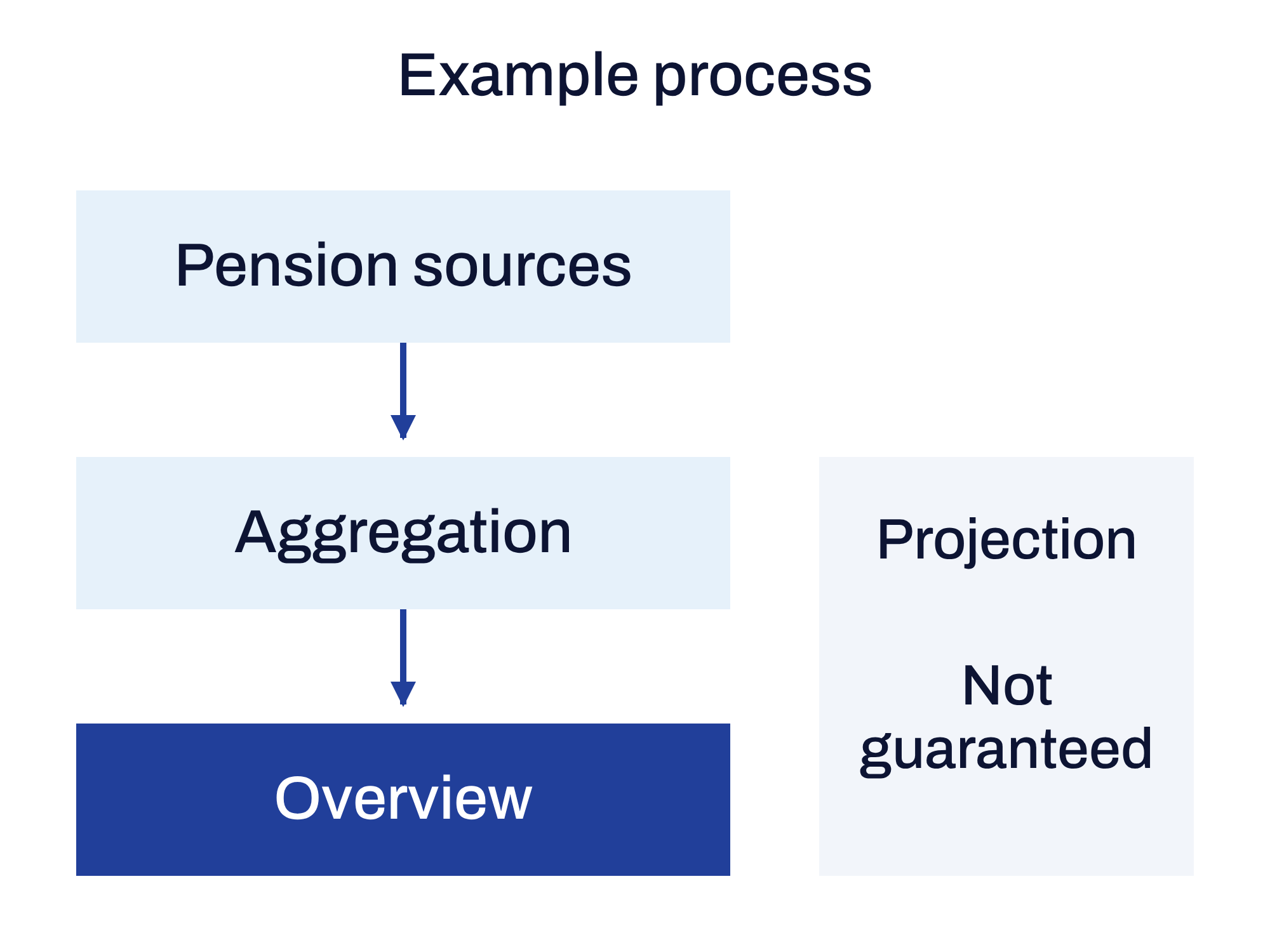
Pension dashboards and data exchange
A pension dashboard displays information supplied by connected pension providers, with each entitlement associated with its source. The British pensions dashboards architecture separates identity verification and consent from finding records and retrieving their values. This division gives product teams distinct integration responsibilities to assess before choosing a connection provider.
The MoneyHelper dashboard remains in development and consumer testing, with public launch handled separately from provider connection. Institutions should verify the latest delivery position before describing access in customer communications. A successful technical connection alone does not establish that a service is publicly available.
Matching records and handling missing values
Pension aggregation depends on matching a verified individual to the correct provider records. The Pensions Regulator asks schemes to assess whether their member data is accurate and digitally searchable. Old names or incomplete identifiers can therefore become operational problems before any retirement calculation begins.
Product acceptance tests should cover an uncertain match, a confirmed entitlement awaiting a value and an unavailable provider. Each outcome needs its own explanation and responsible support contact. Showing an absent value as zero would hide uncertainty and could distort an apparent total. Teams should also preserve the date attached to each returned valuation.
Digitale Rentenübersicht in Germany
The German Digitale Rentenübersicht brings together statutory, occupational and private pension information from participating providers. The service distinguishes guaranteed entitlements already earned from values projected under assumptions about future contributions. Its overview does not calculate an individual retirement shortfall, because that calculation also requires information about personal spending needs.
The German portal also separates its displayed values from inflation scenarios in its Renten-Labor. Product teams assessing similar functions should retain the provider value alongside any adjusted scenario. A change in an inflation assumption should be visible without changing the underlying pension record or implying that the provider issued a new statement.
Retirement estimates and career records in France
The French Mon compte retraite service combines access to retirement rights with simulations and administrative procedures. A career record and a retirement estimate answer different questions for the same individual. The record concerns information already held by pension schemes, while the estimate explores possible retirement outcomes.
The Service des Retraites de l'État explains that information added inside the simulator is used there without being retained or transmitted to pension schemes. For financial product teams, that distinction supports separate workflows for testing assumptions and requesting corrections to official records. A simulated career change should never silently become a verified employment history.
Pension calculators and retirement projections
A retirement projection needs explicit assumptions about contributions, retirement timing and the treatment of inflation. Product teams should label amounts consistently, including whether they represent capital or recurring income. Comparing a capital balance directly with a monthly pension would give users an unreliable impression of their total provision.
The HoFT workplace research identifies pension calculators and goal projections among digital financial wellbeing tools. That context supports evaluating how clearly people understand a result, without assuming that using a calculator improves retirement outcomes. Useful tests ask whether users can identify the assumptions and explain why changing them changes the estimate.
Evaluating PensionTech integration
Procurement teams should ask vendors to demonstrate how an updated source record reaches a customer overview. The demonstration should include delayed data and a correction, with an identifiable owner for each exception. Institutions can then assess support responsibilities and data handling alongside the displayed functions, using actual workflows instead of a polished example alone.
A cross-border pension service needs separate coverage definitions for each national system. Translating an interface does not establish access to another national pension register or make calculation rules interchangeable. Teams should record supported schemes, the permitted access method and the assumptions attached to every projection before extending the service into another market.
PensionTech and Finance Loop
Finance Loop connects professionals working on emerging technologies in finance across European markets. Pension providers and financial technology teams can discuss expert introductions around data exchange, digital customer services and product development through the network.
Finance Loop is a professional network with Central Europe as its current regional focus. Members exchange their practical experience with emerging technologies across these fields: Investment & Digital Assets, Payments & Digital Money, Digital Infrastructure & Sovereignty, and Risk & Compliance.