
AI in finance in Europe
AI in European finance answers to one law, the EU AI Act, and to four European supervisors that read it next to their own rulebooks: the EBA for banks, ESMA for investment firms, EIOPA for insurers and the ECB for the largest euro area banks. Switzerland follows its own path. Events are in the calendar below.
One AI law for the whole EU
The EU AI Act, Regulation (EU) 2024/1689, applies in every member state without a national transposition law. In finance it names two uses as high-risk in Annex III: AI that evaluates the creditworthiness of natural persons or sets their credit score, and AI for risk assessment and pricing in life and health insurance. Fraud detection is expressly excluded from the credit scoring line. Under Article 50, every client chatbot must tell people that they are talking to an AI, and under Article 4, every firm that uses AI must make sure its staff have enough AI literacy.
The member states choose which authority enforces the act for financial firms. Germany gave the job to BaFin for AI used in regulated business, as the AI in finance in Germany page explains; other countries picked their own financial supervisors or a central AI authority. For a bank that operates in several EU countries, that means one set of AI duties and several counterparts on the supervisory side.
Before it settled the details, the European Commission ran a targeted consultation on artificial intelligence in the financial sector with 43 questions on use cases, benefits, barriers and risks, and on how the AI Act fits credit scoring and insurance.
What the EBA, ESMA and EIOPA expect
The European Banking Authority mapped the high-risk duties of the AI Act against EU banking and payments law, with a focus on credit scoring: the Capital Requirements Regulation, the Consumer Credit Directive, the Mortgage Credit Directive and the Payment Services Directive. Its factsheet on the AI Act for the EU banking and payments sector found no significant contradictions and called the AI Act complementary to banking law, which already covers human oversight, data governance and cybersecurity. The EBA plans no new guidelines for now and works instead on a common supervisory approach, including in the AI Board subgroup on financial services.
For investment firms, ESMA published a public statement on AI in retail investment services. MiFID II applies in full: a firm that uses AI must still act in the client's best interest, explain the role AI plays in its investment services and disclose when a client talks to a chatbot. ESMA names algorithmic bias, data quality and a lack of transparency as the risks to manage. Its survey of AI adoption in EU securities markets shows where firms stand: most use cases are for internal work, led by drafting and summarizing text, and only a small share touches investment services directly.
Insurers follow EIOPA's Opinion on AI governance and risk management, which covers AI in pricing, underwriting, claims and fraud detection and sits on top of the Solvency II rules for insurers.
The ECB as supervisor and as AI user
ECB Banking Supervision oversees the significant banks of the euro area directly, so their AI governance comes up in its reviews of internal models, outsourcing and IT risk. The ECB also uses AI in its own work: it has deployed more than a dozen suptech tools, among them Athena, which searches supervisory documents with natural language processing. The suptech in Europe page covers these tools, and the AI in finance in Frankfurt page covers the banks and supervisors in the ECB's home city.
Every AI model that runs on a cloud service also falls under the Digital Operational Resilience Act, which applies across the EU to banks, insurers, investment firms and payment institutions. The contract with the model or cloud provider goes into the register of ICT third-party arrangements, and the largest cloud providers can be designated as critical and supervised at EU level.
Switzerland, Austria and the rest of the DACH region
Austria applies the AI Act directly as an EU member, with the FMA supervising banks and investment firms. Switzerland is outside the EU. There, FINMA published guidance on governance and risk management for AI that names model risks such as bias and a lack of explainability, data risks and growing third-party dependencies, and asks institutions to contact FINMA in good time before they use AI in critical processes. The AI Act still reaches a Swiss provider or user when the output of its AI system is used in the EU, so a Zurich asset manager with EU clients plans for both regimes. The hub answer on AI in wealth management sets the three countries side by side.
Upcoming AI and finance events in Europe
Finance Loop and AI in finance across Europe
Finance Loop is the meeting place for people who build, buy and supervise AI at banks, insurers and asset managers. It connects the finance, IT and AI communities in Germany, Austria and Switzerland, with events in Frankfurt, Munich, Berlin and Hamburg, and it partners with AI and finance events elsewhere in Europe.
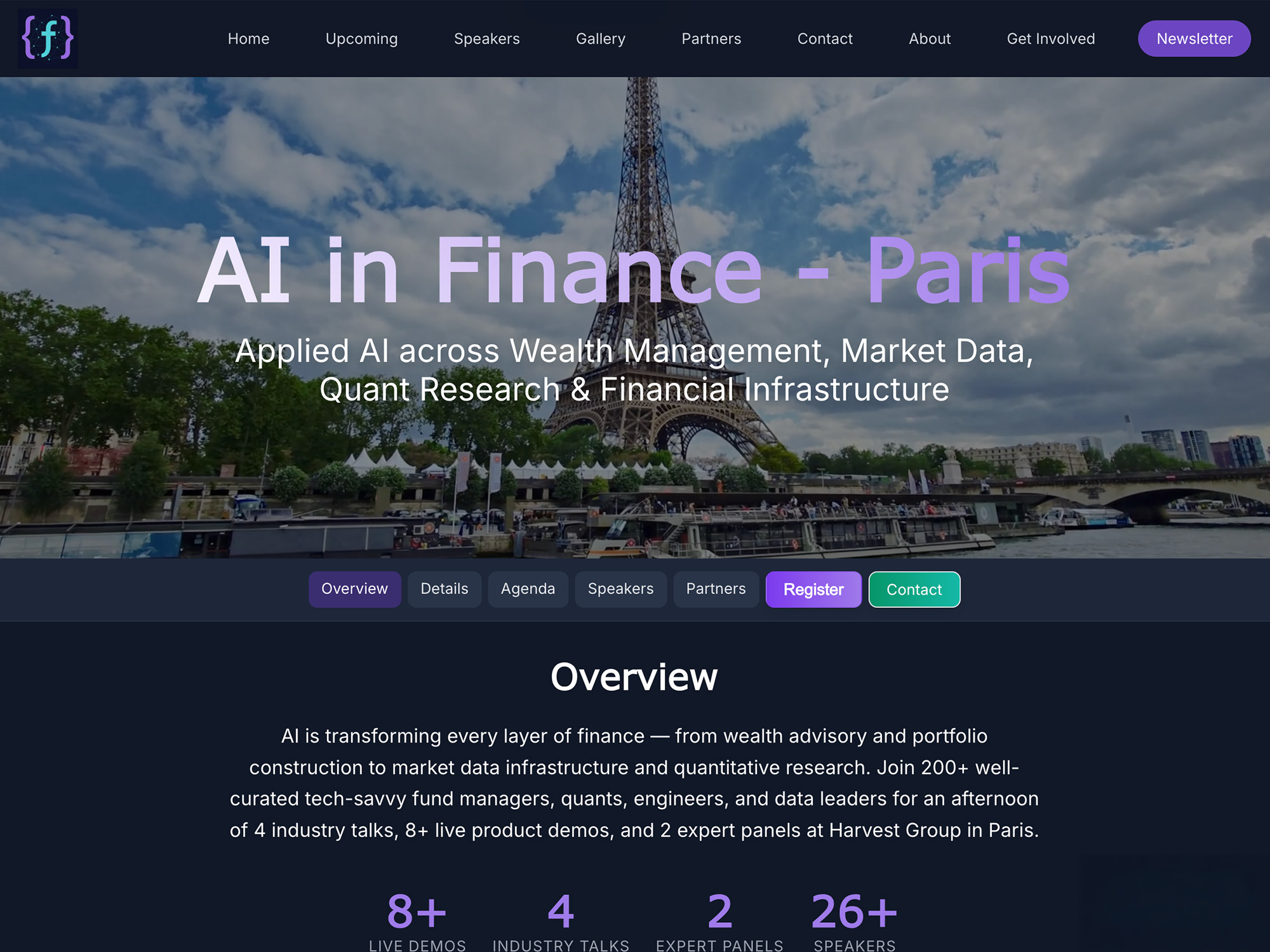
Finance Loop was a partner of AI in Finance Paris, organized by Finteda, with speakers from BNP Paribas, Deutsche Bank and Berenberg, and it supported the AI & Financial Market Data meetup in Paris, hosted at FactSet. It partnered with VI3NNA Congress in Vienna, a forum on AI, finance and web3, and took part in the Point Zero Forum in Zurich, where AI agents that execute transactions were on the agenda next to stablecoins. In Frankfurt, Finance Loop presented an official side event of AI Week Frankfurt on AI and blockchain in finance, and it cooperates with Frankfurt Data Science on AI and data science events. Frankfurt Digital Finance, a Finance Loop partner, has GenAI and European regulation on its program next to digital money.
Investment & Digital Assets
Payments & Digital Money
How does the EU AI Act affect financial services?
For most AI in banks and insurers, such as drafting assistants or fraud models, the act adds transparency and AI literacy duties. The heavy duties apply to credit scoring of private persons and to pricing in life and health insurance: risk management, documentation, logging, human oversight and, for the user, a fundamental rights assessment before first use.
What does the European Banking Authority say about AI?
The EBA found no significant contradictions between the AI Act and EU banking and payments law and sees the two as complementary. It plans no new guidelines for now and works on a common supervisory approach between financial supervisors and AI market surveillance authorities.
How are asset managers in Europe using AI?
According to ESMA's survey of EU securities markets, mostly for internal work: drafting and summarizing, internal assistants and code generation. Portfolio optimization and algorithmic trading with AI were rare, and funds that advertise AI in their investment process are a small niche. The AI in asset management page goes into detail.
Is there an AI in finance conference in Europe?
Several. Finance Loop partnered with AI in Finance Paris and VI3NNA Congress in Vienna, and took part in the Point Zero Forum in Zurich. In Germany, fAInance near Frankfurt Airport and KI Exchange in Hamburg focus on AI for financial institutions. Current dates are on the events page.
AI in finance in Europe and Finance Loop
AI in European finance runs under one AI law and through all three Finance Loop tracks. Finance Loop partnered with AI in Finance Paris and VI3NNA Congress in Vienna and took part in the Point Zero Forum in Zurich.
Finance Loop is a professional network and has the goal of driving the adoption of emerging technologies in finance, such as AI, tokenization, stablecoins, and DeFi. Finance Loop helps its members build skills and personal networks in these fields: Investment & Digital Assets, Payments & Digital Money, and Risk & Compliance.