
Crypto payments
Crypto payments are purchases that a customer pays at the checkout of a shop with crypto assets such as bitcoin, or with stablecoins that track a currency. The customer sends the tokens from a wallet app, usually after scanning a QR code that shows the amount, and the transfer is recorded on a public blockchain. The price stays in euros, and the token amount is calculated from it.
Most merchants in Europe do not keep the tokens they receive. A payment processor quotes the token amount for the order, takes the incoming crypto assets, converts them and pays the merchant in euros, so the shop carries no price risk from a volatile coin. A merchant that accepts tokens into a wallet of its own keeps that price risk and has to convert the tokens itself.
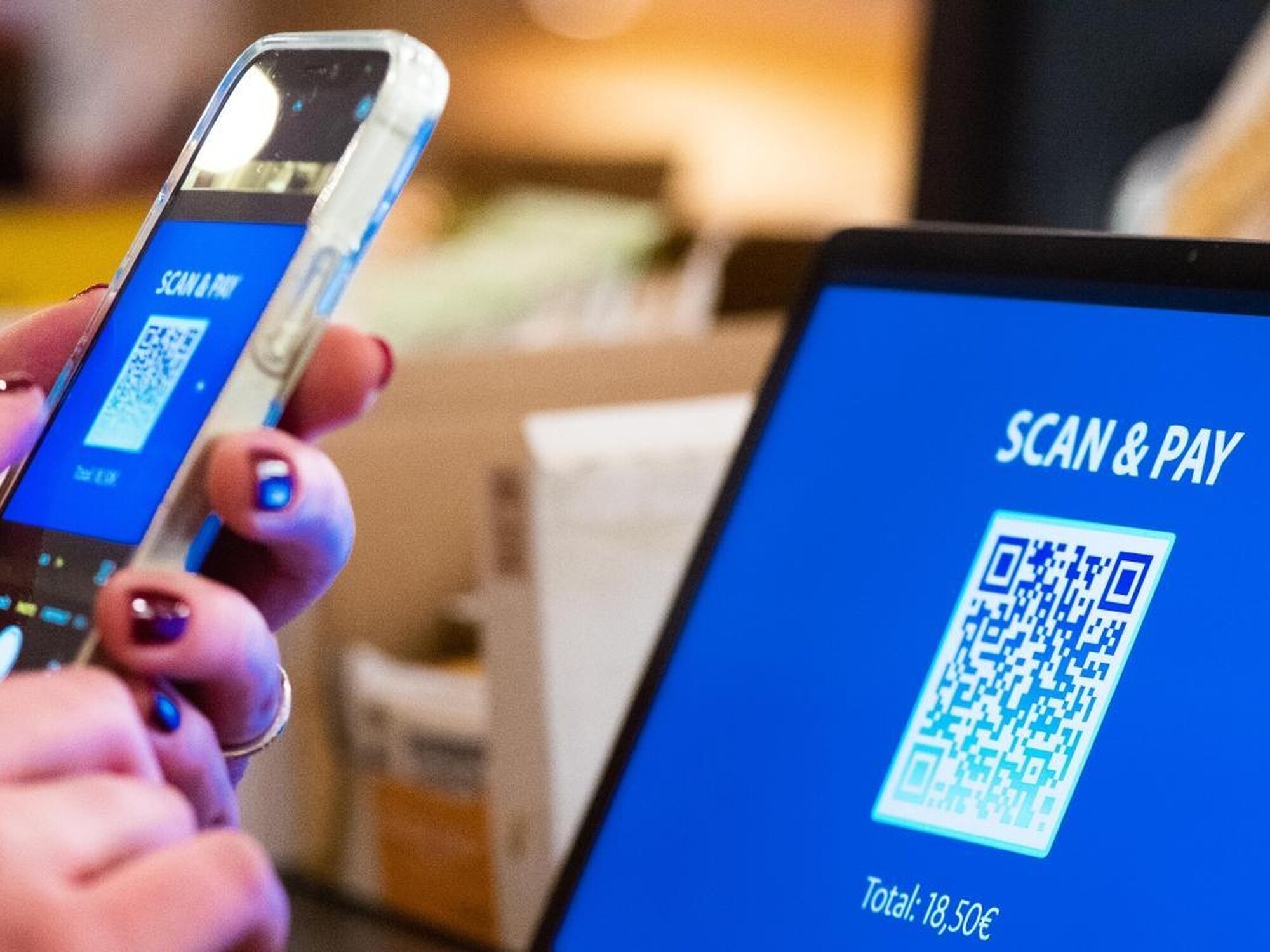
From QR code to euro payout
At a crypto checkout the shop shows the price in euros, and the processor turns it into a token amount on a network the customer picks. The customer confirms the transfer in a wallet, and the processor records the payment once the network has confirmed it. Stripe takes USDC on Ethereum, Solana, Polygon, Base and Tempo as stablecoin payments, sends the customer to a separate page to connect the wallet and credits the merchant in local currency. For businesses in the EU and Switzerland the method runs as a private preview, with a limit of 10,000 US dollars per transaction. Refunds go back in stablecoins to the wallet the customer paid from, and the method has no disputes, because the customer authorizes every transfer.
Bitpanda Enterprise offers Crypto Pay, where customers sell a crypto asset of their choice from their Bitpanda account at the checkout. The merchant receives the full amount in euros in daily bulk payouts, and Bitpanda Payments GmbH runs the service under a PSD2 license. In both models the shop never holds a token, so its books and its prices stay in euros.
Licenses under MiCA and PSD2
The payment processor that sits between the shop and the customer needs an authorization of its own. Under MiCA, exchanging crypto assets for funds and transferring crypto assets on behalf of clients are crypto-asset services. In the EU only firms with a CASP license and, after a notification, banks and other licensed financial firms may offer them. Providers that were active before 30 December 2024 could continue under national transitional rules, which ended on 1 July 2026 at the latest.
Stablecoin payments also fall under payment law, which adds a second license to MiCA. The European Banking Authority advised national supervisors in a no action letter of 10 June 2025 to treat the transfer of e-money tokens on behalf of clients as a payment service under PSD2, with a transition period that ended on 2 March 2026. Article 70(4) of MiCA allows a crypto-asset service provider to offer payment services linked to its crypto services only if it or a partner holds a PSD2 authorization. A processor that transfers euro or dollar stablecoins for merchants therefore works under both regimes.
The travel rule at the checkout
Since 30 December 2024 the Transfer of Funds Regulation applies the travel rule to crypto assets. A crypto-asset service provider sends the name and the wallet address or account number of payer and payee with every transfer, and the regulation sets no minimum amount for crypto transfers. When a customer pays from a self-hosted wallet, the receiving provider obtains and keeps this information itself. For amounts above 1,000 euros it must also take adequate measures to assess whether the address is owned or controlled by its own client.
The provider of the merchant needs procedures for transfers that arrive with missing or incomplete information. Under Article 17 it decides on a risk basis whether to execute, reject, return or suspend such a transfer, or it asks for the missing data before the merchant receives the funds. These checks come on top of the anti-money laundering rules for crypto that apply to every licensed provider.
Tax in Germany for customers and merchants
The Federal Ministry of Finance sets out the income tax rules in its letter of 6 March 2025 on crypto assets. A private person who pays for goods or services with crypto assets sells them for tax purposes. The sale proceeds are the price agreed in euros, or the market value of the tokens if the parties agreed no euro price. Whether the gain is taxed depends on the one-year holding period for crypto in Germany and on an exemption limit of 1,000 euros per year.
For a business that holds crypto assets as business assets, the proceeds of a sale are business income, and the one-year rule for private assets does not apply. On VAT, the Court of Justice of the EU ruled in the Hedqvist case that exchanging traditional currencies for bitcoin and back is a supply of services exempt from VAT.
Upcoming payments events in Europe
How does paying with crypto work?
The customer opens a wallet app, scans the QR code at the checkout and confirms a transfer of the token amount shown for the order. A processor converts the tokens and pays the merchant in euros, so the shop books an ordinary sale. Stablecoin cards work the other way round, because the card program converts the tokens before the payment and the shop receives a normal card payment.
How can a business accept crypto payments?
A business can connect a crypto payment processor to its online checkout or point of sale, or it can publish the address of a wallet it controls. With a processor, the shop is paid in euros and the processor holds the licenses that MiCA requires. With its own wallet, the business keeps the tokens and the price risk, and it needs a stablecoin off-ramp or an exchange to convert them into euros.
Is crypto legal tender in Germany?
Crypto assets are not legal tender in Germany or anywhere else in the euro area. Under Article 128 of the Treaty on the Functioning of the European Union, euro banknotes are the only notes with that status, so nobody in Germany has to accept bitcoin or a stablecoin. Paying with crypto assets is legal when both sides agree, and the rules on the legal tender of the euro leave a shop free to offer crypto as an additional payment method.
Do I pay tax when paying with crypto?
For a private person in Germany, every payment with crypto assets counts as a sale of those assets under the letter of the Federal Ministry of Finance. The gain is the agreed euro price minus the amount the tokens cost when they were bought. That gain is taxable if the tokens were held for one year or less and the total of all private sale gains in the year reaches 1,000 euros.
Which stablecoins can a shop accept in the EU?
A stablecoin that tracks one official currency is an e-money token under MiCA, and only a bank or an electronic money institution may issue it. Euro stablecoins spare a shop that prices in euros any currency conversion at the checkout. For tokens in other currencies, such as the US dollar, Articles 23 and 58 of MiCA require the issuer to stop issuing once the token is used for more than 1 million transactions and 200 million euros a day as a means of exchange within a single currency area.
Crypto payments and Finance Loop
Finance Loop covers crypto payments in its Payments & Digital Money track, next to stablecoins and instant payments. Finance Loop supported the German Blockchain & AI Week 2025 in Berlin, whose conference program included a session titled Crypto Payments and Interchain.
Finance Loop is a professional network and has the goal of driving the institutional use of emerging technologies in finance, such as AI, digital payments, cloud and blockchain solutions. Finance Loop helps its members build skills and personal networks in these fields: Investment & Digital Assets, Payments & Digital Money, Digital Infrastructure & Sovereignty, and Risk & Compliance.