
E-money token
An e-money token is a crypto-asset designed to keep a stable value by referring to one official currency, such as the euro. It records electronic money on a distributed ledger and gives its holder a claim on the issuer. Businesses and individuals can transfer these tokens as a form of digital money, including when paying for tokenized assets.
Like the electronic money in a prepaid card or PayPal balance, an EMT gives its holder a claim on the issuer. Under MiCA, issuers are generally banks or electronic money institutions, and holders can redeem tokens at face value at any time. Euro examples include EURC issued by Circle and EURAU from Frankfurt.
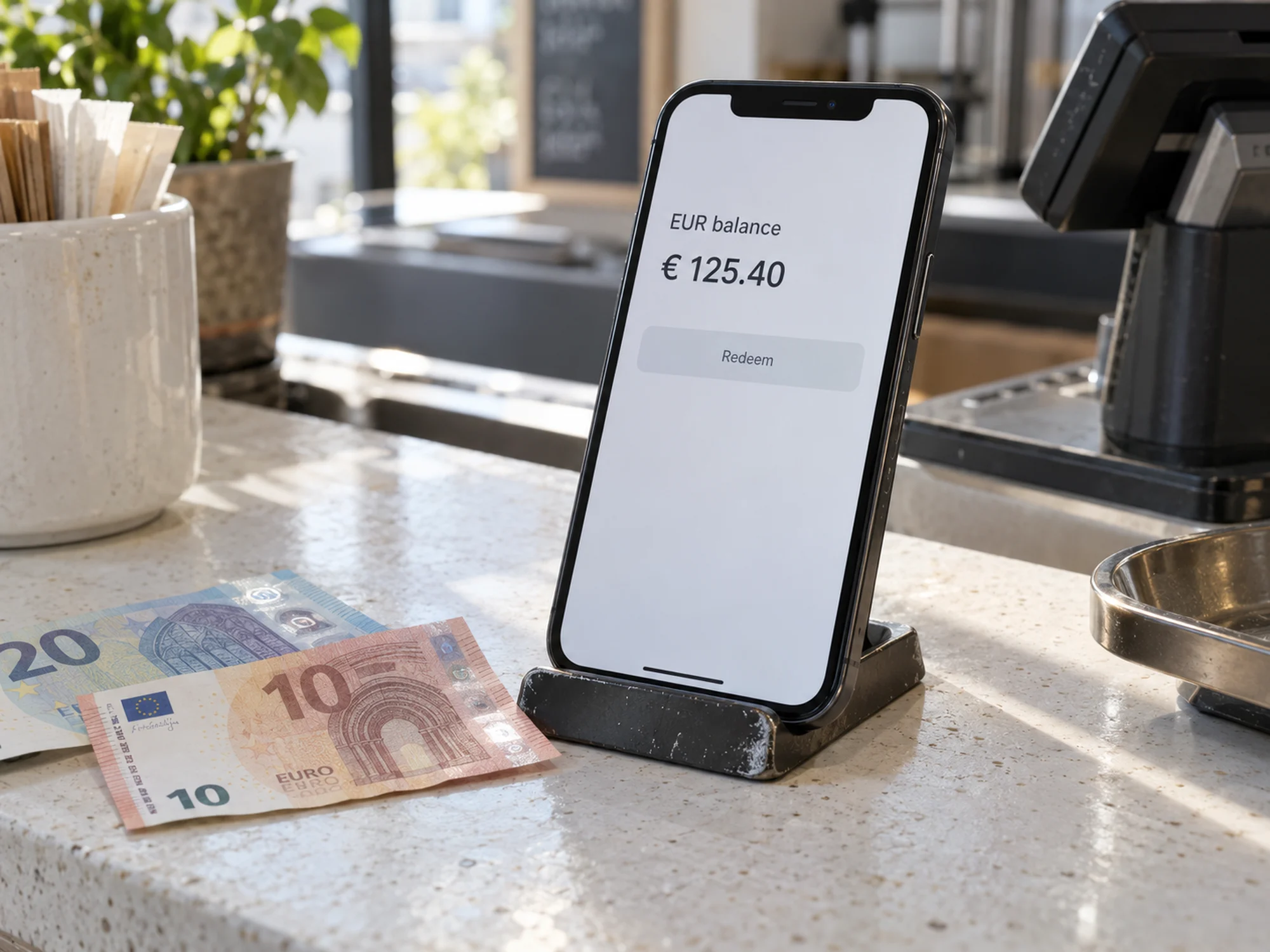
From electronic money to e-money tokens
Electronic money is regulated in the EU under the E-Money Directive 2009/110/EC, and in Germany BaFin licenses its issuers. MiCA, Regulation (EU) 2023/1114, defines an e-money token as a crypto-asset that keeps a stable value by referencing the value of one official currency. Under Article 48, e-money tokens are deemed electronic money. Only a credit institution or an electronic money institution may offer one to the public in the EU, after notifying a crypto-asset white paper to its supervisor at least 40 working days in advance.
The white paper carries prospectus-style liability: a Deloitte Legal analysis points out that the members of the issuer's management body are personally liable for its accuracy and completeness, next to the issuer itself.
Redemption, interest and reserves
An issuer has to issue the token at par when it receives the funds and redeem it at par at any time on the holder's request, without a fee, under Article 49. Article 50 bans interest: neither the issuer nor a crypto-asset service provider may pay anything tied to how long a holder keeps the token, including discounts or rewards from third parties with the same effect.
The money behind the tokens is invested under Article 54: at least 30 percent sits in separate accounts at credit institutions, and the rest goes into secure, low-risk, highly liquid instruments in the same currency. Read more about the rules that apply to stablecoin reserves.
E-money token or asset-referenced token
MiCA has a second stablecoin category: an asset-referenced token (ART) tracks something other than one official currency, such as a basket of currencies, a commodity or another crypto-asset. The asset-referenced token's issuer needs a MiCA authorization of its own, and the token is not electronic money. A token that tracks only the euro is always an EMT.
Size changes the supervisor: the European Banking Authority assesses whether a token is significant, using quantitative thresholds and qualitative criteria. For a significant ART the EBA takes over supervision completely; for a significant EMT issued by an electronic money institution it supervises jointly with the national authority and looks at liquidity and capital.
E-money tokens in Germany
AllUnity, founded by DWS, Flow Traders and Galaxy, issues the euro token EURAU from Frankfurt under a BaFin e-money institution license. Circle issues USDC and EURC under a French license, which MiCA's single license lets it use in Germany. Firms that hold or transfer EMTs for clients can need a payment services license next to their MiCA authorization; Tangany in Munich holds one for this business.
On the capital markets side, 21X settles tokenized securities against e-money tokens on chain under the DLT Pilot Regime. Banks look at a neighboring instrument, the tokenized deposit, which stays a bank deposit; compare these instruments with tokenized deposits.
Upcoming events on stablecoins and digital money in Germany
Finance Loop and e-money tokens
Finance Loop supported the Bybit EU x Circle Roadshow in Frankfurt, with panels on USDC and EURC, and is media partner of Capital & Code, hosted by AllUnity. At the Frankfurt Forum on Digital Assets & Applications, which Finance Loop covers, AllUnity, Deutsche Bundesbank, Deutsche Bank, Commerzbank and DZ Bank discussed payments in DLT-based markets. Finance Loop is also a strategic partner of Frankfurt Main Finance and TechQuartier.
Payments & Digital Money
Risk & Compliance
What is an e-money token?
An e-money token is a crypto-asset under MiCA that keeps a stable value by referencing one official currency, such as the euro or the dollar. The e-money token counts as electronic money, so only a bank or an electronic money institution may issue it, and holders can redeem it at par at any time.
What is the difference between an EMT and an ART?
An EMT references one official currency and is electronic money. An asset-referenced token references anything else, for example several currencies or gold, and needs a separate MiCA authorization.
Can an e-money token pay interest?
Article 50 of MiCA forbids issuers and crypto-asset service providers from granting interest or any other benefit tied to the holding period.
Is every euro stablecoin an e-money token?
Under MiCA, yes: a token that keeps its value by referencing the euro alone is an e-money token. Compare the euro stablecoins that are offered in the European Union.
E-money tokens and Finance Loop
Finance Loop covers e-money tokens in its Payments & Digital Money track and, as settlement assets for tokenized securities, in Investment & Digital Assets. Finance Loop works with AllUnity as media partner for its event Capital & Code and with the Digital Euro Association as partner, and holds events in Frankfurt, Munich, Berlin and Hamburg.
Finance Loop is a professional network supporting the institutional use of emerging technologies in finance, such as AI, digital payments, cloud and blockchain solutions. Finance Loop helps its members build skills and personal networks in these fields: Investment & Digital Assets, Payments & Digital Money, Digital Infrastructure & Sovereignty, and Risk & Compliance.