
Investment & Digital Assets
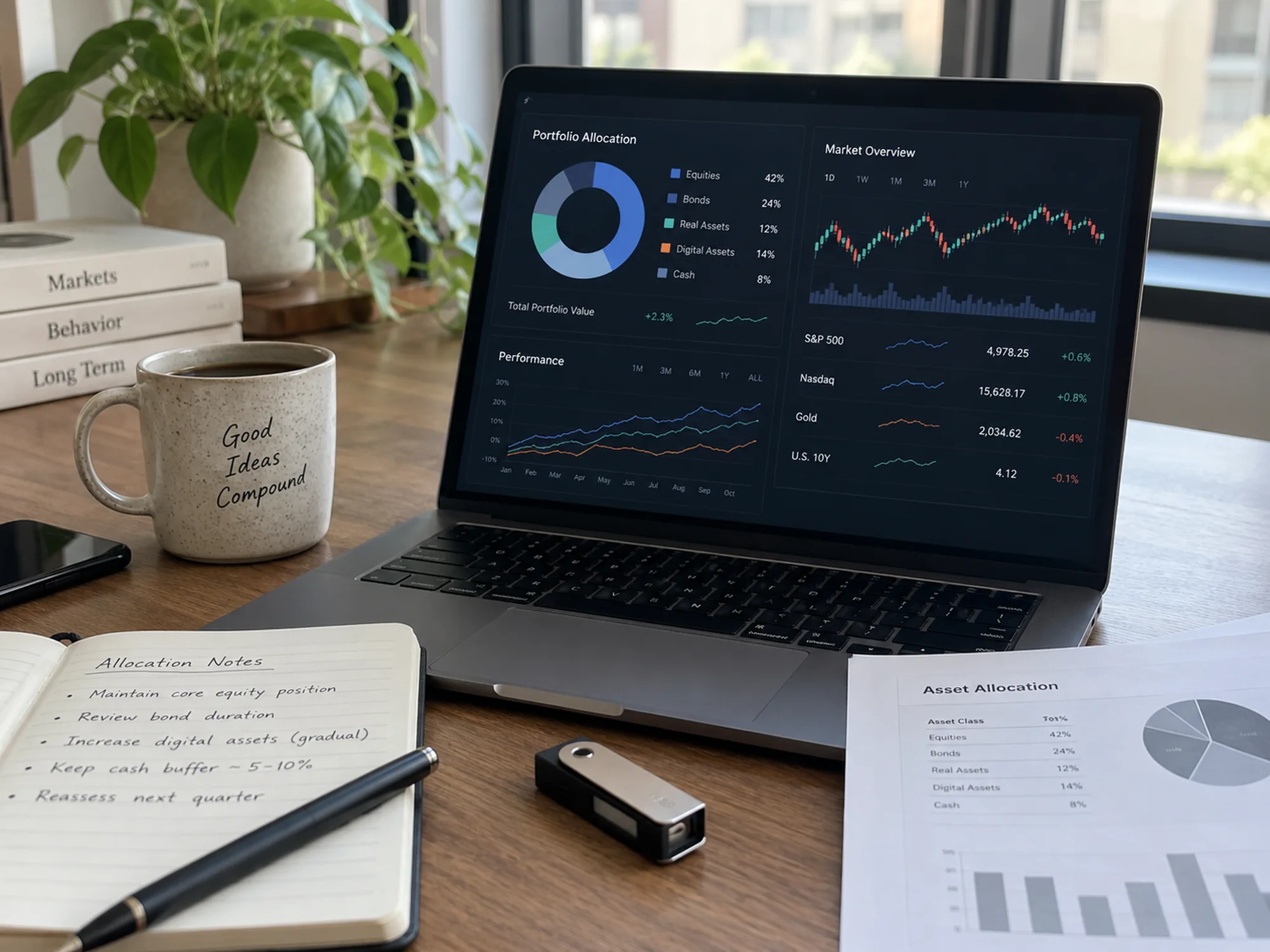
Investment & Digital Assets is one of the focus topics of Finance Loop. Professional investment starts with a mandate: portfolio construction turns objectives into holdings, while strategic asset allocation sets long-term targets. Rebalancing and performance attribution help manage and assess the result. Digital wealth management and AI change how firms deliver these services; fund administration and investment data systems support them behind the scenes. Asset tokenization adds a distinct set of instruments and custody questions. In Frankfurt, Deutsche Börse operates the Frankfurt Stock Exchange and Xetra.
Get into the Loop
Get news about emerging tech in finance, events and learning opportunities.
Collaborate with Finance Loop

Contact Finance Loop to discuss collaborating on Investment & Digital Assets.
-
What are capital markets?
Capital markets are where companies and states raise long-term money with shares and bonds. How equity and debt markets work and what the EU plans for them. -
Primary market vs secondary market: what is the difference?
On the primary market an issuer sells new shares or bonds; on the secondary market investors trade them. How the two differ, with examples for stocks and bonds. -
What is a market maker?
A market maker quotes a buy and a sell price for a security and trades at both with its own money. Market making under MiFID II, on Xetra and in DeFi pools. -
What is an order book?
An order book lists all open buy and sell orders for a security, sorted by price. How matching by price/time priority works and what MiFIR makes venues publish. -
What is WealthTech?
WealthTech is software for wealth management and private investors, from robo-advice to portfolio tools. What it covers and which licenses apply in DACH. -
What is a robo-advisor?
A robo-advisor gives investment advice or manages a portfolio with an algorithm. How it works and which suitability rules ESMA applies to it under MiFID II. -
How is AI used in wealth management?
AI in wealth and asset management mostly helps staff draft and summarize, with a human in charge. Where it is used and what the EU AI Act requires from 2026. -
What is portfolio construction?
Portfolio construction turns an investment mandate into assets, weights and risk limits. How institutional teams build, test and monitor portfolios in DACH. -
What is strategic asset allocation?
Strategic asset allocation sets long-term portfolio targets from goals, liabilities and risk capacity. How professional investors set and review the policy. -
What is portfolio rebalancing?
Portfolio rebalancing brings weights back toward policy targets. Compare calendar and threshold rules, cash flows, trading costs and DACH obligations. -
What is performance attribution?
Performance attribution explains a portfolio's return against a benchmark. Learn allocation and selection effects, model limits and institutional use in DACH. -
What are model portfolios?
Model portfolios set reusable target holdings or weights for a defined investment objective. Learn how advisers adapt and monitor them under DACH rules. -
What is digital wealth management?
Digital wealth management connects onboarding, advice, portfolios and reporting through software. See hybrid services, platform choices and DACH duties. -
What is a portfolio management system?
A portfolio management system connects holdings, risk, proposed trades and mandate controls for investment teams. See its functions and data dependencies. -
What is an investment book of record?
An investment book of record gives managers an intraday view of holdings, cash and exposures. Learn how an IBOR differs from accounting and trading systems. -
What is fund administration?
Fund administration covers accounting, NAV, investor records and reports. Understand how the administrator differs from the manager and depositary in DACH. -
How is net asset value calculated?
NAV is fund assets minus liabilities; NAV per unit divides that sum by outstanding units. Learn the formula, valuation inputs and DACH fund controls. -
What are digital assets?
Digital assets are assets held and transferred as electronic records, from tokenized bonds to bitcoin. The MiCA definition, its exclusions and the DACH rules. -
What is tokenization of assets?
Tokenization of assets records an asset such as a bond or fund unit as a token on a programmable ledger. The steps, the custody question and DACH law. -
What are tokenized securities?
Tokenized securities are shares and bonds issued or recorded on a distributed ledger. How the German eWpG, the EU DLT Pilot Regime and Swiss law treat them. -
What are tokenized funds?
Tokenized funds are investment funds whose share register sits on a distributed ledger. Money market fund tokens, the German KryptoFAV and the risks explained. -
What are real world assets?
Real world assets (RWA) in crypto are tokens for assets that exist off the blockchain, such as bonds, fund shares, property or gold. Examples, rules and risks. -
Security tokens vs utility tokens: what is the difference?
Security tokens give rights like shares or bonds and fall under securities law; utility tokens give access to a service and fall under MiCA. The tests compared. -
What is crypto custody?
Crypto custody is the safekeeping of crypto-assets or their private keys for clients. MiCA Article 75 duties, custodial vs self custody, the German KWG license. -
What is a bitcoin ETF?
A bitcoin ETF is an exchange-traded product that holds bitcoin through a custodian. The SEC approval of January 2024, why UCITS hold none, and ETNs in Europe. -
What is AI in trading?
AI in trading is the use of machine learning to analyze, time and execute orders. How it works, where MiFID II Article 17 applies and what ESMA says. -
What is bitcoin?
Bitcoin is a digital currency that runs on a public ledger without a bank. How it works, proof of work, the 21 million cap and its status under MiCA. -
What is decentralized finance?
Decentralized finance (DeFi) runs financial services such as loans and trades through smart contracts on public blockchains. How it works, its risks and MiCA. -
DeFi vs CeFi vs TradFi: how do they differ?
TradFi runs through banks, CeFi through crypto companies, DeFi through smart contracts. A comparison of records, leverage, protection and EU rules. -
What is a liquidity pool?
A liquidity pool is a stock of two tokens in a smart contract that traders swap against. How the x*y=k formula sets prices, what impermanent loss is. -
Yield farming vs staking: how do they differ?
Yield farming moves crypto-assets between DeFi pools to earn fees; staking locks a proof-of-stake asset for block rewards. Returns, risks and EU law compared. -
DEX vs CEX: what is the difference?
A DEX is a crypto exchange run by smart contracts; a CEX is run by a company that holds client assets. Trading, custody, volume, risks and MiCA compared. -
What is AI in finance?
AI in finance is the use of learning computer models by banks, insurers and asset managers. Use cases, risks, the EU AI Act and the supervisors in DACH. -
What is a blockchain oracle?
A blockchain oracle delivers outside data such as prices or a fund's net asset value to a smart contract. How oracles work, their types and their risks. -
How do smart contracts work?
A smart contract is a program on a blockchain that executes an agreement when set conditions are met. How it works on Ethereum and what the EU Data Act asks. -
What is staking?
Staking locks crypto-assets at a validator of a proof-of-stake blockchain. How staking works, which rewards and risks it has, what MiCA and FINMA say. -
What is a layer 2 blockchain?
A layer 2 blockchain processes transactions off the main chain and settles them there. Rollups on Ethereum, the Lightning Network on Bitcoin, and EU law. -
What is a crypto wallet?
A crypto wallet stores the private keys to crypto-assets and signs transactions. Custodial vs non-custodial, hot vs cold, and what MiCA asks of custodians. -
What is a private key vs a seed phrase?
A private key signs transactions for one address; a seed phrase of 12 to 24 words creates all keys of a wallet. How BIP-39 and BIP-32 work, and custody rules. -
What is a hardware wallet?
A hardware wallet keeps private keys offline and signs crypto transactions inside the device. How signing and the secure element work, and what it cannot stop.
Where to start
Start with portfolio construction to see how an investment mandate becomes holdings. Strategic allocation sets the policy, while rebalancing and performance attribution explain how professionals maintain and assess a live portfolio. Digital assets and tokenization form a separate part of this collection.