
Quantum computing and finance in Frankfurt
Quantum computing matters to Frankfurt finance in two ways. It may one day speed up portfolio optimization and risk simulation, and it threatens the public-key cryptography that protects payments and bank data today. The EU wants finance and other high-risk systems moved to quantum-safe cryptography by the end of the decade. Dated events are in the calendar below.
What quantum finance means
Quantum finance, in the sense banks use the term, is the application of quantum computers to financial problems. A quantum computer works with qubits, which can hold combinations of states at once, and for some kinds of problems that promises a speed-up over classical computers. Three areas of finance come up again and again. Optimization: choosing the best portfolio under many constraints, or the best way to post collateral. Simulation: the Monte Carlo runs behind option pricing and risk measures such as value at risk, which take hours on classical machines. And machine learning, where quantum methods may find patterns in data for credit or fraud models.
Today these are research and pilot topics. The machines available now are small and make errors, so banks test quantum algorithms on narrow problems and compare them with classical methods. The work sits with quant teams, research units and technology partners, and it depends on people who understand both the mathematics of finance and the physics of the machines.
The risk: quantum computers and bank encryption
The more urgent topic for banks is defense. The public-key methods behind online banking, card payments and secure messaging between banks rely on math problems that a large enough quantum computer could solve. Attackers can already record encrypted traffic today and decrypt it later, once such a machine exists, so data that must stay secret for years is at risk now. The same applies to crypto assets: the signatures that protect bitcoin and other coins use the same kind of public-key cryptography.
At a Quantum Safe Financial Forum convened by Europol, banks and experts issued a call to action for financial institutions and policymakers to make the move to quantum-safe cryptography a priority. Europol notes that estimates put such quantum computers ten to fifteen years away, while the move to new cryptography in a large bank can take about as long. The forum recommended coordinated roadmaps, a voluntary framework, modern crypto governance and international cooperation.
The EU roadmap and what banks do now
The EU has set a timetable. Its coordinated implementation roadmap for the transition to post-quantum cryptography, written by the NIS Cooperation Group, asks member states to start right away with national plans and inventories, to protect high-risk use cases, which include finance, by the end of this decade, and to complete the move for all systems about five years later. For a bank this work runs through its ICT risk management under DORA.
The first practical step is an inventory: where does the bank use which cryptography, in which systems, with which suppliers? Many banks find old algorithms deep inside payment systems, hardware security modules and vendor software. The next step is crypto agility, building systems so that an algorithm can be swapped without rebuilding the application. The page on cybersecurity in finance in Germany covers the wider security program, and risk management in Frankfurt the risk models that quantum computing may speed up.
Quantum finance in Frankfurt
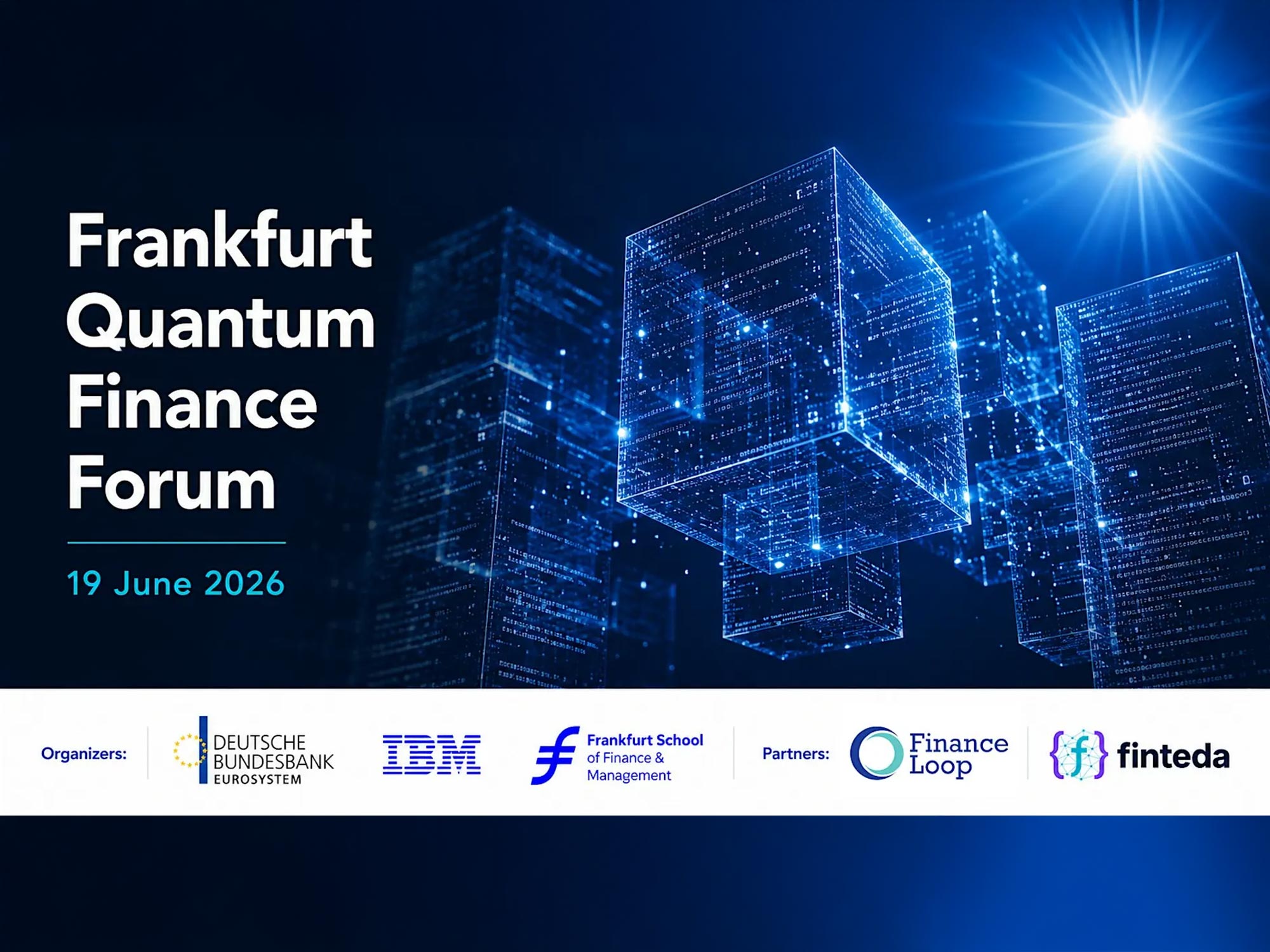
Frankfurt brings together the parties that have to agree on a move of this size: the central banks, the supervisors, the large banks, the exchange operators and the Frankfurt School of Finance & Management. The Frankfurt Quantum Finance Forum at Frankfurt School was organized by Frankfurt School together with the Deutsche Bundesbank, IBM, Finance Loop and Finteda. It brought banking, technology, regulation and academia together on portfolio optimization, risk modeling, cryptography and trading, and on how the industry prepares.
Someone new to the topic should start with the cryptography side, because it has deadlines, and learn the difference between quantum computing and quantum-safe cryptography: the second runs on normal computers and protects against the first. The applications side needs linear algebra, probability and some patience, since results that beat classical methods in production are still rare.
Upcoming events in Frankfurt
Quantum computing at Finance Loop
Finance Loop is the meeting place for quants, security architects, risk managers and technology partners who work on quantum computing in finance. It connects the finance, IT and AI communities in Frankfurt and holds events in Munich, Berlin and Hamburg as well.
Finance Loop co-organized the Frankfurt Quantum Finance Forum with Frankfurt School, the Deutsche Bundesbank, IBM and Finteda, a free in-person conference on quantum computing's financial applications and industry readiness. Frankfurt Digital Finance at the Gesellschaftshaus Palmengarten, where Finance Loop is a partner, had quantum technology on the program of its first day.
Investment & Digital Assets
Payments & Digital Money
What is quantum finance?
It is the use of quantum computers for financial problems such as portfolio optimization, risk simulation and pricing. The term also covers the other side: protecting financial systems against quantum computers that could break today's encryption.
What are the use cases of quantum computing in banking?
Portfolio and collateral optimization, Monte Carlo simulation for pricing and risk, and machine learning for credit and fraud models. Most are in research or pilot stage, tested against classical methods on narrow problems.
What is post-quantum cryptography in banking?
It is the move from today's public-key algorithms to new ones designed to resist quantum computers. The EU roadmap asks for high-risk systems, finance included, to move first. Banks start with an inventory of their cryptography and plan the migration within their DORA ICT risk management.
Is quantum computing a risk to bitcoin?
In the long run, yes, as for all systems built on today's public-key signatures. A large quantum computer could derive private keys from exposed public keys. How and when bitcoin moves to quantum-safe signatures is an open question in its developer community.
Is there a quantum finance conference in Frankfurt?
Yes. The Frankfurt Quantum Finance Forum at Frankfurt School, co-organized by Finance Loop, is a conference on quantum computing in finance. Dates of Finance Loop events are in the calendar on this page.
Quantum computing in Frankfurt and Finance Loop
Finance Loop co-organized the Frankfurt Quantum Finance Forum with Frankfurt School, the Deutsche Bundesbank, IBM and Finteda. Quantum computing reaches into the Risk & Compliance track through cryptography and into Investment & Digital Assets through optimization and the security of crypto assets, and the people working on it meet at Finance Loop events across Germany, Austria and Switzerland.
Finance Loop is a professional network and has the goal of driving the adoption of emerging technologies in finance, such as AI, tokenization, stablecoins, and DeFi. Finance Loop helps its members build skills and personal networks in these fields: Investment & Digital Assets, Payments & Digital Money, and Risk & Compliance.