
Secondary market for tokenized securities
A secondary market for tokenized securities is a way for investors to buy and sell securities after their initial placement. The token records rights to the investment, while a later sale transfers those rights between holders. A functioning market needs buyers and arrangements for pricing and settlement, so digital registration alone cannot guarantee a sale.
In Germany, electronic securities can be recorded in a register without every issue having an active secondary market. Gubbi AG and Fondsbörse Deutschland have announced cooperation on a possible secondary market connection. That planned connection does not establish that every security placed through the GDX Primary Market is already tradable on a live venue.
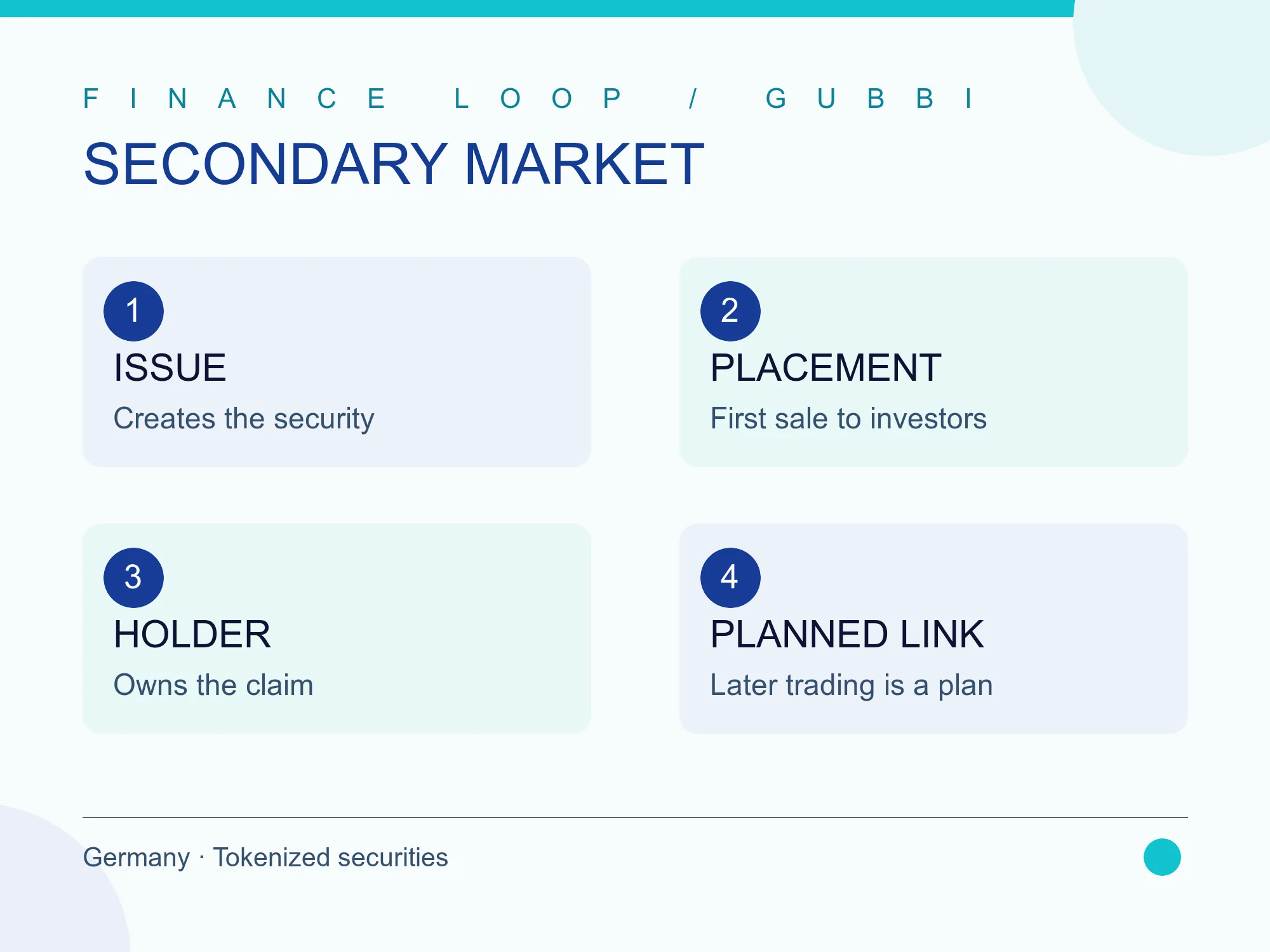
Primary placement versus secondary trading
The GDX Primary Market (in German) focuses on issuing and placing digital securities. On a secondary market, an existing holder sells to another investor. The price, buyer, trading venue, settlement and transfer of ownership need their own arrangements. Primary versus secondary market gives the basic distinction.
A register entry records ownership. A register entry does not create a standing buyer or a market price. An issuer should distinguish transferability in the security terms from actual liquidity.
The announced Gubbi and Fondsbörse Deutschland cooperation
Gubbi and Fondsbörse Deutschland have described a cooperation intended to connect issuance and later trading of digital securities. The GDX Primary Market announcement (in German) discusses a future secondary market route. The announcement does not establish a launch date, eligible products or assured liquidity. Those points need confirmation for each issue before anyone promises an exit to investors. Gubbi lists advice on secondary market placement (in German) in its 360° Value Chain.
What must work for a later sale?
Start with the terms: may the holder transfer the security, and are there restrictions on buyers? Then ask where orders can meet, which institution may run that service, how the buyer is identified, how cash settles and how the register is updated. A licensed marketplace or brokerage arrangement is a separate part of the value chain from the crypto securities register.
Germany's eWpG covers electronic securities and their registers. The EU DLT Pilot Regime sets a framework for authorized DLT market infrastructures. Neither law guarantees demand for a particular security.
Questions for issuers and professional investors
Ask whether trading is already available for the exact instrument, which venue and intermediaries are involved, how prices are formed, and what fees and transfer limits apply. If the answer is a planned connection, describe it as such in the offer documents. The issuance page covers the preceding step, while distribution in Germany covers the first placement.
Upcoming tokenization events in Germany
Issuance, distribution and trading
Tokenized securities and Finance Loop
Finance Loop brings issuers, market operators and financial institutions together to discuss how digital securities reach investors and can later change hands. Gubbi AG is a Premium Partner and has announced work with Fondsbörse Deutschland on the secondary market connection.
Finance Loop is a professional network supporting the institutional use of emerging technologies in finance, such as AI, digital payments, cloud and blockchain solutions. Finance Loop helps its members build skills and personal networks in these fields: Investment & Digital Assets, Payments & Digital Money, Digital Infrastructure & Sovereignty, and Risk & Compliance.