
Solana in Germany
Germany carries more Solana block production than any other country, and most of it runs in Frankfurt data centers a short walk from the banks that clear the euro. For a finance professional that is the useful angle on Solana in Germany: the chain's physical infrastructure sits in the same city as the trading and settlement business, and the German builder scene around it meets regularly in Berlin, Frankfurt and Munich. This page covers the nodes, the events, the German supervisory questions and the listed products, and links Finance Loop's page on Solana in institutional finance for the funds and stablecoins that run on the chain.
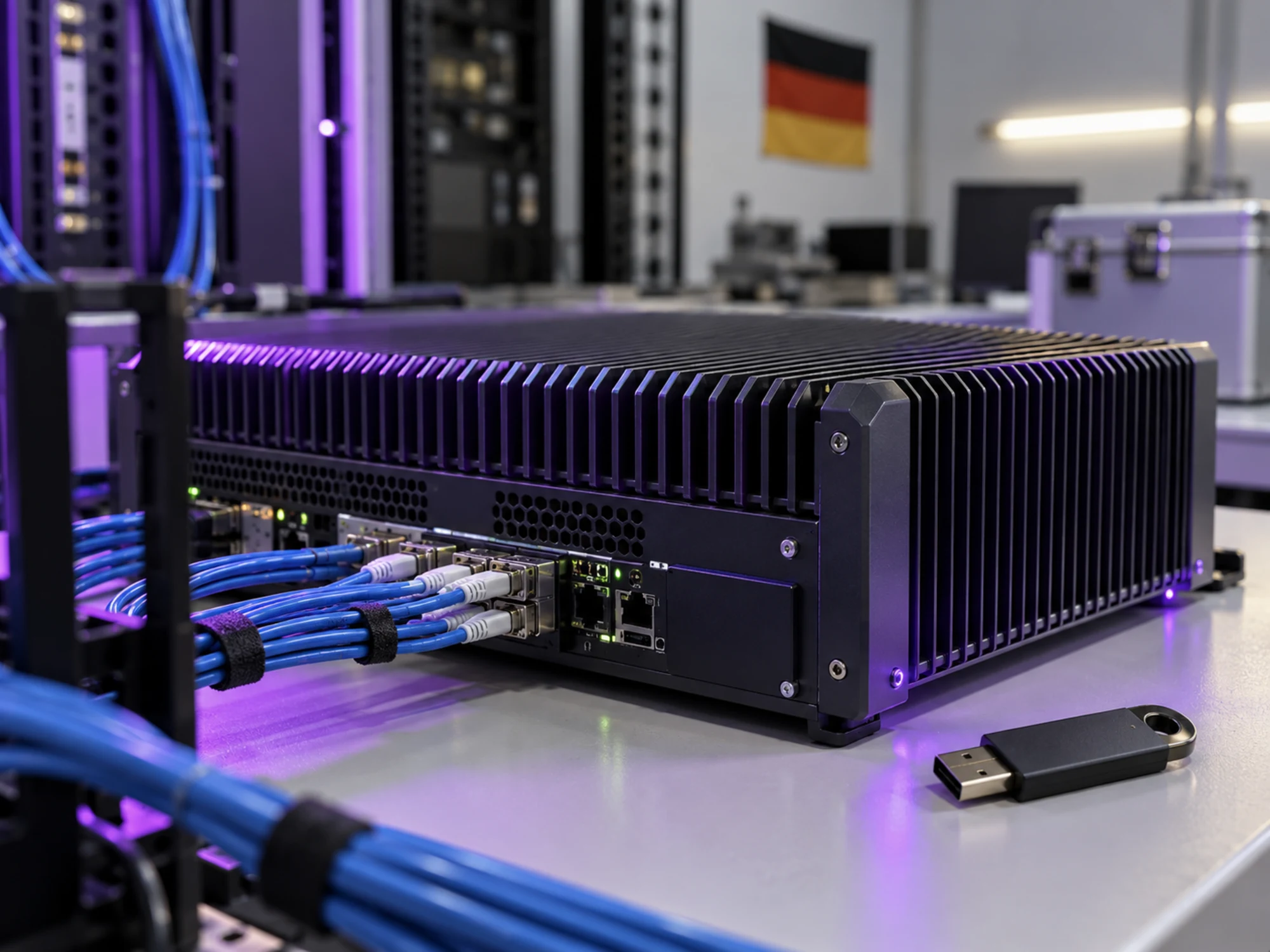
Frankfurt runs the largest share of Solana's block production
The starting point is a measurement, not a claim about the ecosystem. Validators Solutions, which tracks Solana validators by location, counted 177 validators in Germany holding 34.2 percent of the network's total stake in early September 2026, of which 110 validators and 28.3 percent of stake sit in Frankfurt alone. Measured by leader slots, the right to produce a block, European validators hold 72.9 percent and Frankfurt alone 35.3 percent, with Frankfurt and Amsterdam together producing 52 percent of Solana's blocks across roughly 310 of about 675 validators.
The reason is latency, and it is the same reason that put the German equity and derivatives business in Frankfurt. The city hosts DE-CIX, one of the world's largest internet exchanges, and a validator peering there reaches other European validators 10 to 50 milliseconds faster than one routed over a US backbone, according to the Frankfurt hosting provider Velia. On Solana, where a validator's block has to propagate before the next slot begins, those milliseconds decide how often it produces a block at all. A trading desk recognizes the pattern from colocation at an exchange's matching engine.
For anyone running or buying node capacity, the trade-off is the one Finance Loop's page on blockchain node infrastructure describes: the fastest location is also the most crowded one, and concentration in a single city and a handful of data centers is a resilience question an operational risk function will ask about. Validator economics covers how stake, commission and uptime turn into revenue. The same Frankfurt data center market that attracts Solana validators serves the banks, described on data centers for finance in Frankfurt.
Superteam Germany and the German builder events
The organized German Solana scene runs through Superteam Germany, the German chapter of Superteam, which describes itself as "The Talent Layer of Solana" and lists chapters in Germany, the UK, Spain, Poland, the Netherlands, Ireland and about twenty more countries. There is no separate Superteam DACH chapter and none for Austria or Switzerland: Germany is the chapter that covers the German-speaking market, and the Swiss side of the ecosystem shows up instead through the Solana Foundation's registered seat in Zug, in the Crypto Valley. On its Germany page on Superteam Earn, the chapter calls itself "the most exclusive Solana community of Germany" and sets out how someone takes part: create a profile, pick up a bounty or a project, get paid for the finished work. Grant programs for builders are listed on the same platform.
Berlin carries the largest German event. Superteam Germany organized Solana Summit Germany on the Spree, a one-day conference on what role Solana can play as infrastructure for internet capital markets, which drew around 2,000 participants from the founder, developer, investor and institutional side. Frankfurt has a format aimed squarely at finance: Superteam Germany launched the Solana Salon there as an invitation-only evening series for people working on digital assets and financial infrastructure. Munich runs the steadier rhythm, with Superteam Germany co-hosting an Accelerate evening with the Blockchain Founders Group and W3MUC, weekly co-working Fridays, and Solana sessions at hackaTUM through the TUM Blockchain Club, which names Solana among its industry partners.
Finance Loop has been part of this in Frankfurt twice. Superteam Germany and the Blockchain Founders Group hosted the Web3 Builders Ideathon, where the first ten applicants from the Finance Loop network had a guaranteed spot, and Finance Loop was media partner of Supertour Germany: Frankfurt, an ideathon evening with an introduction to the Colosseum hackathon. Finance Loop also brought Solana into its own program: the Solana Foundation speaks at Capital & Code on how funds are distributed and traded on institutional blockchain rails, and Solana was among the supporters of TechClub 25/3 with TechQuartier.
What a German firm needs before it touches SOL
The license questions come from German and EU financial law, not from anything specific to Solana. A bank or broker that holds SOL or a Solana-based token for a customer needs a crypto custody license under the Banking Act (Kreditwesengesetz), granted by BaFin, and Germany issues more MiCA licenses than any other EU country. Offering staking of SOL to customers is a crypto-asset service under MiCA and needs the matching authorization; staking a firm's own holdings does not. MiCA in Germany sets out which service needs which permission.
Solana itself holds no MiCA license, because the regulation applies to firms that offer services, not to a public network with no issuer. What a German compliance officer actually checks is the MiCA documentation of the specific product in front of them: the white paper and the issuer of the token, or the prospectus of the wrapper. For a tokenized fund share settled on Solana, the German framework is the Electronic Securities Act and its crypto securities register, covered on tokenization in Germany.
German investors who want SOL in a securities account use exchange-traded products rather than the chain. These trade on Xetra and Börse Frankfurt alongside equity ETFs, and several of them pass the staking reward through to the product. Finance Loop's page on Solana ETFs and ETNs in Europe compares the wrappers, the custody arrangements and the tax treatment for a German investor. This page does not recommend any of them.
Upcoming blockchain and digital asset events
Investment & Digital Assets
Risk & Compliance
Why are so many Solana validators in Frankfurt?
Because of network latency. Frankfurt hosts DE-CIX, one of the largest internet exchanges in the world, so a validator in a Frankfurt data center reaches other European validators faster than one hosted overseas. Solana gives each block producer a short slot, and a block that propagates late earns less or is skipped, which makes hosting location part of a validator's return. The same latency logic put the German exchange and trading business in Frankfurt decades earlier.
Is there a Superteam Germany, and is there a Superteam DACH?
Superteam Germany exists and is the German chapter of Superteam; a Superteam DACH chapter does not exist, and neither Austria nor Switzerland has a chapter of its own. Superteam Germany was set up in late 2022 as a cooperative of developers, creatives and operators, with support from the Solana Foundation, and it runs events, paid bounties and projects on Superteam Earn, and grant programs. Someone who wants to take part creates a profile on Superteam Earn and works on a bounty or project; chapter membership follows from showing up at events and contributing, and the chapter keeps that inner group small.
Where do Solana events happen in Germany?
Berlin, Frankfurt and Munich, with Superteam Germany as the organizer behind most of them. Berlin hosts Solana Summit Germany, the largest of the German dates. Frankfurt has the Solana Salon, an invitation-only series for people in digital assets and financial infrastructure, plus the ideathons Finance Loop has supported. Munich combines an Accelerate evening with the Blockchain Founders Group and W3MUC, weekly co-working Fridays and Solana sessions at hackaTUM. Dated events that Finance Loop supports appear in the calendar on this page and on crypto events in Frankfurt, crypto in Berlin and crypto in Munich.
How does Solana differ from Ethereum for a German user?
The difference is in how the two networks reach agreement on the order of transactions, not in the German rules that apply to them. Solana combines proof of history, which timestamps transactions before consensus, with proof of stake, and runs with fees that typically stay under a cent. Ethereum settles through proof of stake alone at a higher typical fee, and pushes cheap activity onto layer-2 networks. Both carry euro and dollar stablecoins and tokenized fund shares, and in Germany both fall under the same custody and MiCA requirements, so a firm's choice usually follows the chain its counterparties and its tokenization platform already use.
Does BaFin regulate Solana?
No. BaFin supervises firms, not public blockchains, so there is no German authorization for Solana as a network. BaFin does license the firms around it: the custodian that holds SOL for clients needs a crypto custody license under the Banking Act, a trading venue or broker needs its MiCA authorization as a crypto-asset service provider, and an issuer of a Solana-based euro stablecoin needs e-money institution or bank permissions. The answer for a specific product is in that product's own authorization and documentation.
Solana in Germany and Finance Loop
Finance Loop works with the German Solana scene in Frankfurt: Superteam Germany is an event and network partner, Finance Loop was media partner of Supertour Germany: Frankfurt, and its members had guaranteed spots at the Web3 Builders Ideathon. The Solana Foundation speaks at Capital & Code on how funds are distributed and traded on institutional blockchain rails. Validator infrastructure in Frankfurt data centers belongs to the Digital Infrastructure & Sovereignty track, the custody and MiCA questions to Risk & Compliance.
Finance Loop is a professional network and has the goal of driving the adoption of emerging technologies in finance, such as AI, tokenization, stablecoins, and DeFi. Finance Loop helps its members build skills and personal networks in these fields: Investment & Digital Assets, Payments & Digital Money, Digital Infrastructure & Sovereignty, and Risk & Compliance.