
Tokenized stocks
A tokenized stock is a digital token that represents a company share or a separate product linked to its price. A direct share representation can carry shareholder rights, while a price-tracking token gives the rights defined by its issuer's contract. The label alone does not establish whether the holder owns equity in the company or has a claim against another organization.
The product documents determine whether a holder receives dividends or voting rights and how the claim is backed. Shares held by a custodian and shares issued directly on a digital register use different arrangements to connect tokens with the company. Understanding that connection is necessary to assess the counterparty and custody risks of a particular product.
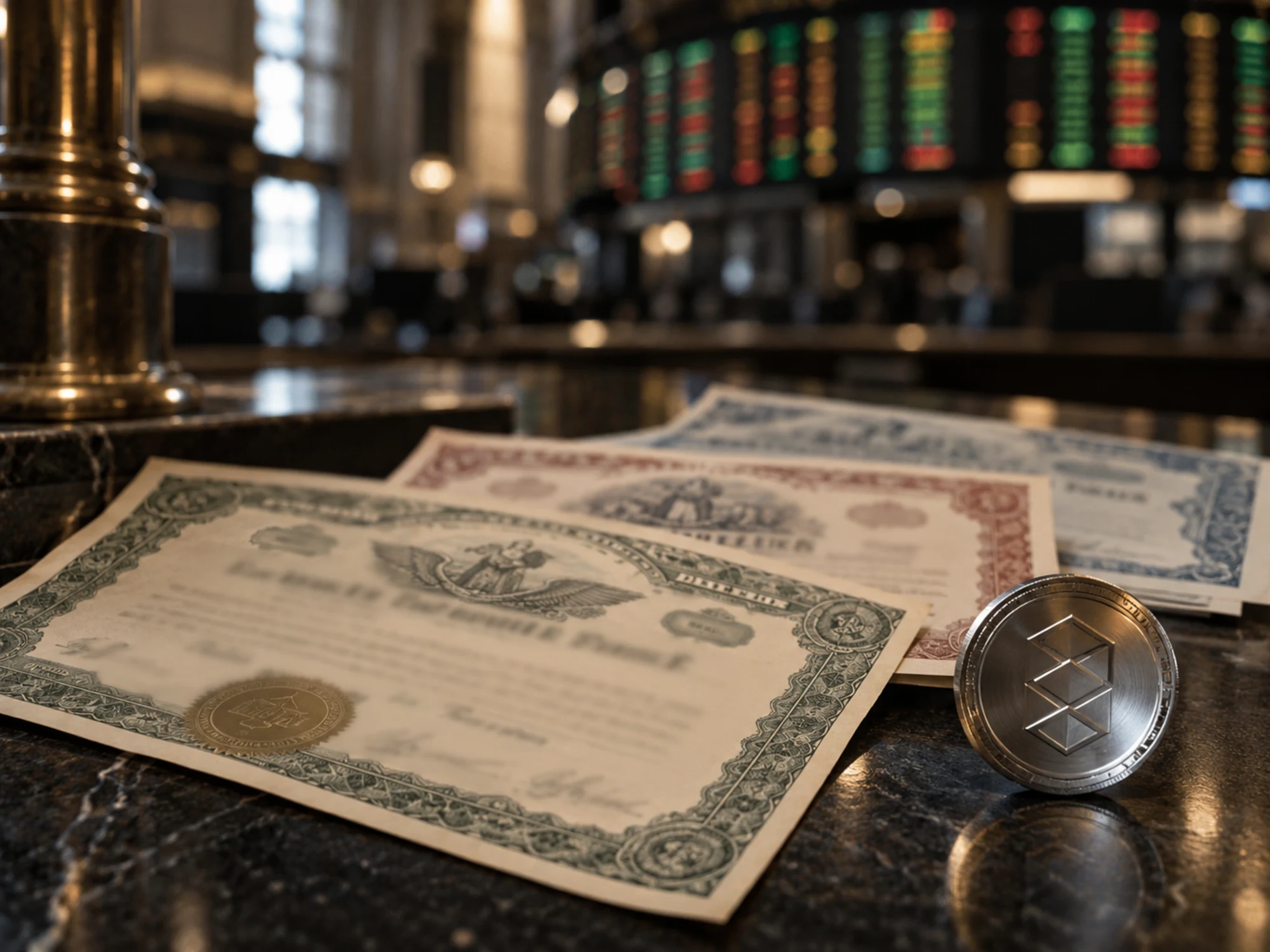
Real shares vs tracker tokens
Robinhood launched stock-price tokens for its European customers under its Lithuanian brokerage license, with derivative contracts issued by a Robinhood Europe entity under MiFID II and recorded on the Arbitrum network. The underlying assets are held by a US-licensed institution, while the token gives a contractual claim against Robinhood rather than ownership of the underlying share.
Other tokens on the market work differently. Backed Finance issues xStocks under a Liechtenstein prospectus regulated by the FMA, backed by shares the issuer holds at a custodian, and these tokens trade on crypto exchanges such as Kraken. The general point made by the Financial Stability Board about tokenization applies here too: the token can be a claim issued directly on the ledger, or a wrapper around an asset held elsewhere, and which one a specific stock token is depends on its issuer's own documentation, not on the word tokenized alone.
What a token holder can and cannot do
A real, tokenized share usually carries the same shareholder rights as the paper original, such as dividends and, depending on the issuer's terms, voting. A tracker token such as xStocks gives price exposure only: the holder has no claim against the underlying company and no vote, only a claim against the token issuer for the value the token tracks. Reading which structure a given tokenized stock uses, from the issuer's own terms and not from its marketing, is the first step before buying one.
How Germany lets a company tokenize its own shares
Germany's Electronic Securities Act (eWpG) originally covered bonds and fund units; the Future Financing Act extended it to shares, so a German stock corporation can issue registered shares directly into a crypto securities register when its articles of association allow it. Bearer shares stay outside this route and can only go into a central register. This is the mechanism behind most tokenized stocks in Germany: the company's own share, recorded on a ledger, and not a third-party tracker token. 21X in Frankfurt holds a BaFin license under the EU DLT Pilot Regime to run a trading and settlement venue for tokenized securities, including such shares.
What changes when a share is tokenized
A tokenized share can settle the moment the ledger updates and trade outside a stock exchange's normal hours, which is what draws crypto-native platforms to the format. Trading in tokenized equities and ETFs on public chains can be followed as it settles: Dune Market Data Feeds carry these trades in their spot feed, with each trade linked to its onchain transaction. What does not change is the underlying company: a token still depends on the company's earnings, and a tracker token still depends on the credit and custody quality of whoever issued it. Regulators have raised questions in practice: reports named EU scrutiny of the tokenized stock offering from Robinhood and OpenAI publicly distancing itself from the private equity token from Robinhood tied to the company, since OpenAI itself had no part in issuing it. Natasha Cazenave, Executive Director of the EU securities regulator ESMA, named the risk in a keynote on tokenization: stock tokens backed by shares held in a special purpose vehicle typically carry no shareholder rights, and when such a token is a synthetic claim instead of direct ownership, investors can misunderstand what they bought.
Where the shares actually sit
A tokenized stock still needs somewhere the real share sits, whether that is a broker's own account or a custodian bank. The underlying assets of the EU stock derivatives from Robinhood are held by a US-licensed institution, while Robinhood records clients' derivative holdings itself. A European holder therefore has a contractual claim against Robinhood rather than direct ownership of the underlying US shares. A German company that tokenizes its own shares under the eWpG avoids that extra layer, because the token is the share, held in a crypto securities register a BaFin-licensed keeper runs directly, with no separate custodian standing between the holder and the company.
Upcoming investment and digital asset events
Finance Loop and tokenized stocks
Finance Loop is the meeting place for people who follow tokenized securities from issuance to trading. Finance Loop lists tokenization events in Germany, where the licensed venue of 21X for tokenized equity and other securities comes up alongside the eWpG rules that let a German company issue its own shares as tokens. Finance Loop and 21X have a cooperation for joint events and knowledge sharing.
Investment & Digital Assets
What are tokenized stocks?
A tokenized stock is a token that either represents a real, legally issued share or tracks the price of a share while being backed by shares an issuer holds at a custodian. The two structures carry different investor protections, so it matters which one a given token is.
Is a tokenized stock the same as owning the real share?
Only when the issuer structures it that way. Germany's eWpG allows a company to issue its actual registered shares as tokens. A tracker token such as xStocks instead gives exposure to the share price, backed by shares the issuer holds, so the holder's rights depend on the issuer's own terms, not on shareholder rights directly.
Can a German company issue tokenized equity?
Yes, since the Future Financing Act amended the eWpG, a German stock corporation can issue registered shares into a crypto securities register when its articles of association permit it, and trade them on a licensed venue such as 21X in Frankfurt.
Tokenized stocks and Finance Loop
Finance Loop covers tokenized stocks and equity as part of tokenization in Germany, where 21X in Frankfurt runs a BaFin-licensed venue for trading and settling tokenized securities under the EU DLT Pilot Regime, and the eWpG lets a German company issue its own shares as tokens. Tokenized equity belongs to the Finance Loop Investment & Digital Assets track, alongside tokenized bonds and funds.
Finance Loop is a professional network supporting the institutional use of emerging technologies in finance, such as AI, digital payments, cloud and blockchain solutions. Finance Loop helps its members build skills and personal networks in these fields: Investment & Digital Assets, Payments & Digital Money, Digital Infrastructure & Sovereignty, and Risk & Compliance.