
AI agents in finance
An AI agent in finance plans several steps, calls tools such as data feeds or bank systems, and hands a result to a person for approval. Allianz settles simple storm claims with seven cooperating agents, and Lloyds Banking Group is bringing an agentic assistant to its app customers. Events on the topic are in the calendar below.
What makes an AI agent different
A chatbot answers one question. An agent gets a goal, breaks it into steps, uses tools to carry them out and checks its own work before it reports back. In finance the tools are the systems a clerk or analyst would use: a market data feed, the core banking system, the claims database, a sanctions list, a spreadsheet. ESMA counts these systems separately in its survey of AI in EU securities markets: agentic use cases made up about a sixth of all reported cases, and they ran with high or medium autonomy more often than other AI. Most AI in finance still needs a human approval at each step; agents are where firms test how much of that approval they can move to the end of the process.
Generative AI writes the text, and an agent decides what to do next. Most agents in finance use a language model for reasoning and combine it with fixed rules for anything that moves money or data. The generative AI in finance page covers the language models underneath.
Examples of AI agents in banking and insurance
In insurance, Allianz's Project Nemo handles food spoilage claims after storms in Australia with seven specialized agents that check cover, verify the weather, screen for fraud and calculate the payout. The whole chain runs in minutes and cuts processing time for eligible claims by 80 percent, and a claims professional makes the final payout decision.
In retail banking, Lloyds Banking Group calls its new app assistant the UK's first agentic AI financial assistant. It gives customers insights on spending, budgeting, saving and investing, breaks requests into steps, turns plain-language questions about transactions into code, remembers context and hands over to human experts when needed. Before the customer rollout, 7,000 staff tested it.
For investment banking and research, Anthropic published ten agent templates for financial services for its Claude models, for tasks such as building pitchbooks, screening KYC documents, reviewing earnings and closing the books at month-end, with connectors to data providers such as FactSet, S&P Capital IQ, MSCI, PitchBook, Morningstar and LSEG. In Germany, Deutsche Bank uses Google's research agent for its Corporate Bank, as the AI in banking in Frankfurt page describes.
Building agents that hold up in a financial firm
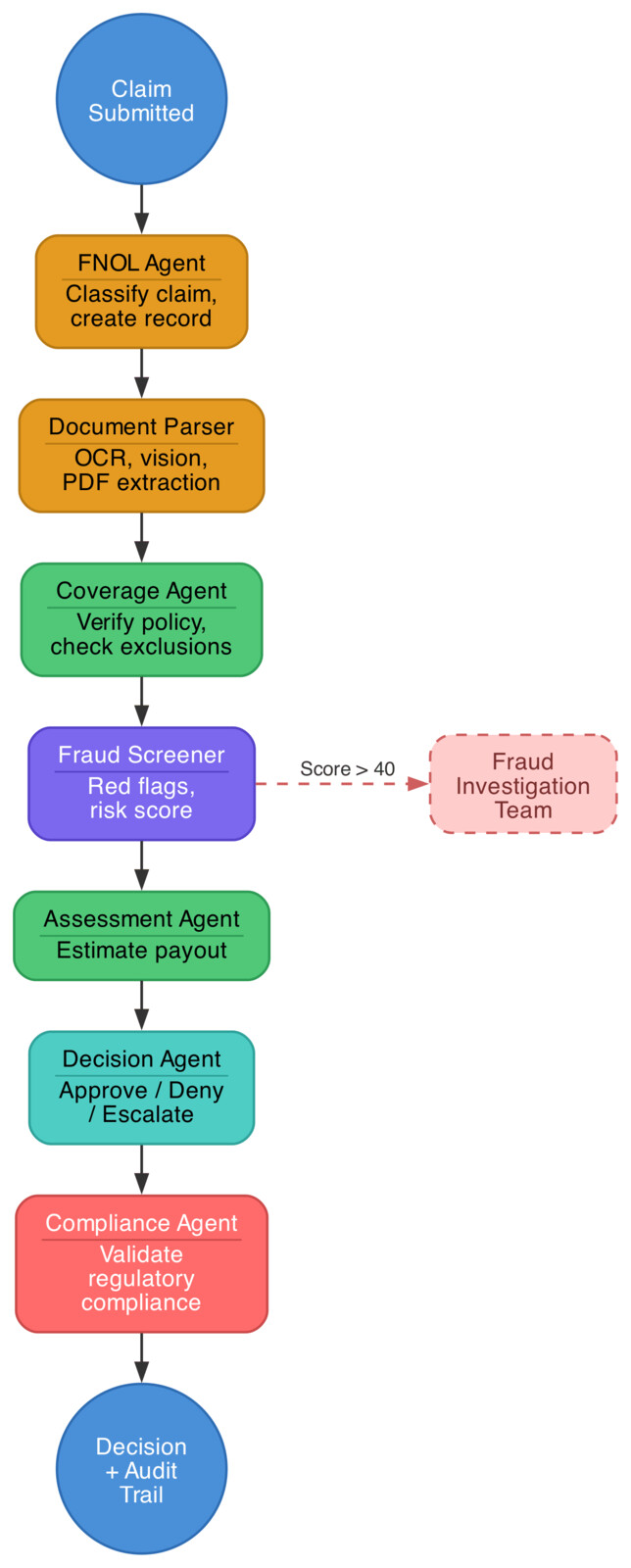
Finance Loop member Fayssal El Mofatiche co-wrote, with Hanane Dupouy, Building AI Agents for Finance, published by Packt. The book builds agents for fundamental analysis, deep research, trading, insurance and compliance in Python, and it spends its second half on evaluation and operations: calibrated LLM judges, drift detection, model risk reports, tracing, versioning and guardrails with human oversight. One of its examples is a multi-agent pipeline for insurance claims that runs from the first notice of loss through a coverage check and fraud detection to a compliance sign-off with a full audit trail.
That list matches what a bank's model risk and audit teams ask for before an agent goes live: a way to measure it, a log of every tool call and a person who signs off.
The rules for AI agents in finance
The EU AI Act has no separate category for agents. The duties follow the use: an agent that scores the creditworthiness of a private customer is high-risk, an agent that drafts a research note is not, and one that talks to clients must say it is an AI. Under MiFID II, an agent in investment services must act in the client's best interest like any other tool of the firm. BaFin's principles for algorithms in decision-making ask for a named owner at each phase of a model, which for an agent means an owner for every tool it may call.
Each model provider and data connector behind an agent is an ICT service under DORA and belongs in the register of third-party arrangements. The EU AI Act in financial services page goes through the provider and deployer duties.
Upcoming events on AI agents in finance
Finance Loop, the meeting place for AI agents in finance
Finance Loop is the meeting place for engineers who build agents and for the risk, compliance and business people who must sign them off. It connects the finance, IT and AI communities in Germany, Austria and Switzerland, with events in Frankfurt, Munich, Berlin and Hamburg.
Fayssal El Mofatiche is also a lecturer at Claude Hacker House, the hands-on Claude series that Finance Loop supports with Finteda and Frankfurt Data Science. At fAInance, which Finance Loop presented, the closing talk by Parloa covered agentic AI in customer experience. KI Exchange in Hamburg put agentic banking on its program, and at the Point Zero Forum in Zurich, where Finance Loop took part, AI agents that execute transactions were part of the theme. Capital & Code in Frankfurt, where Finance Loop is media partner, has a track on agentic payments, started by software agents on behalf of a company or a customer.
Investment & Digital Assets
Payments & Digital Money
What is agentic AI?
Agentic AI is AI that works toward a goal in several steps: it plans, calls tools, checks results and decides the next step. Generative AI produces content in one go; an agent can use generative AI as one of its parts.
What are examples of AI agents in finance?
Allianz's claims agents for storm damage in Australia, Lloyds Banking Group's financial assistant in its app, research agents at Deutsche Bank, and agent templates for pitchbooks, KYC screening and month-end close. In each case a person approves the result.
Are AI agents allowed to make decisions in banking?
They can prepare decisions, and the bank stays responsible for them. For credit decisions on private customers, the EU AI Act requires human oversight of a high-risk system, and BaFin expects a named owner for every model. The firms named here keep a person as the final decision-maker.
Where can I meet people who build AI agents for finance?
At Claude Hacker House in Frankfurt, where finance and tech people build prototypes in one evening, and at Finance Loop events listed on the events page and in the calendar above.
AI agents in finance and Finance Loop
AI agents reach into all three Finance Loop tracks, from research agents in Investment & Digital Assets to claims and KYC agents in Risk & Compliance. A Finance Loop member co-wrote Building AI Agents for Finance and teaches at Claude Hacker House, which Finance Loop supports.
Finance Loop is a professional network and has the goal of driving the adoption of emerging technologies in finance, such as AI, tokenization, stablecoins, and DeFi. Finance Loop helps its members build skills and personal networks in these fields: Investment & Digital Assets, Payments & Digital Money, and Risk & Compliance.