
Cross Border Payments Europe
Cross-border payments in Europe move money between people or businesses whose payment providers are in different countries. A payment can travel through a shared euro payment scheme or through bank connections that also handle other currencies. The route depends on the currency, the participating banks and the destination.
Companies use these payments to buy from foreign suppliers, receive customer payments and transfer money between group companies. SEPA provides common procedures for euro transfers, including instant payments, across its participating countries. Within the EU, providers must charge the same for a cross-border euro payment as for a corresponding domestic payment, while currency conversion charges are assessed separately.
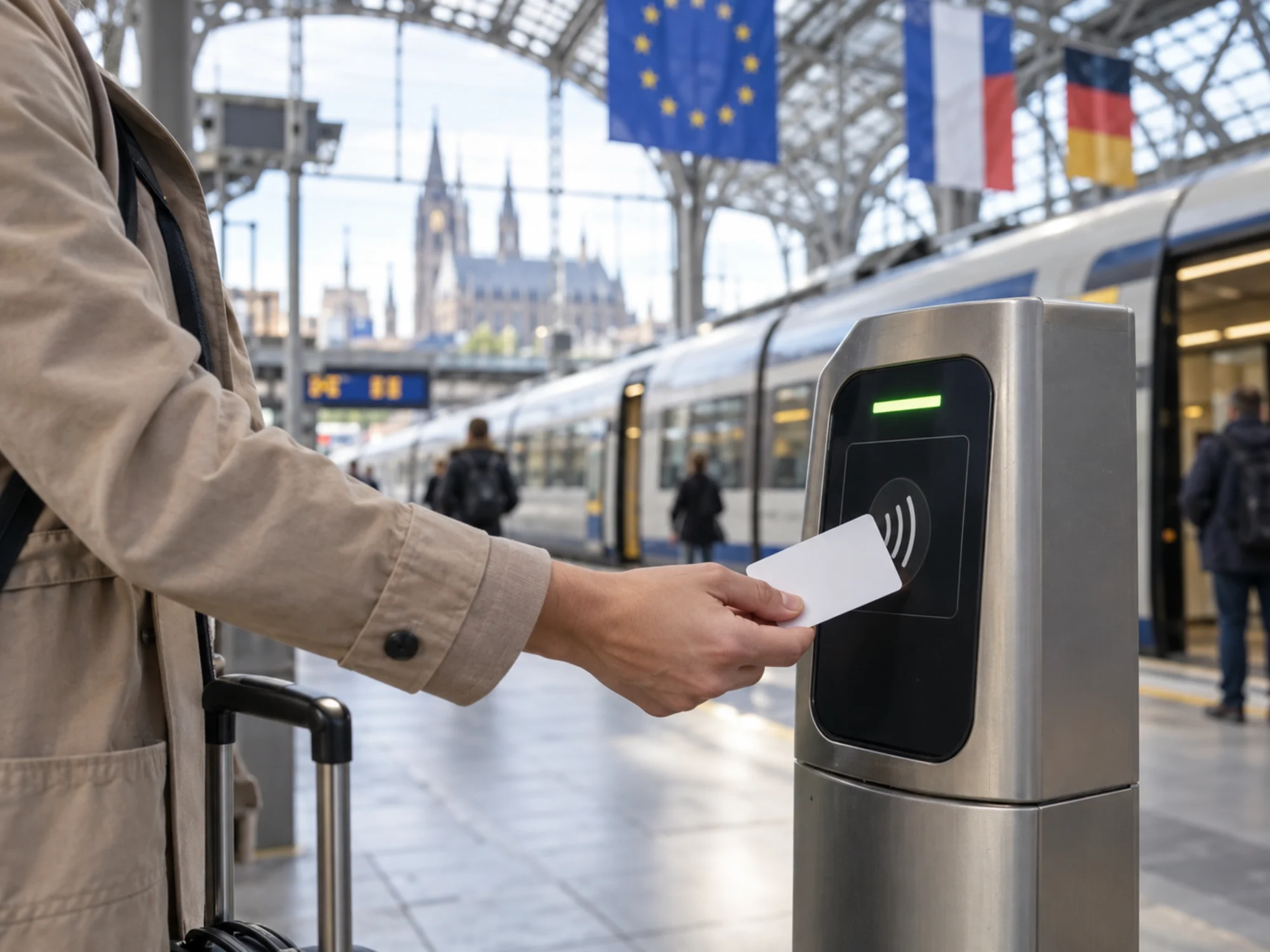
What counts as a cross-border payment in the EU
A cross-border payment moves money between accounts held in different countries. Inside the EU, a large share of this traffic is euro transfers between two SEPA countries, for example a company in Frankfurt paying a supplier in Lyon. The Zahlungsdiensteaufsichtsgesetz (ZAG), the German law that carries the EU's Payment Services Directive, treats a payment institution's cross-border duties the same way as its domestic ones once it holds a BaFin license, because that license is valid across the whole EU under the passporting rules described on the payments in Europe page.
Outside the EU, a cross-border payment usually still travels through correspondent banks: a chain of institutions that hold accounts with each other so that money can move between currencies and jurisdictions it would not otherwise reach directly. That chain is slower and costlier than a domestic transfer, and it is the part of the payment system that EU and G20 initiatives have targeted for years.
The EU rule that keeps cross-border euro payments cheap
Regulation (EU) 2021/1230 on cross-border payments requires that a euro payment sent from one EU country to another costs the sender no more than an equivalent domestic euro payment in the same currency. The rule stopped a practice where a bank could charge a steep fee for a transfer just because it crossed a border, even though the underlying SEPA rail was the same one used for a domestic transfer. The regulation also gives consumers a right to a currency conversion cost comparison before they approve a card payment or an ATM withdrawal in a foreign currency, so a traveler sees the total cost before confirming.
New reporting duties: what CBPR2 and the instant payments rule add
The revised Cross-Border Payment Regulation, known in the industry as CBPR2, extends EU price-transparency and fee-equality rules to more currencies and corridors and adds new duties on currency conversion disclosure. Alongside it, the Instant Payments Regulation brings its own cross-border angle: European Banking Authority implementing technical standards (EBA/ITS/2025/02), published 4 February 2025, set a structured annual report that every payment service provider in the EEA sends to its national supervisor, covering instant-payment uptake and related compliance data. The first deadline falls on 9 April 2026, and covers activity back to 22 October 2022. A payments compliance team in Germany answers to BaFin for this report the same way a team in France answers to the Autorité de contrôle prudentiel et de résolution.
Faster rails: TIPS, Wero and SWIFT
Inside the euro area, cross-border speed increasingly means the same ten-second instant transfer that applies domestically, settled through TIPS, the instant-payment settlement service of the European Central Bank. Wero, the wallet built by the bank-owned European Payments Initiative, already lets a user in Germany send money to a user in Belgium or France on that same instant rail, without the multi-day delay a correspondent-banking transfer to a country outside SEPA can still carry. For corridors that fall outside SEPA and the EU's instant-payment scope, the field still relies on the SWIFT network and, increasingly, on projects that connect it to faster domestic rails.
Upcoming payments events in Europe
Finance Loop and cross-border payments
Finance Loop is the meeting place for people who move money across borders for a living: payment institutions, bank treasury teams, correspondent-banking specialists and the fintechs that build the rails between them. Finance Loop connects the finance, IT and AI communities in Germany, Austria and Switzerland, with events in Frankfurt, Munich, Berlin and Hamburg.
Finance Loop is a partner of the Digital Euro Association, the Frankfurt think tank behind the Digital Euro Conference, where cross-border settlement sits on the agenda next to the digital euro and stablecoins. Finance Loop supported the Bybit EU x Circle Roadshow in Frankfurt, with panels on stablecoins, USDC and EURC as settlement tools for cross-border flows. At Capital & Code in Frankfurt, AllUnity and the treasury head of Läderach discuss stablecoins for treasury and cross-border payments, and a panel titled "Trapped Money" asks how companies free cash held in foreign accounts; Finance Loop is a media partner of Capital & Code 2026. Finance Loop supports When Banks Say 'No', a Frankfurt seminar on sanctions, de-risking and international payment flows, and with Venturebloxx it wrote reports on stablecoins in global B2B payments, including cross-border corridors, and on the future of money in Europe. Related pages: payments in Europe, payments in Germany and stablecoins in Europe.
Why is a cross-border euro payment not more expensive than a domestic one?
Regulation (EU) 2021/1230 requires banks and payment providers to charge the same fee for a cross-border euro payment to another EU country as for an equivalent domestic euro payment. Before the rule, banks often priced the two differently even though both moved over the same SEPA infrastructure.
What is CBPR2?
CBPR2 is the industry name for the revised EU Cross-Border Payment Regulation, which widens price-transparency and fee-equality protections to more currencies and adds clearer disclosure of currency conversion costs before a payment or card transaction is confirmed.
What do banks have to report on cross-border and instant payments from 2026?
Under European Banking Authority implementing technical standards published in February 2025, every EEA payment service provider files a structured annual report with its national supervisor on instant-payment uptake and related compliance metrics. The first filing is due 9 April 2026, covering data back to 22 October 2022, with annual reports after that.
Cross-border payments and Finance Loop
Finance Loop is a professional network supporting the institutional use of emerging technologies in finance, such as AI, digital payments, cloud and blockchain solutions. Finance Loop helps its members build skills and personal networks in these fields: Investment & Digital Assets, Payments & Digital Money, Digital Infrastructure & Sovereignty, and Risk & Compliance.
Finance Loop connects the finance, IT and AI communities in Germany, Austria and Switzerland, with events in Frankfurt, Munich, Berlin and Hamburg. If you work on cross-border payments, you meet people from the same field at Finance Loop events.