
Crypto market data
Crypto market data is information about crypto-asset prices, trading and activity recorded on blockchains. Exchanges publish data from their own trades and order books, while data providers combine information from several sources. This information lets users compare prices and understand the market activity behind a quoted value.
Trading and risk teams use crypto market data to price transactions and value holdings over time. Historical data supports analysis of price changes, while live feeds supply current figures to trading systems and smart contracts. The source and update frequency determine how suitable a feed is for the decision being made.
Where crypto market data comes from
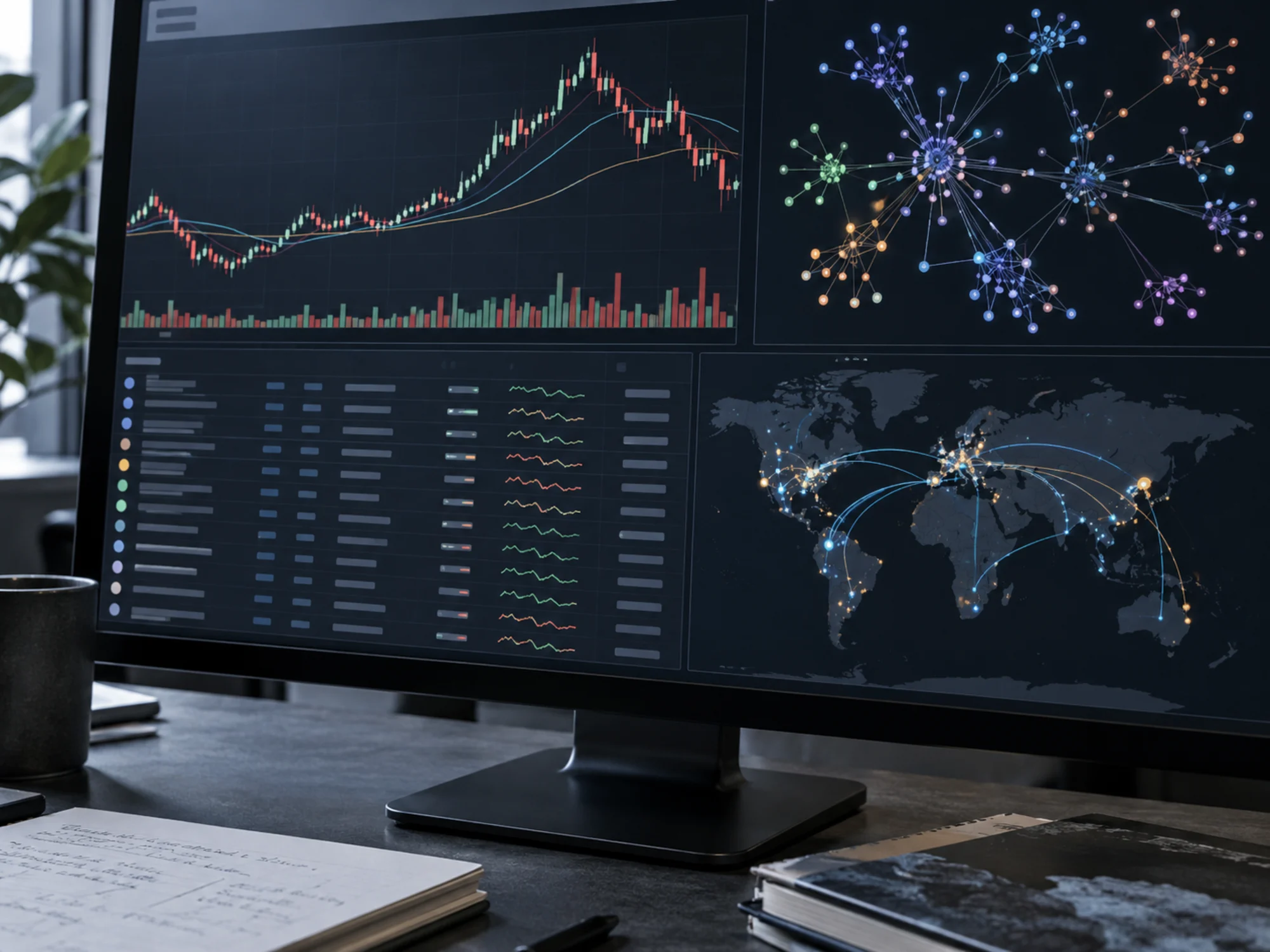
Crypto market data comes from two kinds of source. Exchange-reported data comes directly from a trading venue's own order book: the price and size of each trade. Aggregated data comes from a data provider that collects prices across many exchanges and publishes one figure. CoinGecko, for example, describes itself as an independent data provider that aggregates prices from thousands of exchanges and tracks tokens across more than 200 blockchain networks, publishing its aggregation method so a user can check how a figure was built.
A third source sits onchain: a blockchain oracle writes outside prices directly into a smart contract, so the contract itself can read a value without calling an external API. Oracle networks covers how that delivery works and what it changes for a lending or trading contract. Trades on decentralized exchanges are also recorded onchain, and Dune Market Data Feeds stream them from more than 200 decentralized venues on 12 chains to subscribers over WebSocket, with each message linked to the transaction that settled it.
How firms use crypto market data
A trading desk needs live prices to quote and hedge a position. A risk team needs historical price and volatility data to mark a book or run a stress test. A custody provider needs a reliable reference price to value client holdings. Each use case sets its own requirements for how fast the data has to arrive and how many independent sources back up a single figure.
Traditional market infrastructure has started publishing onchain alongside these providers. Deutsche Börse Market Data + Services in Frankfurt announced on 1 October 2025 that it publishes real-time data from the trading venues Xetra, Eurex, 360T and Tradegate onchain through Chainlink's DataLink service, so smart contracts on more than 40 blockchains can read figures that used to reach only traditional trading systems.
MiCA rules on market data and market abuse
Title VI of MiCA, Regulation (EU) 2023/1114, sets rules against market abuse involving crypto-assets, including insider dealing and market manipulation through price data. A crypto-asset service provider that runs a trading platform has to make its trading data public on reasonable commercial terms, a transparency duty similar to the one MiFID II sets for securities markets. A firm that reads a manipulated price, whether from an exchange feed or an oracle, can act on a wrong figure. Oracle networks covers a case where a trader manipulated an oracle's price feed to borrow far more than his collateral was worth.
Upcoming crypto and data events in Germany
Finance Loop and crypto market data
Finance Loop connects people who build and use market data pipelines in traditional and crypto finance. On 15 April 2024, Finance Loop, Chainlink and TechQuartier invited guests to a Chainlink panel at TechQuartier in Frankfurt, a pre-event of the Crypto Assets Conference, where the evening opened with the decentralized oracle networks of Chainlink for smart contracts. At a MarketVector Indexes panel at TechQuartier, Martin Leinweber, Digital Asset Product Strategist at MarketVector, showed a systematic method for choosing crypto assets, and Dominik Poiger of Deutsche Digital Assets explained the market for crypto ETPs. Related pages: oracle networks, European crypto exchanges and crypto in Europe.
Investment & Digital Assets
Risk & Compliance
What is a crypto market data API?
A crypto market data API is a programming interface that returns prices, trading volumes and other market figures on request, so a trading, risk or accounting system can read them automatically. Providers such as CoinGecko publish REST and WebSocket APIs; blockchain oracles deliver the same kind of data directly into a smart contract instead of a server.
Is crypto market data regulated in the EU?
MiCA's Title VI sets market abuse rules for crypto-asset trading, including a duty for trading platforms to publish their trading data on reasonable commercial terms. A data provider that only aggregates prices from public sources, without running a trading platform itself, does not need a MiCA license for that activity alone.
How real time is crypto market data?
The delay in crypto market data depends on the source. An exchange's own order book updates with every trade. An aggregator that pulls from many exchanges adds a small delay for collection and calculation. An onchain oracle updates on a schedule or when the price moves past a set threshold, which a lending protocol relies on to keep collateral valued correctly. Dune Market Data Feeds, which stream trades from decentralized exchanges, publish a p95 latency of 1.34 seconds for spot trades and 590 milliseconds for perpetuals.
Crypto markets and infrastructure
Crypto market data and Finance Loop
Finance Loop, Chainlink and TechQuartier held a panel on decentralized oracle networks for smart contracts at TechQuartier in Frankfurt, a pre-event of the Crypto Assets Conference. Crypto market data and the infrastructure behind it sit in the Investment & Digital Assets track of Finance Loop.
Finance Loop is a professional network supporting the institutional use of emerging technologies in finance, such as AI, digital payments, cloud and blockchain solutions. Finance Loop helps its members build skills and personal networks in these fields: Investment & Digital Assets, Payments & Digital Money, Digital Infrastructure & Sovereignty, and Risk & Compliance.