
eWpG
Germany's Electronic Securities Act, or eWpG, provides a legal framework for issuing eligible securities through an electronic register instead of a paper certificate. Issuers can use a central register or a crypto securities register. The register records the security and supports the legal arrangements for ownership and transfer.
Electronic issuance allows companies and financial institutions to organize securities processes using digital records. KfW and Siemens have issued digital bonds under the act and provide examples of its practical use. The register model determines the relevant responsibilities and transfer procedures, alongside the technology used.
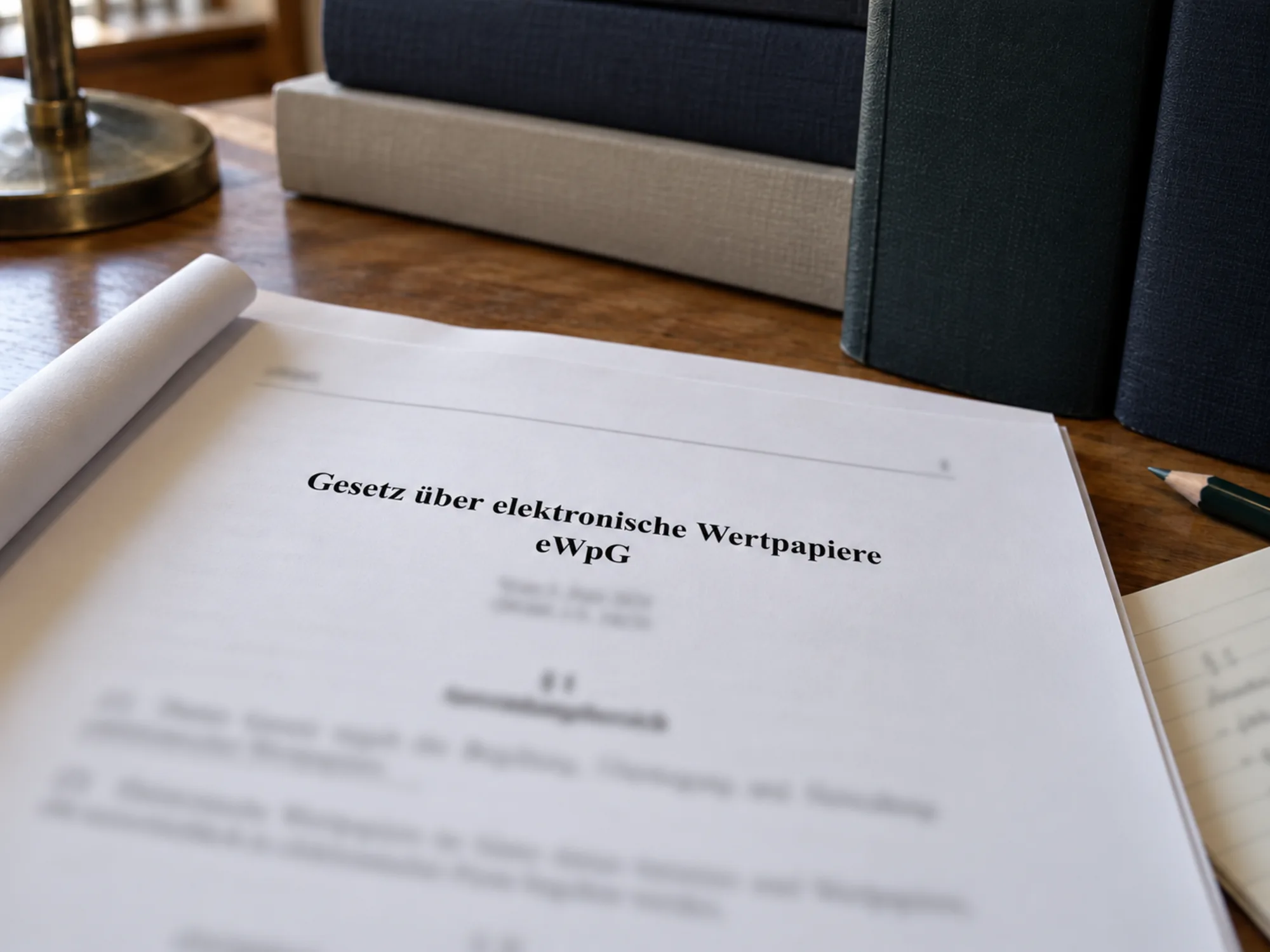
Why German securities needed paper
Traditional German securities issuance used certificates, often a global certificate deposited with a central securities depository. The eWpG allows an electronic register entry to replace that certificate. The eWpG has been in force since 10 June 2021.
Section 2 eWpG gives an electronic security the same legal effect as a certificated security unless the act provides otherwise. Section 2 eWpG also treats the electronic security as a thing under German civil law, preserving a property-law basis for ownership.
Central register or crypto securities register
A central register is kept by a central securities depository or a licensed custodian. Clearstream runs the D7 platform, which supports central register securities; the Deutsche Börse overview includes the KfW bond example.
A crypto securities register must record data in sequence and protect it against unauthorized deletion or later changes. A blockchain can provide this recording system, but Section 16 eWpG does not prescribe a particular blockchain. The issuer names the registrar; if it names none, it is the registrar itself. Register keeping and custody of crypto securities are different services.
For individual registration, transferring ownership requires agreement between the parties and a register change on the instruction of the entitled party. Section 25 eWpG sets out both requirements. Moving a token between wallets is therefore not, by itself, a complete description of the legal transfer.
Bonds, fund units and shares
The current scope of the eWpG covers bearer bonds and registered shares. Bearer shares must use a central register; registered shares can also use a crypto securities register. Electronic fund units follow separate provisions in Section 95 KAGB, which applies specified eWpG rules to them. The rules for crypto fund units are explained under tokenized funds.
In September 2024 Siemens issued a 300 million euro digital bond with a one-year term. The issue settled in central bank money through the Bundesbank's trigger solution. Property-backed bonds are another use case, covered under tokenized real estate.
How the act fits with MiCA and the DLT Pilot Regime
A crypto security is a financial instrument, so MiCA does not apply to it; MiCA covers crypto-assets such as bitcoin and stablecoins. The act defines the instrument and its register. Where the security is traded and settled is a matter for securities law: an exchange, an MTF, or a venue under the DLT Pilot Regime such as 21X. Issuers who plan a first issue find the steps on the page on issuing tokenized securities in Germany.
Upcoming events on tokenized securities in Germany
Finance Loop and electronic securities
Gubbi, a Finance Loop Premium Partner, distributes tokenized securities under the act through its GDX Primary Market, with each issue entered in a crypto securities register run by a licensed register keeper. The Frankfurt Forum on Digital Assets & Applications, which Finance Loop covers, named the act among the rules that move DLT into capital markets, and the Crypto Assets Conference, a conference Finance Loop has partnered with, returns to it in its regulation sessions.
Investment & Digital Assets
What is the Electronic Securities Act?
The German law has allowed electronic securities since 10 June 2021. An electronic register entry replaces the certificate, and the security generally has the same legal effect as a certificated security. Section 2 eWpG also treats it as a thing for German property law. Electronic fund units use separate KAGB provisions.
Who may keep a crypto securities register?
The issuer names a register keeper; without that designation, it is the register keeper itself under Section 16 eWpG. Commercial register keeping is a regulated financial service under Section 1 KWG. The provider needs the applicable authorization; being the issuer does not by itself settle the licensing question.
Is a crypto security covered by MiCA?
No. A crypto security is a financial instrument and stays under securities law. MiCA applies to crypto-assets that are not financial instruments.
Electronic Securities Act and Finance Loop
Finance Loop covers electronic securities in its Investment & Digital Assets track, from the register rules to the bonds and funds issued under them. Finance Loop works with Gubbi, which distributes such securities, and with 21X, which runs a trading venue for tokenized securities, and brings issuers, banks and lawyers together at events in Frankfurt, Munich, Berlin and Hamburg.
Finance Loop is a professional network supporting the institutional use of emerging technologies in finance, such as AI, digital payments, cloud and blockchain solutions. Finance Loop helps its members build skills and personal networks in these fields: Investment & Digital Assets, Payments & Digital Money, Digital Infrastructure & Sovereignty, and Risk & Compliance.