
Crypto custody Germany
Crypto custody in Germany is the safekeeping of crypto-assets or the private keys that give access to them on behalf of customers. A custodian manages access and carries out transfers when the customer instructs it to do so. This lets customers use a professional custody service without keeping sole responsibility for their own keys.
MiCA governs custody of crypto-assets such as bitcoin and ether, while crypto securities fall under separate securities rules. BaFin supervises the relevant services in Germany. Providers including Commerzbank, DZ BANK, Boerse Stuttgart Digital and Tangany use different operating models, from custody within a bank to services that another institution connects to its own systems.
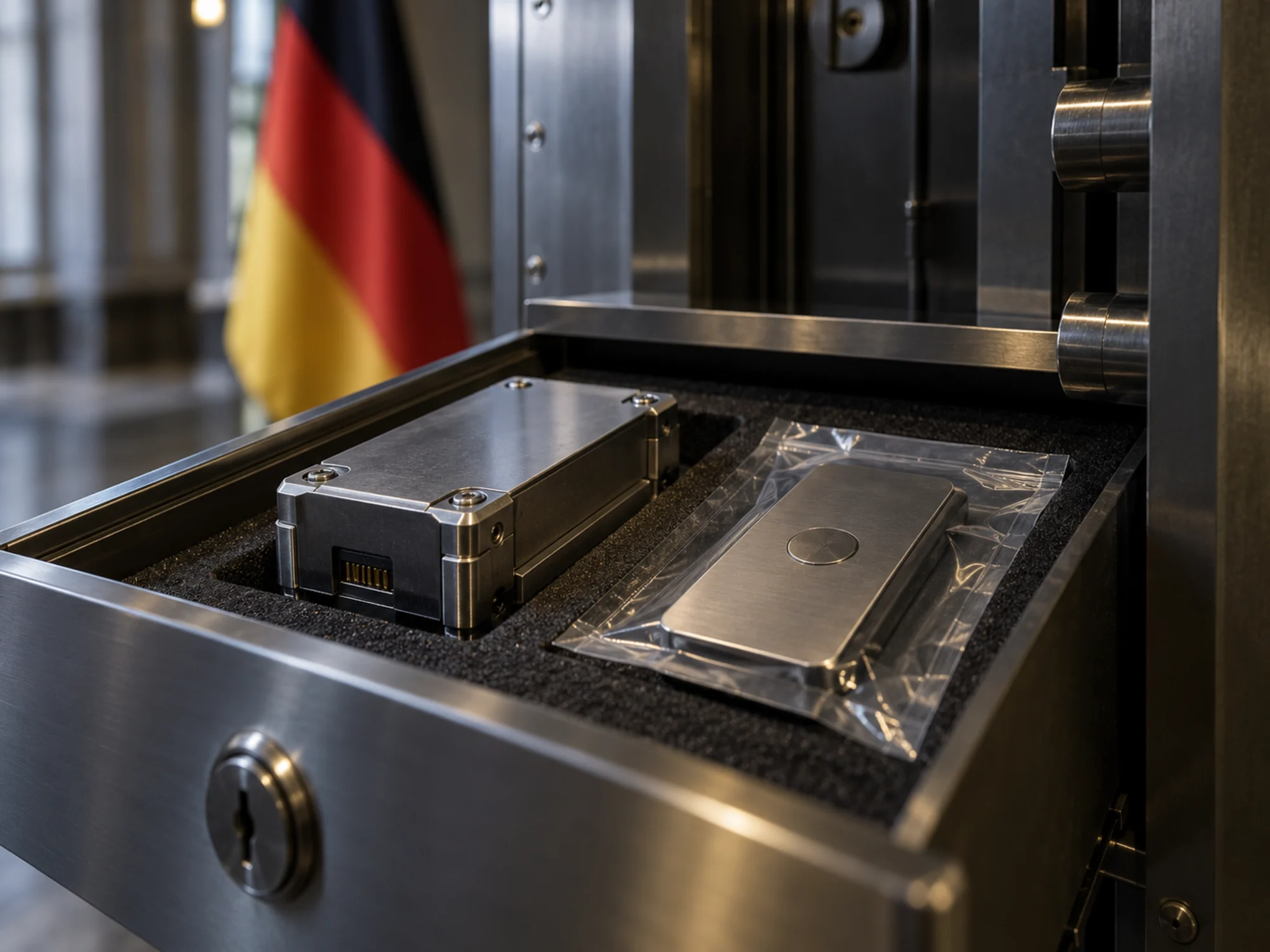
How Germany started licensing crypto custody
A bank has always held securities for its clients in a custody account. Germany applied that idea to crypto before the EU did: when it carried the amended fourth EU anti-money laundering directive into national law, it added crypto custody business to the Banking Act (KWG). BaFin defines the activity in a guidance notice (in German): the custody, administration and securing of crypto-assets or of private cryptographic keys that serve to hold, store or transfer crypto-assets, for others. Firms that already did this had to notify BaFin and file a full license application within a transition period.
This early start means that many German custodians have run under supervision for years. Tangany in Munich worked under a KWG crypto custody license before it received its MiCA license, and Commerzbank became the first full-service bank in Germany with such a license. Read the answer What is crypto custody? and the explanation Crypto custody: how it works to distinguish custodial keys from keys held by their owners.
MiCA license or Banking Act: which rule applies
For bitcoin, ether and stablecoins, the EU Markets in Crypto-Assets Regulation now applies. Custody and administration of crypto-assets for clients requires a CASP authorization under MiCA or eligibility as a financial entity under Article 60. For custodians authorized under Article 63, custody is class 2 with 125,000 euros in permanent minimum capital; Article 67 requires safeguards at least equal to that amount or one quarter of the preceding year's fixed overheads, whichever is higher. Financial entities operating under Article 60 are exempt from Article 67. MiCA also requires segregation of client assets from the custodian's own and liability for losses from incidents such as a hack, unless the custodian proves it was not at fault. BaFin (in German) let firms with a KWG custody license move to MiCA in a simplified procedure based on its gap analysis, and they could keep working under the old license until BaFin decided on the new one. For new providers, the comparison uses one quarter of projected fixed overheads for the first twelve months.
Crypto securities are the exception: A token issued under the Electronic Securities Act (eWpG) is a financial instrument and therefore outside MiCA, so safeguarding the private keys for such securities stays a business under the Banking Act. BaFin calls it qualified crypto custody (in German), and it needs a license under section 32 KWG. A bank that wants to hold both bitcoin and tokenized bonds for its clients therefore deals with two regimes. Compare the token types of digital assets in Germany to distinguish these categories and their applicable rules.
Build or buy: the routes of German banks
Some banks build custody themselves: Commerzbank holds the assets of its corporate clients and works with Crypto Finance, a Deutsche Börse subsidiary, for trading. Deutsche Bank is preparing its own MiCA custody service for bitcoin, ether and the stablecoins USDC, EURC and EURAU. Crypto Finance (Deutschland) in Frankfurt received four BaFin licenses for trading, settlement and custody and is the sub-custodian behind crypto custody from Clearstream, where bitcoin appears in the same custody report as a client's bonds.
Other banks buy custody services: Boerse Stuttgart Digital keeps the coins for the meinKrypto wallet from DZ BANK in the app of the Volksbanken and Raiffeisenbanken and for the offer from DekaBank to the savings banks; its custody company was the first German provider with an EU-wide MiCAR license, lists more than 5 billion euros in custody and names Munich Re as insurer. Tangany sells custody as a service: a broker or bank connects through an API and keeps the customer relationship, and Tangany holds more than 3 billion euros for over 60 institutional clients. Landesbank Baden-Württemberg offers crypto custody through the institutional platform from Bitpanda.
What custody teams in Germany deal with now
In crypto staking, a custodian with the right MiCA scope can stake coins such as ether for clients, as Tangany and Crypto Finance do, and each bank has to decide whether it passes the rewards and the slashing risk on to customers. For stablecoins, Tangany received a BaFin payment services license for e-money tokens, because holding and transferring euro stablecoins can require one on top of MiCA.
Under the travel rule, every transfer from a German custodian carries the names of sender and recipient under the EU Transfer of Funds Regulation, and a transfer to a self-hosted wallet needs extra checks.
Upcoming crypto custody and digital asset events in Germany
Finance Loop and crypto custody in Germany
Finance Loop brings custody teams from banks, exchanges and specialist custodians together in Germany, Austria and Switzerland, with events in Frankfurt, Munich, Berlin and Hamburg. Finance Loop connects the finance, IT and AI communities.
Tangany is an event partner of Finance Loop, and a speaker from Tangany was on the program of the Digital Finance Night that Finance Loop hosted during the Crypto Assets Conference. Custody and MiCAR compliance were topics of the Forum für Digitale Vermögenswerte, where Finance Loop was a partner, and Blockdaemon, which provides institutional staking and node infrastructure, is also a Finance Loop partner. At Capital & Code in Frankfurt, where Finance Loop is a media partner, Dr. Ming Schuhmacher of Deutsche Bank discusses use cases, custody and new payment rails for stablecoins with BitGo and Hercle.
Investment & Digital Assets
Risk & Compliance
Who needs a crypto custody license in Germany?
A firm that holds crypto-assets or their private keys for customers must meet the authorization requirements for its activity. For crypto-assets under MiCA, it generally needs a CASP authorization from BaFin; eligible financial entities can provide the crypto services permitted under Article 60 after submitting the required complete notification to their home supervisor. A bank must submit that information at least 40 working days before its first service. For crypto securities under the eWpG, the firm needs a license for qualified crypto custody under section 32 KWG. A person who keeps the keys to their own coins needs no license.
Which banks in Germany hold crypto for customers?
Commerzbank holds crypto for corporate clients, DZ BANK offers meinKrypto to customers of the Volksbanken and Raiffeisenbanken with Boerse Stuttgart Digital as custodian, DekaBank uses the same partner for the savings banks, and LBBW works with Bitpanda. Deutsche Bank is preparing its own crypto custody service for customers.
What happens to my crypto if the custodian fails?
MiCA requires a custodian to keep client crypto-assets separate from its own assets and to hold enough of each asset to cover client claims, so the coins belong to the clients and not to the custodian's estate. The custodian is liable for losses from incidents it caused. This is the main difference to leaving coins on an unlicensed platform.
Is there a crypto custody community in Germany?
Custody specialists meet at the Crypto Assets Conference and at Digital Finance Night in Frankfurt, at the Forum für Digitale Vermögenswerte and at Finance Loop events in Munich, where Tangany is based. The events calendar lists dates for these meetings of custody specialists.
Crypto custody in Germany and Finance Loop
Crypto custody belongs to the Investment & Digital Assets track of Finance Loop. Tangany is an event partner of Finance Loop and spoke at its Digital Finance Night in Frankfurt, and custody was a topic at the Forum für Digitale Vermögenswerte, where Finance Loop was a partner.
Finance Loop is a professional network supporting the institutional use of emerging technologies in finance, such as AI, digital payments, cloud and blockchain solutions. Finance Loop helps its members build skills and personal networks in these fields: Investment & Digital Assets, Payments & Digital Money, Digital Infrastructure & Sovereignty, and Risk & Compliance.