
AML Training
AML training teaches employees how to recognize money laundering and terrorist financing in the customers and transactions they handle. It explains the duties attached to their work, including how to assess suspicious activity and pass a concern to the people responsible for investigating or reporting it.
Companies subject to anti-money laundering law in Germany must provide initial and ongoing instruction for their staff, covering criminal methods and the relevant duties. Training connects those methods with the checks employees perform in their own roles, including the data protection rules that apply to their work.
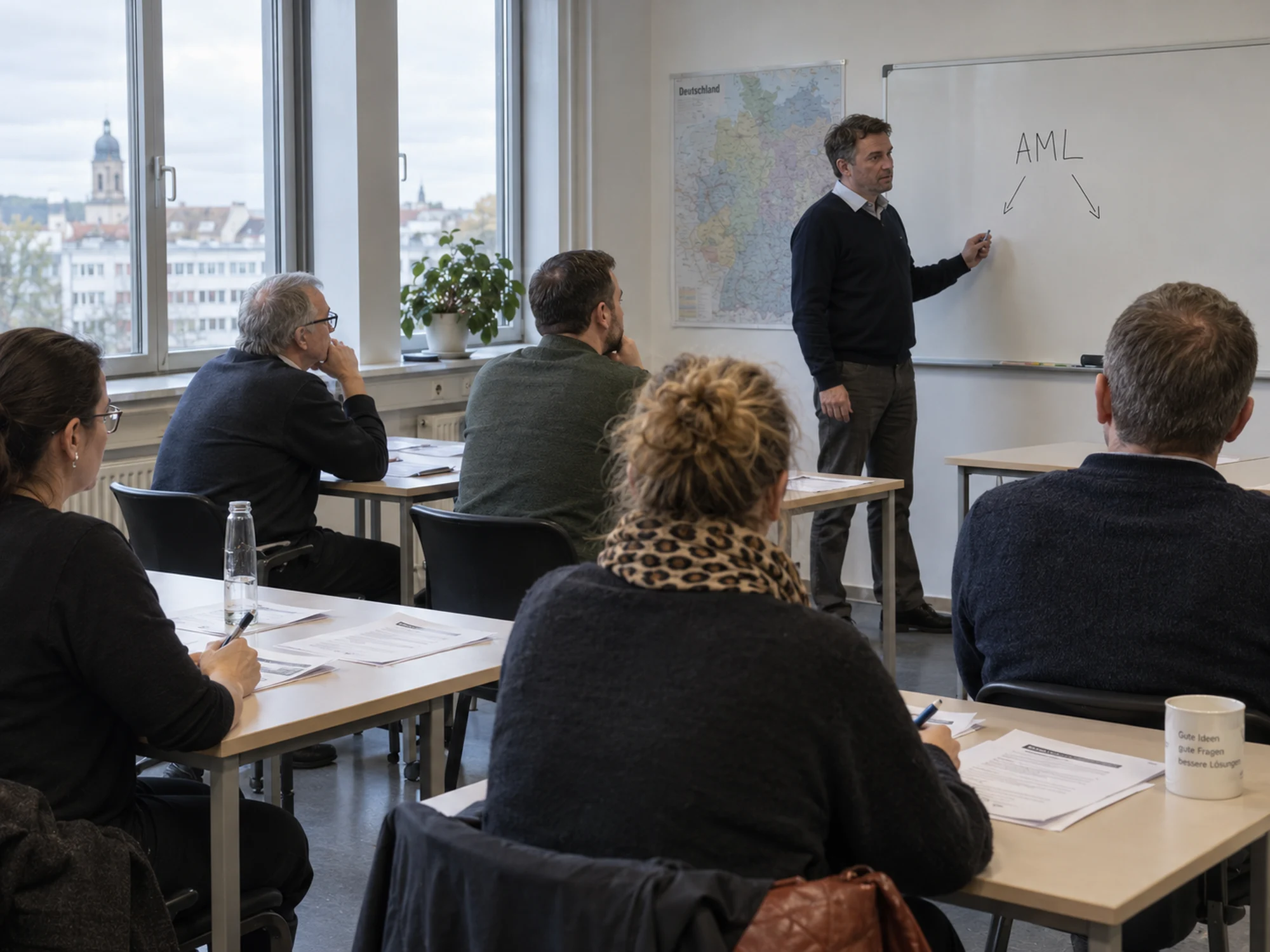
Staff training under Germany's Money Laundering Act
Section 6 of Germany's Money Laundering Act (in German) lists the internal safeguards an obliged entity must have. One of them is the initial and ongoing instruction of employees on the typologies and current methods of money laundering and terrorist financing and on the rules and duties that apply. Obliged entities include banks, payment and e-money institutions, crypto-asset service providers, life insurers and fund managers, and outside finance also real estate agents and dealers in goods. A course for branch staff at a bank therefore differs from one for an estate agent.
The EU is moving much of this into the AML package: a directly applicable AML Regulation and a new supervisor, AMLA, seated in Frankfurt.
Course formats and certificates
For all staff, the Haufe Akademie (in German) sells an e-learning module on money laundering prevention of about one hour, with practical cases and a record of completion. AML officers and their deputies need more: the TÜV NORD Akademie (in German) teaches them for two days, online or in person, on the legal basis, the FATF, the UN and the EU, the officer's tasks, the set-up of a prevention system, monitoring and suspicious activity reports.
Certificates with an assessment come from ACAMS, which offers AML Foundations as its introductory certificate and topic versions for fintech and for cryptoassets and blockchain. Crypto firms add the travel rule, blockchain analytics and self-hosted wallets, described under crypto compliance training.
Upcoming events on AML and financial crime
Finance Loop and AML training
Finance Loop is the meeting place for AML officers, investigators and the people who build monitoring and screening software. Finance Loop supported When Banks Say 'No', a half-day payments seminar at the NEXTOWER in Frankfurt, where Dr. Julia Pfeil of Dentons spoke on payments governed by sanctions and anti-money laundering law and a further talk showed how blockchain forensics traces crypto flows.
At the Bybit EU Crypto Evening at TechQuartier, supported by Finance Loop, compliance under MiCAR was on the agenda. New events on financial crime reach you through the newsletter.
What is AML training for staff?
AML training is instruction for employees on how money laundering and terrorist financing work and what the law asks of them: knowing the customer, spotting unusual transactions and reporting a suspicion. The Haufe module for all staff takes about an hour, the TÜV NORD course for AML officers two days.
How often is AML training required?
German law asks for initial and ongoing instruction and names no fixed interval. Each firm decides how often its staff are trained and keeps a record, since the training is one of the safeguards it must be able to show.
Which AML certification fits fintech and crypto staff?
ACAMS has foundation certificates for fintech and for cryptoassets and blockchain. Crypto compliance training also needs to cover the travel rule and blockchain analytics.
Who needs AML training beyond the compliance team?
AML training is required for every employee of an obliged entity whose work the rules touch, from branch and call center staff to relationship managers. AML officers and their deputies take longer courses than the rest of the staff.
AML Training and Finance Loop
Finance Loop brings AML officers, investigators and compliance software builders together at its events, among them a Frankfurt seminar on sanctions, AML law and crypto tracing that Finance Loop supported. Finance Loop places AML in its Risk & Compliance track.
Finance Loop is a professional network supporting the institutional use of emerging technologies in finance, such as AI, digital payments, cloud and blockchain solutions. Finance Loop helps its members build skills and personal networks in these fields: Investment & Digital Assets, Payments & Digital Money, Digital Infrastructure & Sovereignty, and Risk & Compliance.