
Fintech Germany
Fintech in Germany covers companies that use technology to provide or improve financial services. Their products include mobile banking, digital investment, payment processing and software for established financial institutions. Consumers use these services to manage money, while banks and businesses use them to process transactions and automate financial operations.
Berlin is home to the mobile bank N26 and the broker Trade Republic, while Frankfurt combines financial technology with established banks and the ECB. BaFin supervises regulated financial activities, and Munich and Hamburg have their own fintech communities. The market includes consumer-facing providers as well as firms supplying payment, compliance and infrastructure tools to other businesses.
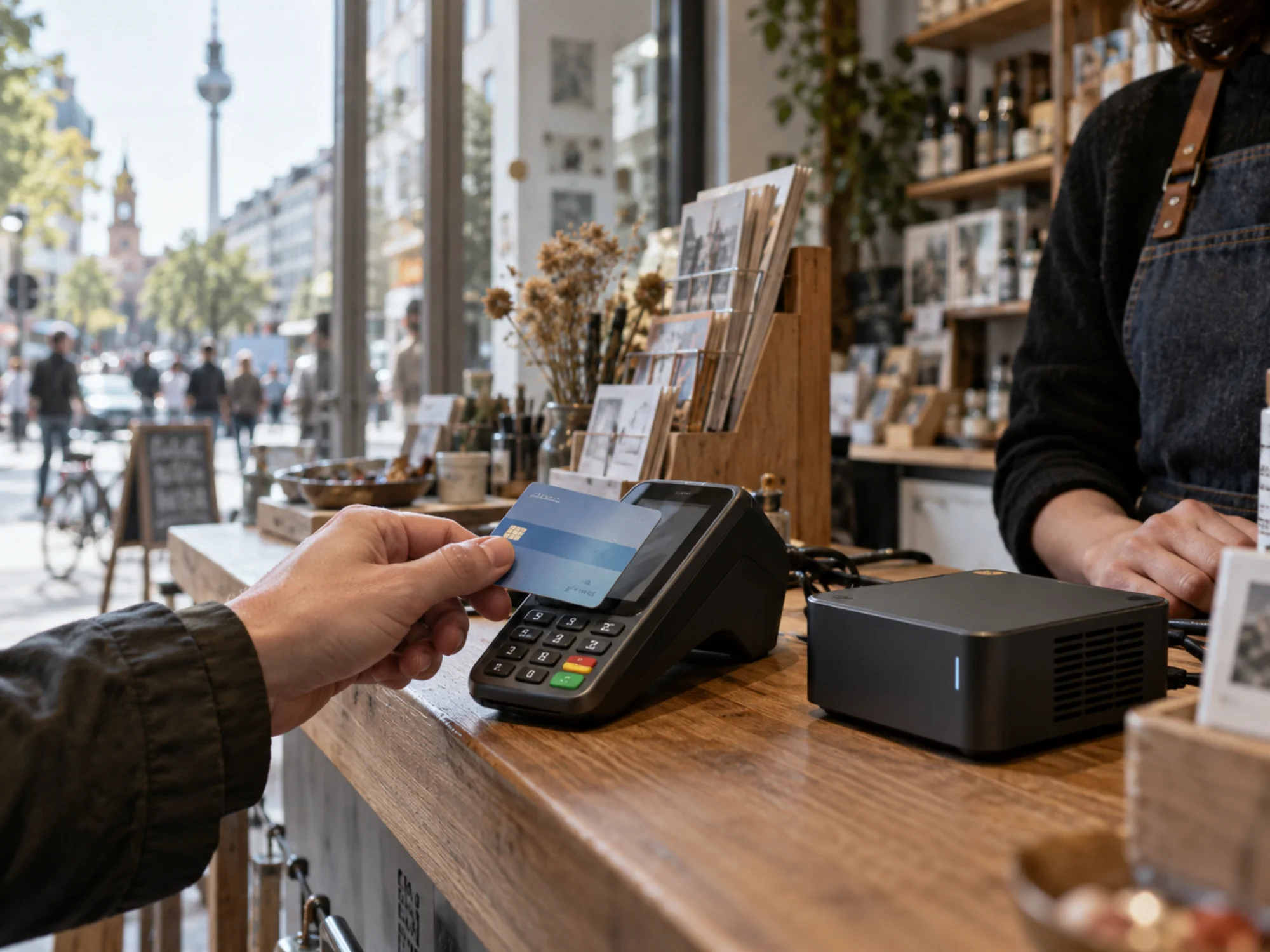
Germany as a fintech market
IMARC Group puts the German fintech market at about 13.5 billion US dollars and expects it to reach 36.6 billion by 2034. About 20 percent of Germans bank only digitally, and another 30 percent use a digital and a traditional bank side by side. The International Trade Administration lists digital banking, payments, capital markets, insurtech and regtech as the main segments, and Berlin, Frankfurt, Munich, Hamburg and the cities of North Rhine-Westphalia as the hubs.
Berlin leads by count: the Investitionsbank Berlin found 189 active fintechs there, against 62 in Munich and 52 in Frankfurt. Frankfurt fintechs sit closer to their regulator and to the banks and asset managers they sell to. Behind the household names is a wide layer of business-to-business fintechs: banking-as-a-service platforms, payment processors, and software vendors that sell risk and compliance tools to banks and insurers. Money for later rounds is the weak point: 83 percent of German fintechs call later-stage financing a significant obstacle, the International Trade Administration reports.
Who supervises fintech in Germany
BaFin, the Federal Financial Supervisory Authority, licenses and supervises banks, payment institutions, e-money institutions, investment firms and crypto-asset service providers from its offices in Bonn and Frankfurt. BaFin runs a fintech contact point for young companies that need to find out whether their product needs a license before launch, and a BaFin license has become an argument a German fintech can make to customers in other EU countries. Crypto custody has been a licensed financial service in Germany since 1 January 2020, and the Electronic Securities Act created a license for keeping crypto securities registers, as the Chambers fintech guide for Germany sets out. Crypto custody has been a licensed financial service in Germany since 1 January 2020, and the Electronic Securities Act created a license for keeping crypto securities registers, as the Chambers fintech guide for Germany sets out.
Payment fintechs work under the EU's second Payment Services Directive (PSD2), which lets a licensed provider read a customer's bank account data once the customer agrees; that rule is the legal base for open banking apps. Crypto fintechs need an authorization under MiCA, the EU's Markets in Crypto-Assets Regulation. A fintech that sells software to banks and insurers also has to reckon with DORA, the EU law on digital operational resilience that makes a bank's IT suppliers part of its risk management.
Financial supervision after Wirecard
The best-known German fintech scandal is Wirecard. The payment processor from the Munich area was a member of the DAX until it filed for insolvency on 25 June 2020, after revealing that 1.9 billion euros were missing. BaFin had supervised only Wirecard's banking subsidiary, not the group, and the auditor had not verified the cash balances.
The case changed supervision. The enforcement of financial reporting moved to BaFin, BaFin's leadership left in 2021 as part of a reform of the agency, and the German parliament ran an inquiry into the collapse.
Fintech associations and the Fintech Germany Award
Germany has no single fintech association. Fintechs work through the fintech group of the German Startups Association, which nine fintechs founded in 2015, through Bitkom's banking and financial services division, and through regional bodies such as Frankfurt Main Finance, which has a membership category for fintechs.
The Fintech Germany Award has honored German fintechs since 2016, organized by Techfluence UK. The Fintech Germany Award's categories run from seed stage through growth stage, with special awards for sustainable finance, Web3 and AI. The 2025 gala took place at the House of Finance and Tech in Berlin.
Upcoming fintech events in Germany
Finance Loop, the meeting place for fintech in Germany
Finance Loop is the meeting place for fintech founders, bankers, IT people and AI engineers across Germany, Austria and Switzerland. Finance Loop connects the finance, IT and AI communities and holds events in Frankfurt, Munich, Berlin and Hamburg.
Finance Loop organized TechClub 25/3 with TechQuartier, supported the FinTech Founder & Investor Evening, covered Frankfurt Digital Finance and held a Munich launch event. Finance Loop hosts the Digital Finance Night in Frankfurt, ran a side event during Sibos across from Messe Frankfurt, and covered KI Exchange 2026 in Hamburg, a Payment & Banking conference on AI for banks and fintechs.
How big is the fintech market in Germany?
IMARC Group estimates the German fintech market at about 13.5 billion US dollars, and the International Trade Administration ranks Germany fourth in the world and first in the EU. The first market study for the Federal Ministry of Finance, by Gregor Dorfleitner and Lars Hornuf, counted 433 fintechs in 2016, 346 of them active; counts today differ by source, and Berlin alone has 189 active fintechs by the Investitionsbank Berlin's count.
Is there a fintech community in Germany?
Fintech people in Germany organize by city more than through one national community: TechQuartier in Frankfurt, the House of Finance and Tech in Berlin, the Fintech Monitor network in Hamburg and Werk1 in Munich each run their own meetups and programs. Finance Loop is a professional network that connects the finance, IT and AI communities across these cities and the wider DACH region.
What is the Fintech Germany Award?
The Fintech Germany Award is a prize for German fintechs, given since 2016 and organized by Techfluence UK. A jury of more than 20 investors, bankers, lawyers and journalists picks winners in seed, early and growth stage categories and special awards; the 2025 ceremony was held in Berlin.
Fintech in Germany and Finance Loop
Finance Loop holds fintech events in Frankfurt, Munich, Berlin and Hamburg, the four cities where most German fintechs are based, and is built in collaboration with Frankfurt's fintech hub TechQuartier. Finance Loop connects the finance, IT and AI communities in Germany, Austria and Switzerland.
Finance Loop is a professional network supporting the institutional use of emerging technologies in finance, such as AI, digital payments, cloud and blockchain solutions. Finance Loop helps its members build skills and personal networks in these fields: Investment & Digital Assets, Payments & Digital Money, Digital Infrastructure & Sovereignty, and Risk & Compliance.