
Frankfurt finance
Frankfurt is a financial center: a location where banks, investors, financial markets and the infrastructure for transactions are concentrated. A financial center connects the financing needs of businesses and households with lenders and investors through banking, asset management, insurance and capital markets. Banks provide accounts, credit and payment services, while companies raise capital through shares and bonds; trading venues, clearing houses and settlement systems organize securities transactions and money transfers, supported by legal advisers, technology providers and financial researchers.
Frankfurt combines international banking with monetary policy and supervision, with the European Central Bank and the Deutsche Bundesbank based in the city. Deutsche Börse Group connects the region to international securities and derivatives markets, while European and German supervisory institutions oversee financial firms serving companies and cross-border clients. Frankfurt Main Finance brings financial firms, public authorities and universities together as the financial center initiative, connecting commercial services, public institutions, market operators and research.
History of Frankfurt as a financial center
Frankfurt's financial history began with trade. The autumn fair is first documented in 1150; Emperor Frederick II granted it an imperial privilege in 1240. Merchants arriving from different regions brought different currencies, creating demand for money changing and reliable exchange rates. In 1585, merchants agreed on uniform exchange rates, an agreement recognized as the foundation of the Frankfurt Stock Exchange. The exchange initially served trade in currencies and bills of exchange. Share trading developed later.
Private banks extended Frankfurt's business from merchant finance to government borrowing and investment. Bankhaus Bethmann placed an imperial loan in 1779, while the Rothschild banking house connected Frankfurt with European government finance. The first share traded in Frankfurt was an Austrian National Bank security in 1820. In 1837, Bethmann and Rothschild financed the Taunus Railway through a share issue. Berlin became Germany's leading exchange after the foundation of the German Empire in 1871, but Frankfurt retained its international business.
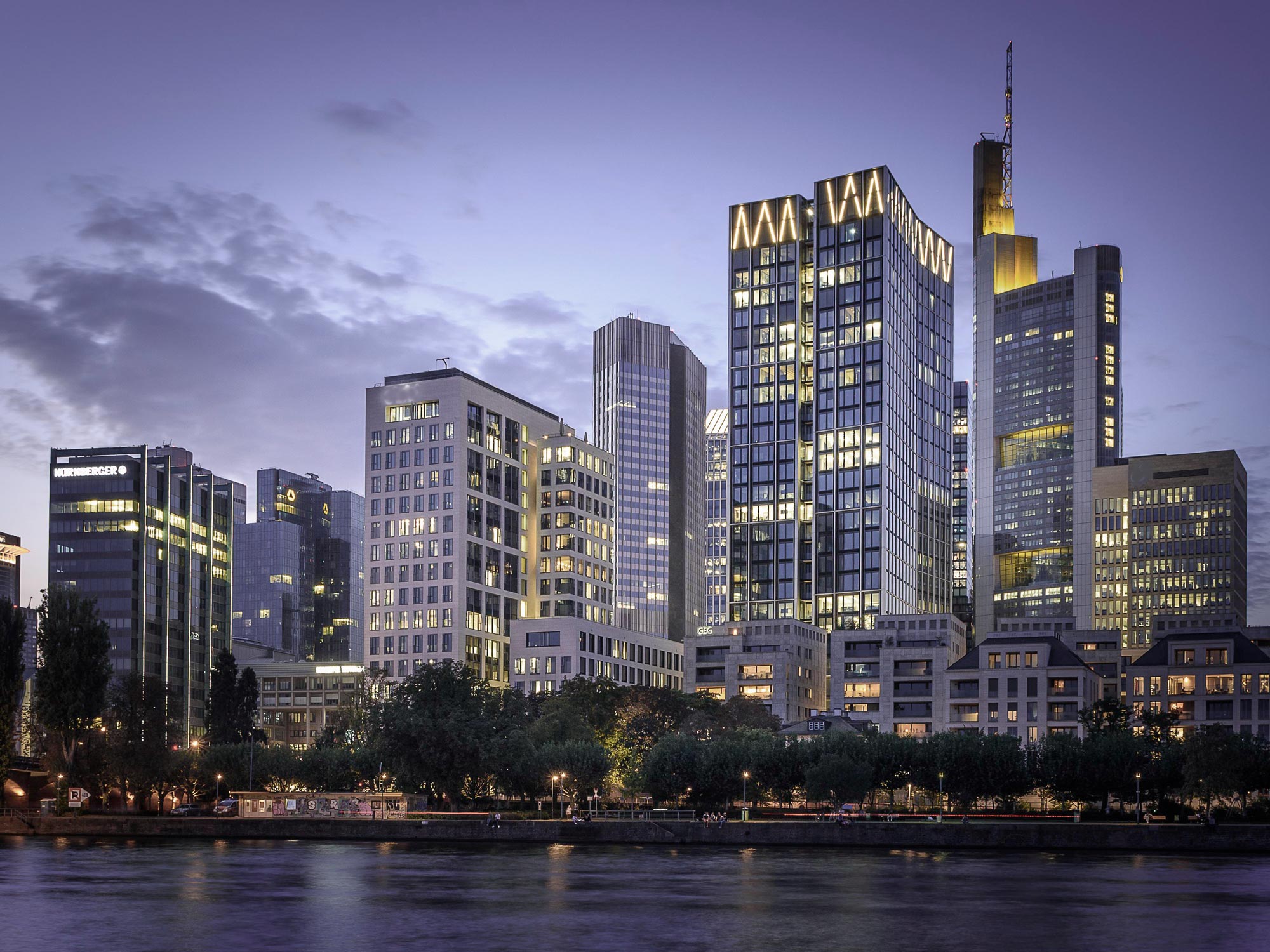
Wars and dictatorship interrupted that development. Nazi controls restricted free securities trading, and the exchange building was severely damaged during the Second World War. Reconstruction brought Frankfurt a new central banking role: the Bank deutscher Länder was established in 1948 and the Deutsche Bundesbank in 1957. The expansion of banks and their office space also changed the city. Frankfurt's postwar high-rise planning concentrated office towers in the banking district, linking the financial industry to the skyline.
The European Central Bank was established in 1998. The euro followed in 1999, with notes and coins entering circulation in 2002. Frankfurt became a center of monetary policy for the euro area as well as a commercial financial center. Frankfurt's banks, supervisors and market infrastructure perform different functions within this financial center. The history of Frankfurt as a financial center connects these stages with the development of the banking district.
Banks in Frankfurt and the banking district
Banks in Frankfurt serve households, German businesses and international clients. Deutsche Bank is headquartered in the city and operates corporate banking, investment banking, private banking and asset management businesses. Commerzbank also has its head office in Frankfurt and serves corporate, private and small-business customers. Corporate banking supplies credit, trade finance and payment services. Investment banking helps companies issue securities and carries out transactions in financial markets. These activities connect the location with financing decisions made far beyond the city.
The banking industry includes different ownership structures. DZ BANK, headquartered in Frankfurt, is the central institution of the cooperative banking network. DekaBank is the securities house of the savings bank financial group. Their work connects local banks with capital markets and services that require a larger institution. Banking in Frankfurt therefore includes universal banks, network institutions and specialist services, alongside private banking and the modernization of digital banking. Digital banking solutions connect customer interfaces with accounts, payments and operational systems.
The banking district is the concentration of financial offices and high-rise buildings around Neue Mainzer Straße and Taunusanlage. Its appearance reflects the postwar expansion of banks and office construction. The financial center extends beyond that skyline: Deutsche Börse has its corporate headquarters in neighboring Eschborn, while institutions, research and services operate across Frankfurt and the Rhine-Main region. The history of the financial center explains how banking and city planning developed together.
Frankfurt Stock Exchange and securities infrastructure
The Frankfurt Stock Exchange connects investors with securities issued by companies and other borrowers. Deutsche Börse Group operates the Xetra and Börse Frankfurt trading venues. Trading establishes prices and brings buy and sell orders together; a completed trade still needs settlement. Capital markets in Frankfurt depend on the infrastructure that carries a transaction from an order to the exchange of securities and money.
Eurex organizes derivatives trading, including instruments used to manage financial risks. Eurex Clearing acts as a central counterparty in the markets it clears, standing between trading parties and managing their obligations. Clearstream provides securities settlement and custody services. Clearing manages obligations and counterparty risk; settlement transfers the securities and money. These functions have distinct responsibilities even when they belong to the same corporate group.
The infrastructure serves banks, brokers, asset managers and institutional investors across countries. Its systems must process transactions, protect records and handle failures. Frankfurt's market role consequently involves software and operational expertise alongside traders and issuers. Investors encounter the exchange through prices and executed orders, while institutions also work with clearing arrangements, collateral and custody.
Asset management and insurance
Asset management in Frankfurt concerns the investment of money entrusted by individual and institutional clients. DWS is headquartered in Frankfurt and operates investment management businesses internationally. DekaBank connects the savings bank network with securities and investment services. Fund managers select investments within a fund's rules, while individual mandates follow a client's agreed objectives. Portfolio management requires research, risk controls and an understanding of the liabilities or spending needs that the investments must support.
Insurers accept specified risks in return for premiums and invest assets to meet future claims. The surrounding region includes R+V in Wiesbaden and Alte Leipziger in Oberursel. These are Rhine-Main locations, not Frankfurt city headquarters. Insurance and pension institutions are also investment clients, linking long-term obligations with bond markets and other assets. The presence of EIOPA connects Frankfurt with European insurance supervision, while BVI represents the fund industry. Investment management, insurance and supervision contribute different expertise to the location.
Financial center rankings and bank employment
Financial center rankings compare locations using a defined method. The Global Financial Centres Index combines external indicators with assessments from financial services professionals. Its competitiveness framework considers the business environment, human capital, infrastructure, financial sector development and reputation. A place in the index expresses that comparison; it does not measure every service available in a city or determine whether a particular institution is suitable for a client.
The October 2025 study by Helaba forecast roughly 75,500 bank employees by the end of 2026; that was a projection, not a headcount. In Global Financial Centres Index 38, published in September 2025, Frankfurt ranked 12th among 120 financial centers. Employment concerns the workforce; the index concerns comparative competitiveness. The Frankfurt Financial Center Report examines policy and development across the financial center's action areas.
Monetary policy, supervision and financial infrastructure
Frankfurt's public institutions have different responsibilities. The European Central Bank sets monetary policy for the euro area, while ECB Banking Supervision works with national authorities through the Single Supervisory Mechanism. BaFin supervises banks, insurers and securities markets in Germany. EIOPA develops the European framework for insurance and occupational pensions supervision. AMLA, the EU authority based in Frankfurt, coordinates anti-money-laundering supervision and prepares direct supervision of selected financial institutions.
These bodies serve the financial system, not the commercial interests of an individual bank. Their work affects capital requirements, risk management, consumer protection and financial reporting. The Deutsche Bundesbank also contributes to banking supervision and operates payment infrastructure. Banks and market operators need legal, compliance and technical expertise to meet these obligations while providing financial services.
FIRM e.V. supports research and professional education on risk management and regulation. Its round tables bring bank risk managers and compliance specialists together to discuss methods and regulatory questions.
Industry associations and the International Bankers Forum
Industry associations represent the needs of different parts of the financial center. Bankenverband Mitte speaks for private banks in Hesse, Rhineland-Palatinate and Saarland and works with the Association of German Banks at the national level. The Frankfurt-based BVI represents the German investment fund industry, including its interests in European regulation. The Interessengemeinschaft Frankfurter Kreditinstitute supports the financial center and links banks with education, including awards for graduates of Frankfurt School of Finance & Management.
Investment associations serve companies and professionals in different ways. The BVI works on fund industry regulation and issues such as retirement provision, market data and infrastructure financing. Its seminars and conferences bring regulatory work into professional education. CFA Society Germany supports investment professionals through education, working groups and industry exchange. DVFA represents financial analysts and investment professionals in German capital markets. These professional bodies connect analytical work with standards and continuing development.
The VuV represents independent asset managers, whose client mandates differ from the management of a bank or an insurance company. The Bundesverband Alternative Investments represents alternative investment interests across asset classes and products in Germany. Company associations can discuss regulatory positions; professional organizations also address the skills and practices of the people making investment decisions. Company representation and professional education address different needs within the same financial center.
The International Bankers Forum is a professional association for exchange on banking operations, credit economics and financial policy. Dr. Nader Maleki is its president. The Frankfurt committee organizes regular meetings, roundtables and hybrid conferences. The forum connects practitioners across institutions; its professional discussion complements the representation of industry interests by banking and investment associations.
Financial center policy and sustainable finance
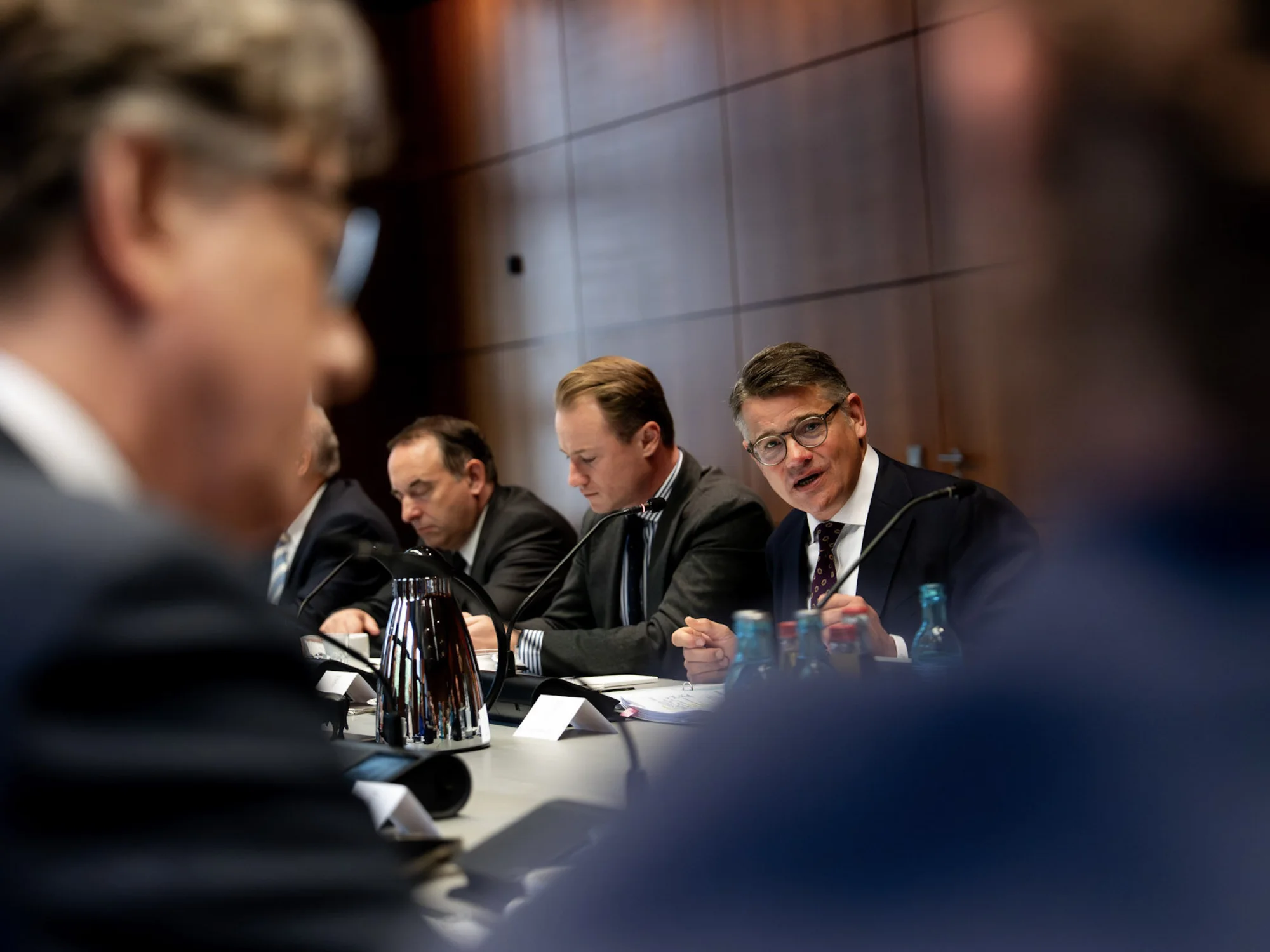
The Hesse Financial Center Cabinet brings the state government and financial sector together to discuss the location's development. The forum adopted a financial center strategy and a charter of cooperation. The strategy sets priorities for the business environment, regulation, innovation, sustainable finance, education and international communication. The charter concerns cooperation among supporters. Their adoption provides a work program; individual projects still need decisions by the responsible organizations.
The Sustainable Finance Cluster brings financial market expertise together around sustainability. Its work connects financial institutions with questions about financing the transition of businesses and assessing environmental risks. Sustainable finance involves the use of capital, risk analysis and reporting, not a separate type of bank. The financial center strategy places this work alongside education and market development. Frankfurt Main Finance helps coordinate the wider financial center dialogue without taking over the legal responsibilities of banks or supervisors.
Initiatives and hubs behind Frankfurt finance
Frankfurt Main Finance is the financial center initiative of Frankfurt, founded in 2008. The State of Hesse and the cities of Frankfurt, Eschborn and Offenbach back it, and more than 75 members belong to it, from banks and asset managers to auditors, universities and fintechs, which have a membership category of their own. Frankfurt Main Finance speaks for the financial center in Germany and the euro area and keeps partnerships with financial centers from Shanghai to Montreal.
TechQuartier, run by FinTech Community Frankfurt GmbH at Platz der Einheit, connects more than 750 startups with over 30 corporate partners and is the fintech hub of the federal Digital Hub Initiative. The independent portal Finanzplatz Frankfurt am Main publishes financial news and event listings, and the FinTech FFM Meetups group brings fintech founders together informally. AI Hub Frankfurt Rhein-Main connects people who apply AI in banks and other industries, and Frankfurt Data Science and Frankfurt Forward run meetups for the data and startup scene.
Communities and meetups in Frankfurt finance
The Frankfurt Payments Network is an association of more than 250 payments professionals, founded in 2011, with monthly meetups and webinars on instant payments, Wero, stablecoins and fraud; its members work in payments in Frankfurt. The Frankfurt Bitcoin Meetup meets every third Thursday of the month after volunteers revived the city's original Bitcoin group, with discussions about investing in Bitcoin and custody. Meetups for crypto and blockchain in Frankfurt cluster around the spring conferences, often at TechQuartier.
Fondsfrauen, a network of more than 6,000 women in the financial industry, and the Germany committee of 100 Women in Finance run events for women in banking and asset management, and the association Women in Finance e.V. is registered in Frankfurt. These groups support women in finance in Frankfurt. Finteda, a practitioner network for finance, technology and data that began as a Frankfurt meetup for quants, holds invitation-only events, and Finance Loop works with it.
Research and professional exchange on AI in Frankfurt involve hessian.AI and the association AI Frankfurt Rhein-Main. A Claude meetup meets every other week in the Gutleutviertel, with AI in finance and AI in banking among the topics discussed in the city. TechQuartier is one of 25 hubs of the federal Digital Hub Initiative. Banking Exchange, the annual banking conference of Payment & Banking, meets in Frankfurt, alongside other networking events in Frankfurt, from Meetup groups to conference side events.
GM, FFM! contributes to community exchange on web3 in Frankfurt. The association worked with dfv Euro Finance Group on a joint EURO FINANCE Tech Day focused on connections between established finance and web3. Its role is community discussion and educational exchange about decentralized technologies. GM, FFM! belongs in the technology community around the financial center, distinct from trade bodies representing banks or investment managers.
Universities and research in Frankfurt finance
Goethe University and the House of Finance
Goethe University Frankfurt has a finance department in its Faculty of Economics and Business. The House of Finance of Goethe University Frankfurt on the Westend campus puts the university's finance, economics and law institutes in one building. Among them are SAFE, the Leibniz Institute for Financial Research, which advises policymakers on a sustainable financial system for Europe, and the Center for Financial Studies, which surveys decision-makers of the German financial sector. With Johannes Gutenberg University Mainz and TU Darmstadt, Goethe University runs the Graduate School of Economics, Finance, and Management, whose master's program has a track in quantitative finance.
Finance research examines how markets, financial institutions and legal rules interact. The House of Finance brings economic and legal work together, allowing questions about monetary stability, financial contracts and market regulation to be studied across disciplines. This research contributes to policy discussion and professional education; academic institutions do not perform the supervisory duties of a financial regulator. FIRM e.V. cooperates with Frankfurt School and the House of Finance on research and teaching.
Frankfurt School and professional education
Frankfurt School of Finance & Management teaches finance from the bachelor's level to executive education, and its Master in Financial Technology combines finance, data-driven technology and regulation. The Centre for Digital Economics of Frankfurt School of Finance & Management is a partner of Finance Loop and took over from the Frankfurt School Blockchain Center.
Degree programs train students for financial and managerial work. Executive education serves professionals who need to update their knowledge while working. Financial technology education adds data analysis and technical methods to financial reasoning. Research on digital economics addresses how technology changes markets, institutions and economic decisions. These educational and research functions support the financial center through skills and analysis.
Futury and research transfer
Futury, the Startup Factory whose shareholders are Frankfurt School, Goethe University, the University of Mainz and TU Darmstadt, counts Banking & Finance among its five focus areas. The House of Digital Transformation, also at the Bertramshof, is a nonprofit association that connects business, science and politics in Hesse on topics such as AI and quantum computing.
Futury supports the development of business ideas from research and helps founders work with industry partners. Its programs cover early validation, company development and growth financing. Futury and hessian.AI agreed to cooperate on support for AI startups, including a joint accelerator. The collaboration combines research-oriented technical validation with industry contacts and business development. For finance, this places technology transfer alongside university teaching and established financial research.
Applied finance and technical training
Frankfurt University of Applied Sciences teaches International Finance as a seven-semester bachelor's in German and English, with a semester abroad.
Quantitative methods inform risk measurement, pricing and investment decisions; quantum computing raises research questions about computation and cryptography. These subjects connect quant finance in Frankfurt and quantum computing in Frankfurt finance with work in financial institutions. AI training in Frankfurt includes courses at Frankfurt School and the chamber of commerce, as well as hands-on formats from Finance Loop.
Financial journalism and news portals
Financial journalism gives the industry a shared record of decisions, transactions and debates. The Börsen-Zeitung covers banks, capital markets, companies and economic policy. Handelsblatt reports on business, finance and politics, while the economics coverage of the Frankfurter Allgemeine Zeitung connects company and market developments with economic policy. Its finance section covers financial markets and investment. FINANCE focuses on corporate finance, CFOs, financing and deals. Readers can follow transactions and policy changes between professional meetings and compare reporting with company disclosures or regulatory publications.
Payment & Banking concentrates on payments, fintech and digital banking through articles, podcasts and industry discussion. Its Banking Exchange (BEX) in Frankfurt brings that discussion into a conference format. Reporting and conferences perform different functions: an editorial publication follows developments over time, while a meeting enables questions and exchange between practitioners. Both contribute to discussion of how established banks and newer financial technology businesses work.
Summits and weeks of Frankfurt finance
Euro Finance Week takes place each November at the Frankfurter Hof, run by dfv Euro Finance Group, which calls it the finale of the year for the finance community. Euro Finance Week is a week of conferences under one name: an opening conference, a China Day, a Green Finance Forum, a EURO FINANCE Tech Day, an investors forum and the Frankfurt European Banking Congress.
The Frankfurt Finance & Future Summit of Weimer Media Group brings decision-makers from finance and the Mittelstand together in the autumn, at venues such as Kap Europa and the Städel Museum, with an IPO Night and a media prize for midsize companies. In September, FINANCE, a fair for private investors at Messe Frankfurt, opens the autumn season for finance in Frankfurt. At the end of October, AI Week Frankfurt gives one of its five days to banking and finance.
Partner conferences of Finance Loop in Frankfurt
The Crypto Assets Conference, run by Frankfurt School of Finance & Management and Deutsche Börse Group, and the Digital Euro Conference of the Digital Euro Association take place on consecutive days each spring, and Finance Loop has been a partner of both. Frankfurt Digital Finance meets at the Gesellschaftshaus Palmengarten. Capital & Code, held at SPARK Europe, covers payments, stablecoins and tokenized funds, with Finance Loop as media partner.
Smaller formats fill the rest of the calendar: the Frankfurt Forum on Digital Assets & Applications, the International Financial Standards Conference and the FinTech Founder & Investor Evening, each with Finance Loop as partner or organizer.
Event formats from Finance Loop in Frankfurt
Finance Loop runs the Digital Finance Night in the week of the Crypto Assets Conference and the Digital Euro Conference, an evening for people who work on digital assets and payments projects at institutions. Finance Loop co-organizes the Frankfurt Quantum Finance Forum with Frankfurt School, the Deutsche Bundesbank and IBM, on the risk that quantum computers pose to the cryptography banks and custodians use.
With TechQuartier, Finance Loop organized TechClub 25/3, announced as Europe's Biggest FinTech Afterwork Party, and during AI Week Frankfurt it held an official side event on AI and blockchain in institutional finance.
Upcoming finance events in Frankfurt
Which finance events take place in Frankfurt each year?
Frankfurt hosts the Crypto Assets Conference and the Digital Euro Conference in spring, with the Digital Finance Night between them. The FINANCE fair for private investors takes place at Messe Frankfurt in September. The Frankfurt Finance & Future Summit and AI Week Frankfurt bring finance programs to the autumn. Euro Finance Week takes place in November with the European Banking Congress. Current dates are in the events calendar.
What is Euro Finance Week?
Euro Finance Week is a week of finance conferences in Frankfurt each November, organized by dfv Euro Finance Group at the Frankfurter Hof. The program of Euro Finance Week bundles an opening conference, the Frankfurt European Banking Congress, a Green Finance Forum, a China Day and a tech day, and most sessions address executives of banks and asset managers.
Is there a Frankfurt finance network?
Frankfurt has several financial networks with different responsibilities. Frankfurt Main Finance represents the financial center in policy discussions. TechQuartier connects startups and corporate partners, and FinTech FFM Meetups organizes informal fintech evenings. The International Bankers Forum provides professional exchange on banking and financial policy. Frankfurt Payments Network connects payments professionals. Finance Loop connects finance, IT and AI professionals through its events. The networks differ in membership, subjects and formats.
Investment professionals can use the education and exchange offered by CFA Society Germany and DVFA. The BVI serves the fund industry, VuV represents independent asset managers, and BAI addresses alternative investments. GM, FFM! is a web3 community around Frankfurt, not an asset management association. Its work includes exchange with established finance at the EURO FINANCE Tech Day.
Where do I find a Frankfurt finance meetup?
TechQuartier hosts fintech and finance meetups, FinTech FFM Meetups posts its evenings on Meetup.com, and AI Hub Frankfurt runs meetups on AI in finance and other industries. Finance Loop lists its own meetups and partner events on its meetups page and in the calendar on this page.
Frankfurt finance and Finance Loop
Finance Loop started in Frankfurt, is built in collaboration with Frankfurt Main Finance and TechQuartier, and holds most of its events in the city, from the Digital Finance Night to the Frankfurt Quantum Finance Forum. Finance Loop also runs events in Munich, Berlin and Hamburg and connects the finance, IT and AI communities in Germany, Austria and Switzerland.
Finance Loop is a professional network supporting the institutional use of emerging technologies in finance, such as AI, digital payments, cloud and blockchain solutions. Finance Loop helps its members build skills and personal networks in these fields: Investment & Digital Assets, Payments & Digital Money, Digital Infrastructure & Sovereignty, and Risk & Compliance.
Finance Loop: Connecting Germany with Europe
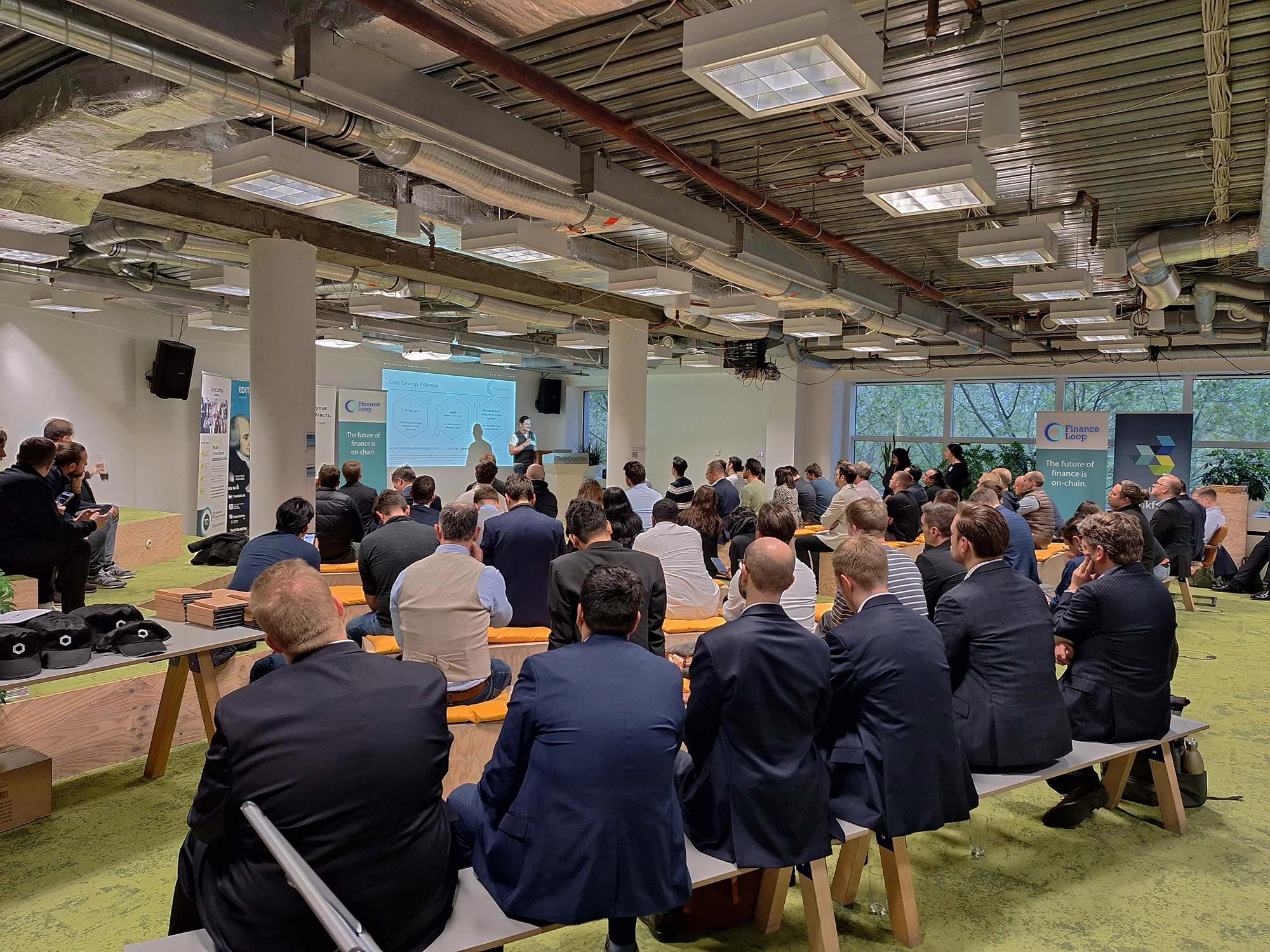
Finance Loop is the professional network that connects the finance, IT and AI communities in Frankfurt. Finance Loop is a strategic partner of Frankfurt Main Finance and TechQuartier, runs its own formats such as the Digital Finance Night, and partners with the conferences on digital assets, payments and AI in finance that take place in the city.
A compliance officer, a payments product owner and an AI engineer from the same bank rarely sit in one meeting at work. At Finance Loop events they meet: questions about tokenized securities reach across departments. The same applies to payment services using instant payments, to the requirements of DORA, and to AI in lending.
Finance Loop is a professional network supporting the institutional use of emerging technologies in finance, such as AI, digital payments, cloud and blockchain solutions. Finance Loop started in Frankfurt, has more than 4,000 members and is built in collaboration with Frankfurt Main Finance and TechQuartier. In the city it runs meetups with community partners, the Digital Finance Night and the Bitcoin seminar for investors, and it supports the Claude agent workshops of Claude Hacker House at TechQuartier. Dates are on the events page, and the free Network Membership and the paid plans are on the membership page.
Photos: Basti Wöhl / Hessische Staatskanzlei